
 AUS
AUS
 NZ
NZ
 UK
UK
 CA
CA
 USA
USA
 IND
IND






Summary
- Manufacturing is a vital part of the economy and has survived several challenges
- On the back of rebalances in its sectors, products, technologies, and supply chains, the industry has streamlined its stance
- The current pandemic is propelling Australia to be self-reliant for its needs and demands and local manufacturing importance is garnering awareness
- Australian-based businesses have the bright opportunity to ramp up domestic production with reduced exports, globally, and shift focus into niche businesses
In the current unpredictable times and volatile market conditions, a local manufacturing resurgence could give domestic players a fighting chance for survival.
With countries depending on each other in the current contemporary times, sudden restrictions in overseas markets have caused an upheaval in the supply and demand dynamics. This has shed light on the fact that economies are missing out on domestic production and relying on imports.
The COVID-19 crisis brought along an unexpected demand for medical supplies and other products, and with border restrictions, uncovered the over-dependence of Australia on supply chains of other economies.
Australian Manufacturing- An Overview
Manufacturing is a process that changes materials, substances, or components into new products.
Manufacturing is a vital part of the Australian economy, employing approximately a million people. According to a report released by The Australian Industry Group (Ai Group) in May last year, manufacturing is Australia’s seventh largest industry for employment and sixth largest for output. It accounts for 11% of annual export earnings and has the highest business expenditure on R&D of any industry.
The industry has survived several challenges- the Global Financial Crisis, unfavourably high exchange rates, rapid rise of China as the global dominant production house, end of local automotive assembly operations a couple of years back, onset of digitalisation, ‘the fourth industrial revolution’, and large increases in local energy and other input costs.
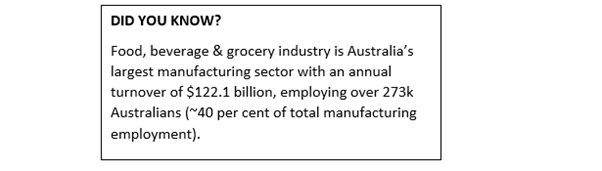
Moreover, the industry has witnessed few critical rebalances in its segments, products, technologies, and supply chains that sync with long-term domestic and international structural shifts. Employment has also increased while food, beverages and groceries manufacturing along with their supply chains constitute the most evident growth sectors.
A sinusoidal trend has been observed, as post a strong period of activity during 2017-18, the Australian economy slowed in 2019 due to various factors.
Why is Local Manufacturing Garnering Attention?
The current pandemic is triggering a rethink on how Australia should be self-reliant for its needs and demands. COVID-19, primarily a health threat, has brought along an array of issues that have propelled the need of local manufacturing. For instance, borders have been sealed, exports and imports have been halted and there are restrictions on productivity, globally, due to lockdowns and quarantines overpowering any other aspect of life.
Driven by this glitch, the dependency on other nations has not only been highlighted more than ever before, but a sense of self-reliance and importance of what we may call a “Make in Australia” has been largely felt.
Given that the manufacturing industry has been withering on the vine, for quite some time, importance of local manufacturing is even paramount in the current scenario when Australians need better products and services, as they abide by COVID-19 regulations.
We say that manufacturing has been on the shrink, as it has fallen to 6 per cent of GDP after reaching a high of nearly 30 per cent of GDP in the 1960s.
Faltering Trade Relations- China Chronicle
COVID-19, devastating summer bushfires, prolonged drought periods, and tough domestic and international trading environments have had a destructive impact on the manufacturing industry, which has seen a downturn in investment.
It is of paramount national interest that Australia needs to be much more self-reliant, smart, and balanced in its approach.
Relations with its biggest trade partner, China has not been in the best of shapes, after China imposed an 80 per cent tariff on Australian barley imports and banned beef shipments over compliance issues- a big blow to the country’s agricultural industry. Moreover, Australia's first calls for investigation into the origins of COVID-19 on a global level, also resulted in some uneasiness between the nations. It should be noted that Australia relies heavily on China for the purchase of its natural resources (primarily iron ore, natural gas, and coal), highlighting high dependence on commodity exports.
Is COVID-19 Australia’s Cue to Strengthen Its Manufacturing Sector?
The simplest answer to the above is- Yes. As countries continue to reduce exports during the COVID-19 shutdown, Australian-based businesses have the bright opportunity to manufacture locally. Particularly, growth in the production of essential products such as food, pharmaceuticals, and services such as electricity should be prioritised. These are opportunities that previously would have been outsourced in favour of cheap labour overseas.
It should be noted that since other countries are retaining their production for local requirements, that translates to a short supply in Australia. This is positive for local manufacturers, as there is a shift in focus into niche businesses that get to attend to local demands. With the economy slowly reopening, a high demand for instrumentation from manufacturers is expected, as many manufacturing plants might increase their capacity to meet raging demands.
What Can Work in Favour?
Besides the opportunities for Australian manufacturers that can produce specialised products across a range of industries, increasing competitive advantage over international peers due to advanced manufacturing adoption can work well in Australia’s favour.
Australia has been noticeably adopting to highly specialised areas- be it manufacturing of paper or medical products. Moreover, there has been continued investment in automation, high-tech and productivity enhancing technology that can boost the manufacturing industry.
Not to forget are Government stimulus packages, for instance the three economic stimulus packages that have been put in place at the Commonwealth level, with total expenditure and revenue measures of $194 billion (9.9 per cent of GDP) through FY2023-24 can help boost the industry.
Renowned ASX-listed Manufacturers
Advanced manufacturing accounts for around half of annual manufacturing output of more than A$100 billion of the country. Moreover, it is one of the fastest growing export sectors.
Some of the renowned ASX-listed manufacturers are Caltex Australia Limited (ASX:CTX), Viva Energy Group Limited (ASX:VEA), Amcor PLC (ASX:AMC), and CSL Limited (ASX:CSL)- which have experienced strong revenue growth relative to previous years, due to business restructuring processes, automation adoption and focus on boosting productivity.
Amid the COVID-19 crisis, Australian-born healthcare companies have been thriving to support Australia and economies worldwide to address the global pandemic and help save lives. For instance, ResMed Inc. (ASX:RMD) has been supporting customers around the world with digital health technologies and out-of-hospital management software.
Experts opine that Australians have grasped the significance of local manufacturing as an alternative for its dependency on other economies and imports, while adhering to local quality control and supply security in the crisis hour. There is need for the country to be independent again and support local production, and at the back of Government support, skilled labour and local demand, this can be met.
(NOTE: Currency is reported in Australian Dollar unless stated otherwise)
