
 AUS
AUS
 NZ
NZ
 UK
UK
 CA
CA
 USA
USA
 IND
IND







ASX-listed energy retailers are under pressure over the increase in their raw material cost and stringent measures adopted by ACCC in the name of new Default Market Offer (or DMO).
The raw material prices for energy generation is witnessing a surge in the international market, which is now prompting the speculators to discount the stock value of ASX energy retailers.
Also Read: Understanding Crude Oil Dynamics Through The Web Of Global Influencers
Raw Material Market
Crude oil
The crude oil prices recovered sharply in the international market, with Brent Crude Oil Futures recovering over 6.30 per cent from the level of USD 59.40 (Dayâs low on 1 November 2019) to the level of USD 63.17 (Dayâs high on 5 November 2019).
The crude oil prices rose, post an increase of 5.7 million barrels in the commercial crude oil inventory in the United States amid higher oil imports.
The commercial crude oil inventory in the United States rose from the level of 433.2 million barrels to 438.9 million barrels for the week ended 25 October 2019 amid higher imports and lower exports.
The United States import rose for the week ended 25 October 2019 despite steady production of 12.6 million barrels per day.
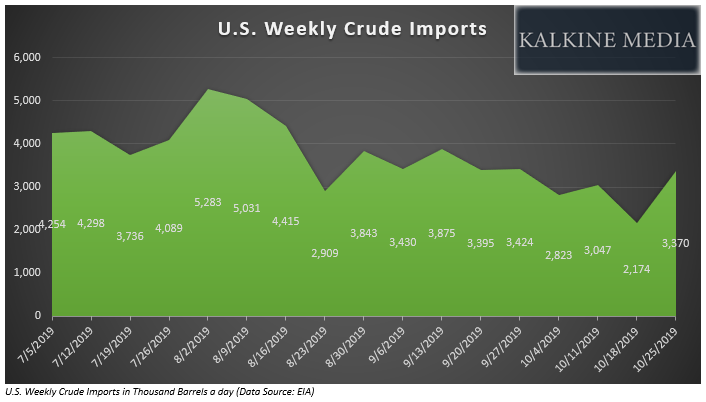
The oil imports for the week ended 25 October 2019 stood at 3,370 thousand barrels a day, up by over 55 per cent against the previous week imports. The high imports, coupled with stable domestic production and falling exports, suggested high demand for oil in the United States, which in turn, supported the crude oil prices in the international market.
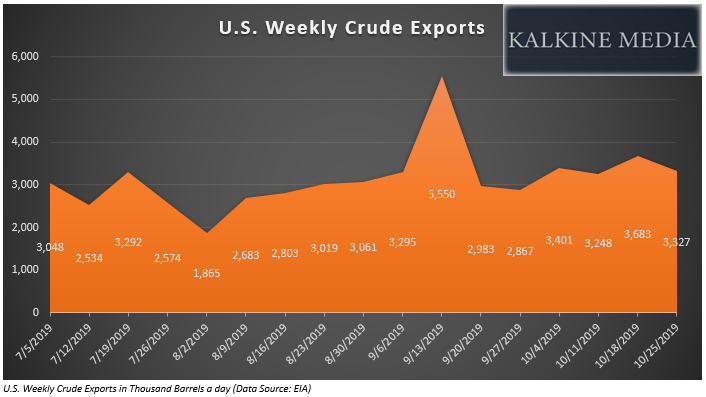
The United States crude oil imports spiked in the week ended 25 October 2019, and the exports plunged to stand at 3,327 thousand barrels a day, which in turn, marked a downfall of over 9.50 per cent against the export level for the week ended 18 October 2019.
The export fell despite the high domestic production amid an increase in input to refineries. As per the data, the total crude oil inputs into refineries stood at 15,998 thousand barrels per day for the week ended 25 October 2019, which marked an increase of 0.83 per cent against the previous week input level of 15,865 thousand barrels a day.
The refineries utilisation percentage also increased for the week ended 25 October 2019 to stand at 87.7 per cent, against the previous week utilisation rate of 85.2 per cent.
To conclude, the increase in imports coupled with higher utilisation and falling export suggested higher crude demand in the United States, supporting the crude oil prices in the international market.
The rise in crude oil prices exerts pressure on the ASX energy retailers amid their negative correlation to the crude oil prices.
To Know More, Do Read: EIA Oil Forecast Unfolds; Crude Experiences Supply Glut, While ASX-Energy Retailers Knocking Heavenâs Door
Coal Futures
Coal prices also recovered in the market, with the benchmark Newcastle coal futures recovering to the level of USD 72.30 per tonne. The Australian energy sector largely relies on the coal for the energy generation, and the recovery in coal prices along with the forecasts of an average price of USD 72 per tonne for the Newcastle thermal coal spot is further leading the energy investors to pull down the stock prices of the energy retailers in Australia.
To Know More, Do Read: Australia Diverting Coal To Emerging Asia While Chinaâs Coal Import Policies Cracking Down on ASX Coal Stocks
Apart from the rise in raw material cost, the new energy policies of the government are also impacting the energy retailers and are anticipated to impact the ASX energy stocks over the short-run before ultimately proving beneficial over the long-run.
To Get Acquainted with the Australian Energy Policies, Do Read: Energy Policies to Fuel ASX Energy Stocks Over the Long-Run?
Natural Gas
Australian higher LNG exports have already created a shortage of natural gas in the domestic market, and many energy retailers and raw material producers are trying to switch to natural gas for electricity generation, which in turn, is further exerting pressure on the energy retailers in Australia.
To Know More, Do Read: Origin Energy Joins the Cause of Reducing Carbon Footprints
Natural gas prices are also showing recovery in the international market amid seasonal demand from the northern hemisphere due to cold weather conditions. The Natural Gas Futures on the New York Mercantile Exchange (NYMEX) rose from the level of USD 2.187 (Dayâs low on 11 October 2019) to the present high of USD 2.902 (Dayâs high on 5 November 2019 7:54 PM AEST), which in turn, marked a price increase of almost 33 per cent.
To Know More About the Domestic Natural Gas Conditions, Do Read: Australia Set to Surpass Qatar Over LNG Exports; Domestic Natural Gas Conditions To Derail the Projections?
With the raw material prices increasing the electricity retailers are taking a hit in the short-run; however, the industry experts have forecasted a rush in the energy stocks over the long-term amid high global demand for energy in the years ahead.
To Know More, Do Read: S&P 500 To Inch Further; Energy Sector To Leap And Push The ASX-Listed Energy Players
Energy Retailers on ASX
AGL Energy Limited (ASX: AGL)
The share prices of the company fell from the level of $20.020 (Dayâs high on 31 October 2019) to the level of $19.480 (Dayâs low on 6 November 2019 2:38 PM AEST), which in turn, marked a decrease of over 2.30 per cent.
However, the prices recovered from the level of $18.390 (Dayâs low on 26 August 2019) after a price correction from the level of $21.370 (Dayâs high on 30 July 2019), which marked a fall of over 16 per cent.
To Know More, Do Read: ACCCâs DMO Hits Another Energy Retailer-AGL Nosedives Despite Positive FY2019
Viva Energy Group Limited (ASX: VEA)
Post recovering from the level of $1.78 (Dayâs low on 10 October 2019) to the level of $2.11 (Dayâs high on 29 October 2019), the share prices of the company tumbled again on ASX to reach the level of $1.97 (Dayâs low on 31 October 2019).
However, the stock recovered again to the level of $2.10 (Dayâs high on 5 October 2019) before falling again to the level of $2.06 (Dayâs low on 6 November 2019 2:38 PM AEST)
While the energy retailers are facing the pressure of increased raw material prices, the ASX oil & gas explorers have taken a breather amid the increase in crude oil prices, which also acts as a reference price for LNG.
ASX Oil & Gas Explorers
Woodside Petroleum Limited (ASX: WPL)
The increase in oil prices supported the stock of the company, and WPL rose from the level of $30.580 (Dayâs low on 3 October 2019) to the present high of $33.545 (Dayâs high on 6 November 2019 2:38 PM AEST), which marked an increase of 9.70 per cent.
Beach Energy Limited (ASX: BPT)
The stock surged from the level of $2.245 (Dayâs low on 1 November 2019) to the present high of $2.490 (Dayâs high on 6 November 2019 2:38 PM AEST), which marked a price gain of almost 11 per cent.
Oil Search Limited (ASX: OSH)
OSH recovered from the level of $6.880 (Dayâs low on 10 October 2019) to the present high of $7.440 (Dayâs high on 6 November 2019 2:38 PM AEST), which represented a price gain of over 8 per cent.
Disclaimer
This website is a service of Kalkine Media Pty. Ltd. A.C.N. 629 651 672. The website has been prepared for informational purposes only and is not intended to be used as a complete source of information on any particular company. Kalkine Media does not in any way endorse or recommend individuals, products or services that may be discussed on this site. Our publications are NOT a solicitation or recommendation to buy, sell or hold. We are neither licensed nor qualified to provide investment advice.
