
 AUS
AUS
 NZ
NZ
 UK
UK
 CA
CA
 USA
USA
 IND
IND





In a rising global concern of sea level to uncontrolled rainfall, shifting weather pattern and risk of devastating flooding has prompted the worldwide move toward climate change. The increasing global warming poses a significant risk of flood, drought, malnutrition impacting living beings and economy. Last year, extreme temperature, delayed monsoon, and drought has extended the catastrophic effect of bushfire in Australia is the testimony to the rage of global warming.
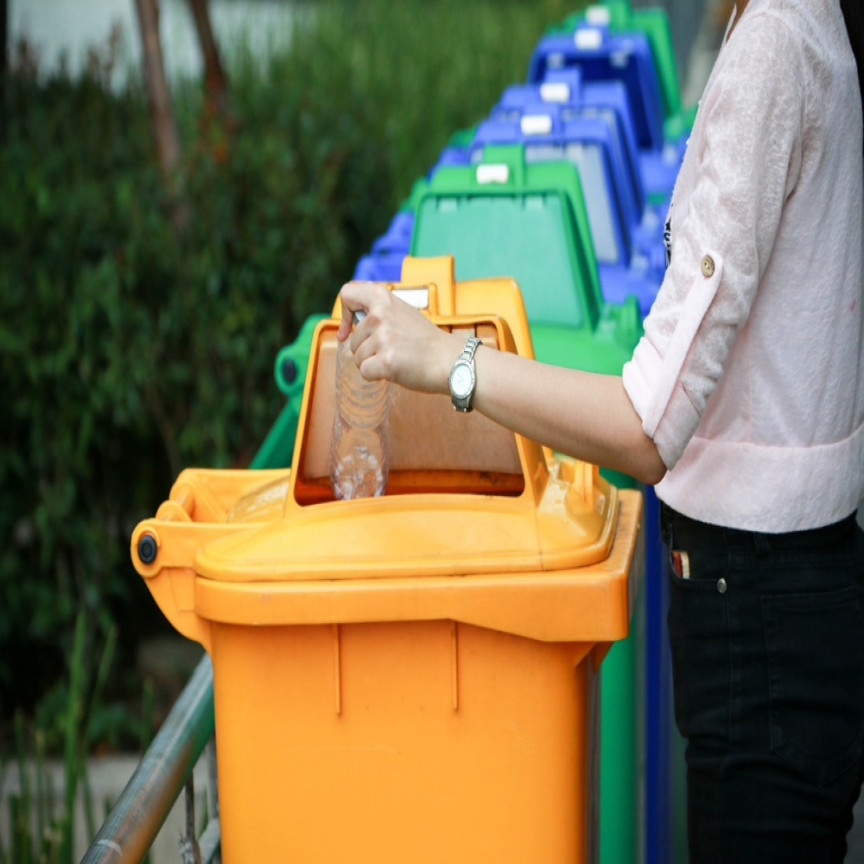
To restraint the rising alarm of climate change, one quintessential step can be a reduction of waste or making productive use of waste as a resource. The circular economy initiative is vital for the nation, environment, and social sustainability.
The two-term often used in the circular waste economy, are resource recovery and recycling rate. Where resource recovery is the total waste amount sent for recycling or can be used for energy recovery of the entire contaminants and residual wastes thrown to disposal. The recycling rate is the proportion of material recovered or recycled out of total waste material sent for recycling or energy recovery purpose.
Interesting Read: Recycling market: Waste Management.
In the milieu of which “The 2018 National Waste Policy: Less Waste, More Resources” was passed by the Australian Local Government Association and Australia's Environment Ministers in December 2018. The National Waste Policy (Policy) acts as a guide for the collection and national action plan for managing waste and recycling to 2030.
The Policy has set out an innovative way of thinking waste as a resource via applying the circular economy principle. The principle includes five rules, and they are:- 1) avoiding waste, 2) resource recovery improvement, 3) waste recycling and creating market demand for the recycled products, 4) managing segregating waste and logistics to aid environment and human health via reducing land spills and, lastly, 5) consumer awareness and investment support for tapping the business opportunity.
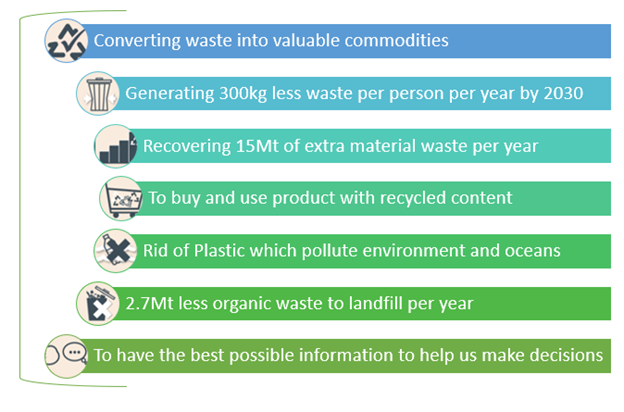
The 2030 National targets based on circular economy are: -
- Paper, plastic, glass and tyres waste export ban from 2H2020.
- 10% per person reduction in total waste generation by 2030.
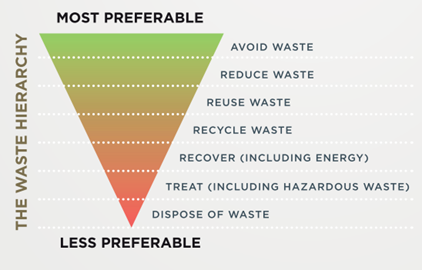
- Waste recovery of ~80% by 2030 via following waste hierarchy model.
- To increase usage of the recycled product substantially by governments and Industry.
- To phase out the use of unnecessary plastic by 2025.
- To channelise around 50% of organic waste to landfill by 2030.
- To make available the comprehensive data for the public to support Policy and investment decision.
What Does the Target Mean?
One question may arise! Is the concept of Waste Management being new and has begun with the 2018 National Waste Policy?
Actually No, Australia has state and territory level government regulation and Policy managing the waste. Though it is managed separately, themes across states or territories remain the same, i.e. ensuring waste safety and following the waste hierarchy model.
For example, in this article, we have considered three regions, i.e. ACT, NSW and NT, for parametric analysis.
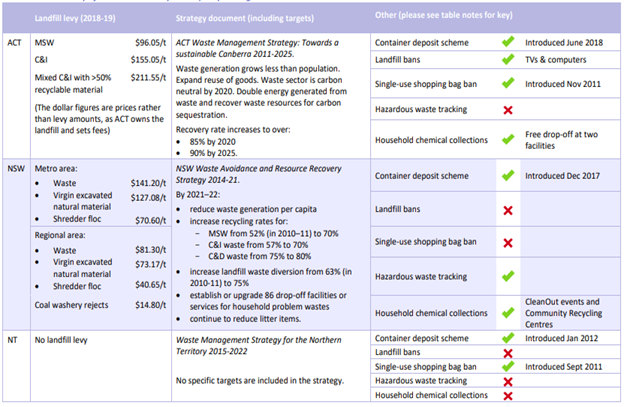
Source: Department of Environment and Energy
In the above table, we see the heading as "Landfill levy" and "Strategy Document", what is it?
Landfill Levies: It is a tipping fee at the landfill applied to the type of waste by weight generally in terms of a tonne. The cost employed to the disposal aid in preserving landfill capacity by making it expensive, which is utilised to support local Industry to use recycled material as feedstock and hence making recycled material attractive.
The raised fund, apart from supporting attractiveness of recycling can also be used to fund recycling infrastructure, governance organisations and programs related to waste management.
Strategy Document: Similarly, to policy it is a region-wise document guiding the organisations and industry for waste management. Strategy Document set out the target over a period of time concerning to waste resource management, recovery, and other waste performance guide.
Australia Waste Generation: An Overview
In FY17, Australia generated around 67Mt of waste out which include 14.2 Mt of organics, 12.3 Mt of ash, 17.1 Mt of masonry materials, 6.3 Mt of hazardous waste (mainly contaminated soil), 5.5 Mt of metals and cardboard waste. The amount of waste is equivalent to the 2.7 per capita of waste.
Around 31.7Mt of waste from total waste generated were processed for recycling during the financial year. The masonry materials account for 12.3Mt followed by organics (7.3 Mt) and metals (5.0 Mt). The waste majorly was contributed by construction and demolition (C&D) material 43% followed by commercial and industrial (C&I) waste 37% and municipal solid waste (MSW) 20%.
Must Read: Three Waste Management Companies Creating Sustainable Future.
Waste Energy Recovery and Resource recycling Rate
In FY17, around 1.97Mt of waste was converted to energy mostly via landfill gas collections that account for 90% of the supply. Waste from MSW such as food, garden and paper and cardboard along with C&I waste material leads to methane generation which is often utilised in generating electricity. In last ten years from FY07 to FY17, ACT waste increased by 125% followed by QLD 21% and NSW 14%, whereas region such as NT, SA, TAS, VIC and WA fell by 37%, 14%, 8%, 20% and 40% respectively in the same interval.
The resource recovery and recycling rate of Australia during the same financial year was 62% and 58% respectively. Expanding, MSW, C&D and C&I resource recovery rate accounts for 55%, 67% and 62% respective. In a similar fashion, the recycling rate is around 46%, 67% and 58%.
Interestingly between 1989-90 and 2015-16 financial year, greenhouse gas (GHG) emissions from landfills fell by CAGR of 3.45% to 8,694kt carbon dioxide equivalent.
How is Energy Recovered from Waste?
The energy is recovered in the form of heat from MSW, C&D and C&I via anaerobic digestion, combustion and gasification. The heat generated is used for electricity generation or for both combined heat and power (CHP) known as Bioenergy.
Anaerobic Digestion: In this process, the air is expelled from wet biomass in digestor vessels, following which bacteria convert hydrocarbons into a mixture of methane and CO2 (biogas). For thumb rule, around 35 to 50 kt per year of organic waste convert into 2MW of electricity and up to 2.2.MW of heat.
Combustion or Incineration: In this process, dry biomass material is fed to the combustion chamber where the heat is utilised to convert water into steam and thus propel the turbine to generate electricity like coal-fired powerplant.
Gasification: Gasification is a process in between anaerobic digestion and combustion. In this MSW or biomass waste is converted into a gas via a chemical reaction. In this waste material is fed along with a controlled amount of air or oxygen in a unit sealed with refractory insulation which is heated at high temperature without burning the waste material. The process breaks down the waste molecules producing syngas, or synthesis gas, i.e. the mixture of carbon monoxide and hydrogen.
In 2020, the bioenergy potential is anticipated to be around 93PJ which comes from bagasse (30%), forest residue (23%), landfill gas (18%), sewage gas (8%), animal and urban waste (14%, 7% each), pulp and paper mills (5%) and others (2%).
I am ending the article with a quotation from the Department of Environment and Energy: -
“We all generate waste, and this waste has an impact on our environment. We all have a role in working to reduce waste where possible, making productive use of our waste as resources where we can’t avoid waste generation.”
