
 AUS
AUS
 NZ
NZ
 UK
UK
 CA
CA
 USA
USA
 IND
IND


.jpg)





Highlights
- The average price of petrol continued to rise to new highs of 146.14 pence per litre, while diesel was at 149.66 pence per litre on 11 November, as per RAC.
- Average fuel prices have risen by about 32 pence per litre in the last 12 months.
The average price of petrol at forecourts was at 146.14 pence per litre, while for diesel it was at 149.66 pence per litre as of Thursday, thus continuing its record price rise, according to industry body RAC.
Petrol prices had breached record highs of 142.48 pence per litre on October 24, while diesel prices reached a peak of 147.93 pence per litre in the following week. The last time petrol prices had reached a record high was in April 2012.
The average fuel cost (of petrol and diesel) has risen by about 32 pence per litre in the last one year, thus making it about £18 more costly to fill up an average 55-litre family car in the UK.
Petrol prices are being impacted by crude oil trading above US$ 80 per barrel and by an increase in raw material costs. Moreover, petrol retailers are also taking a higher margin per litre than usual, thus further weighing on fuel prices.
A lack of lorry drivers has caused a petrol supply shortage in recent months.
Let us take a look at 2 FTSE 100 index listed fuel forecourt operators and how they have performed:
- BP PLC (LON: BP)
BP is a UK based multinational oil and gas supermajor and is the largest forecourt operator in the UK.
The company recently said that oil demand was recovering and was back at the key level of 100 million barrels per day, reaching above its pre-pandemic levels. This surge in demand has come despite not seeing full recovery in air travel as yet.
The demand rise also comes at a time where there is a rising sense of urgency to reduce emissions and turn away from fossil fuels.
The company has also been in talks with energy company JX Nippon Exploration and Production to acquire its oil and gas fields in the Andrew area in the UK’s North Sea, according to some media reports.
(Image source: EODHD/Others)
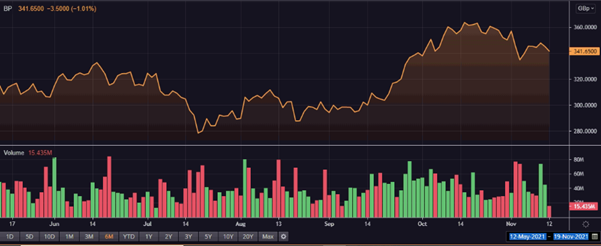
BP’s shares closed at GBX 340.90, down by 1.23 per cent on 12 November. The company’s market cap is at £68,607.86 million, and its one-year return stands at 43.90 per cent as of 12 November.
- Royal Dutch Shell PLC (LON: RDSB)
Royal Dutch Shell is another British multinational energy and petrochemicals supermajor. It is also one of the biggest petrol operators in the UK.
The company’s CEO Ben van Beurden recently said that while the group can transition to net zero emissions by 2050, it would require the money from its legacy oil and gas business to help fund the green transition.
Mr van Beurden also dismissed splitting its business into two: a renewable energy business and an oil and gas business, which had been suggested by activist investment fund Third Point management.
(Image source: EODHD/Others)
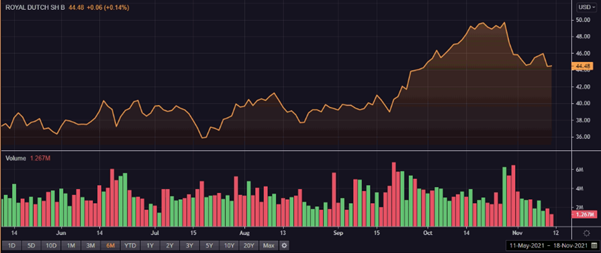
Royal Dutch Shell’s shares closed at GBX 1,657.00, down by 1.12 per cent on 12 November. The company’s market cap stands at £60,740.50 million, and its one-year return stands at 48.61 per cent as of 12 November.
