
 AUS
AUS
 NZ
NZ
 UK
UK
 CA
CA
 USA
USA
 IND
IND







Nutmeg Savings and Investment Ltd, the London-based robo adviser, on Thursday, 17 June, announced that the New York-headquartered investment banking giant JP Morgan Chase & Co (NYSE:JPM) has bought the company for an undisclosed amount.
With a clientele of more than 140,000 people and an asset under management (AUM) of £3.5 billion, Nutmeg will become the part of JP Morgan’s expansion plans in the UK, effectively forming the bedrock for the bank’s digitally-equipped offerings in the space of wealth management.
Following the development, the stock of JP Morgan dropped a little more than 3% in the trade today. According to the latest data available with the New York Stock Exchange, the stock of JP Morgan fell as much as 3.21% to an intraday bottom of $151.25 in the early afternoon trading session from the previous closing of $156.27 apiece.
JP Morgan Chase & Co shares (17 June)
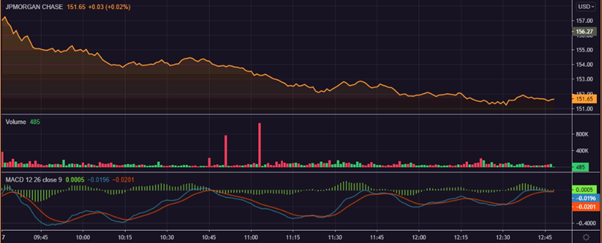
Image Source: EODHD/Others
Extending the losses, the stock of JP Morgan has collapsed nearly 9% in the last 9 trading days, barring a single day of positive closing in the present week. JP Morgan shares ended at $166.44 on Friday, 4 June.
Over the course of its incorporation as a robo advisor, Nutmeg has attracted a number of venture capitalists, global leaders in the financial services sector, and several institutional investors with whom the former have shared the vision for the future of wealth management.
Also Read | Economy Set to Get a Big Boost with New Infrastructure Bank
The amalgamation of Nutmeg’s services and the clients, the acquisition is likely to complement the launch of Chase as a digital bank in the UK in the later part of the present calendar year.
The extant customers of Nutmeg will continue to enjoy the present set of products and services as all the existing arrangement will remain unaffected. Following the completion of the deal in the later half of the year after receiving the requisite approval from the regulators, both the corporations are likely to work closely to develop further offerings for the benefit of the collective clientele.
