
 AUS
AUS
 NZ
NZ
 UK
UK
 CA
CA
 USA
USA
 IND
IND






Summary
- CPI inflation rate touches a four-year low
- All sub-categories except food and beverages display falling prices
- Output inflation for goods leaving the factory is negative
- Bank of England announce quantitative easing stimulus worth £100 billion
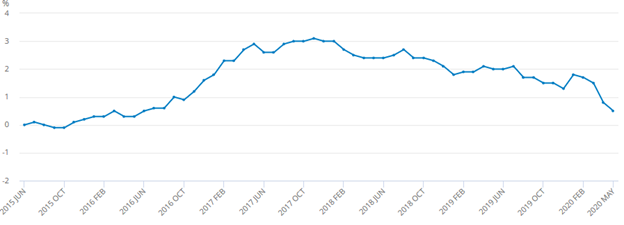
Inflation rate in the UK has fallen to a four-year low level of 0.5 percent in May this year, measured by the consumer price inflation (CPI), as recorded by the Office of National Statistics (ONS), UK. It was 0.8 percent during the earlier month of April. With Bank of England’s announcement of giving a fresh dose of QE stimulus to the corona-hit economy, things might start to look up again.
Inflation rate measures the variations in prices of good and services over time and, in general, a rise in inflation levels is indicative of higher levels of national economic activity.
This is the lowest inflation observed in the last four years, since 2016. Before that, in September 2015, the CPI had moved to a negative figure of -0.1 percent (refer graph below).
Monthly trend in CPI Rate (All Items)
(Source: Office of National Statistics, UK)
During May this year, except for the category of ‘food & beverages’, all others displayed negative inflation rates, with the largest fall coming from motor fuel, and ‘recreation & culture’. Global fuel prices are still trending at low levels, putting downward pressure on the motor fuel component of inflation, which also includes transport duties and retail charges, apart from the fuel price. Petrol prices slipped by 2.8p per liter during the past one month, while diesel prices saw a fall of 2.6p for the same time.
CPI inflation rate also dropped for the categories of health, restaurants & hotels, furniture & household goods, clothing & footwear and housing services, during the month of May 2020.
With the lockdown in place, the UK Government is facing difficulty in measuring the consumer price inflation rates, especially for the 74 goods which are not available to consumers during these testing corona lockdown times, and they carry a 14 percent weight in the consumer price index.
Core inflation has also displayed a downward monthly trend. It measures the prices variations in all items except alcohol, energy, food and tobacco categories. Core inflation rate dropped to 1.2 percent in May, down from 1.4 percent recorded in April 2020.
Economists are also hinting that this trend of consecutively falling prices every month may be the start of a prolonged period of low prices for goods and services, which is a definite cause of concern.
Looking at a weak consumer demand across all goods and services, Samuel Tombs, Chief UK Economist, Pantheon Economics, a reputed consultancy firm, is suspecting the inflation rate to touch a level of zero in the times to come.
Lane Clark and Peacock, a leading pension consulting firm has gone to the next level and predicted that the CPI inflation rate could slide below -2 percent mark by September this year, and in that case the Government may not need to announce any hike in State pensions, which is linked to the inflation levels.
While CPI inflation rates are a leading indicator of varying consumer prices in any economy, producer price index or PPI gives a closer picture of this change on the manufacturers’ front, and includes data on their input and output prices. It indicates the trend in economic production levels across the entire set of manufacturing businesses in the country. Let us glance briefly through them.
The PPI output inflation for goods leaving factory fell by 1.4 percent in May 2020, as compared to a lesser decline of minus 0.7 percent last month, in April. The largest contribution came again from petroleum products. On the other hand, the monthly PPI input rate of inflation displayed a growth of 0.3 percent in May, as compared to a fall of 5.5 percent observed in April.
Bank of England rolls out QE support
The Bank of England has roll out yet another monetary stimulus package on June 18, and will be buying bonds worth £100 billion to aid the ailing businesses and give a positive thrust to the economy. This has taken the value of total quantitative easing support from BoE to £745 billion.
This stimulus is in line with Tombs’ expectations as he had predicted that the British central bank will be giving away a stimulus of £100 billion in the month of June, followed by half of that in September this year. The interest rates which are already at an all-time low level of 0.1 percent since the month of March, have been left unchanged.
Bank’s idea is to purchase government bonds from investors, which should ideally motivate them to buy other wealth assets, thereby creating a spiral effect in the economy and lead to overall growth. This QE support is expected to boost commercial borrowings and thereby boost investments and consumer spend.
In addition this, the government is also preparing a package which may involve sales tax cuts and financing transportation projects.
Britain has already seen a record fall of 20 percent in its GDP (Gross Domestic Product), or economic production in simpler words, in the month of April 2020, which means that the country’s economy is contracting sharply.
The recovery phase is full of many challenges including the social distancing norms that are still in place, to stop a second wave of infections (which make company operations run slower than before, along with an added cost of maintaining the required safety and hygiene); fear of a no-deal Brexit on the horizon; low consumer demand for all products and services except essentials; and businesses running out of cash reserves & unable to make profits.
Equity markets were seemingly unperturbed with the trend in falling UK prices as well as the Bank of England’s stimulus. The FTSE 100 index traded at 6,224.07 points on June 18 at 4.35 pm GMT+1, down 0.47 percent, while the FTSE 250 index traded at 17,518.26 points, down 0.36 points on June 18 at 4.40 pm GMT+1.
In sum, the latest data on inflation rates for the month of May 2020 is not encouraging and it depicts a slowdown in economic activity, across the board. Even though the UK Government is coming out with various packages including today’s central bank quantitative easing package, a long-term sustained recovery is seems far away, with the pandemic driven restrictions still in place.
