
 AUS
AUS
 NZ
NZ
 UK
UK
 CA
CA
 USA
USA
 IND
IND


.jpg)





Highlights
- Mental health is affected by various socioeconomic considerations and affects the individual and the people around them.
- The Australian government is focusing on the two key priorities- mental health and suicide prevention.
- In Australia, R U OK? Day has been going on since 2009, but it is more important this year because of the increasing mental health issues in children.
Mental health impacts every aspect of human life; it affects behaviour, physical health, work and relationships, as well as the people around them. It is a state of wellbeing that enables an individual to deal with what life puts in.
The studies suggest that young Australians are experiencing psychological distress that refers to non-specific symptoms of anxiety, stress, and depression. Moreover, the rising psychological distress is an indication of impaired mental health and may cause some common mental disorders, like depressive and anxiety disorders.
RELATED READ: Rising youth mental health crisis in Australia calls for collaborative action
Source: © Skypixel | Megapixl.com
There are various socioeconomic factors affecting mental health, such as a person’s access to services, living conditions as well as employment status.
According to the Australian government department of health, almost half of all Australian adults -~7.3 million people- will face mental ill-health at some point. As per the government, in 2019, suicide was the main reason for death of people aged 15-49 years in Australia. Moreover, it can affect a person at any stage of life and can have a harmful effect not just on the person’s life, but also on the people who are around and the country as a whole.
Increasing mental health issues in Children
In Australia, psychiatrists encourage parents to communicate to their children about how they are managing lockdown situations as hospitals in Australia are witnessing a spike in mental health issues among youth.
Some experts highlighted that vulnerable children from disadvantaged backgrounds are progressively coming to the hospital for mental health related issues such as anxiety, self-harm, and eating disorders.
Also, according to recent data, a surge in calls to Kids Helpline witnessed a rise in children being hospitalised due to mental illness.
RELATED ARTICLE: Why regular physical activity is critical to your mental health
Suicide prevention in Australia
In Australia, suicide rates have increased over the last decade. One of the biggest issues for governments, communities, and the healthcare industry to tackle this complex issue is the readiness of evidence.
For the Australian government, the two key priorities are mental health and suicide prevention. The Australian 2021-22 budget offers almost AU$2.3 billion investment in the National Mental Health and Suicide Prevention Plan that will lead to a significant improvement in the mental health as well as suicide prevention system. Furthermore, the government has plans to spend a record AU$6.5 billion in mental health and suicide prevention services and supports in 2021-22.
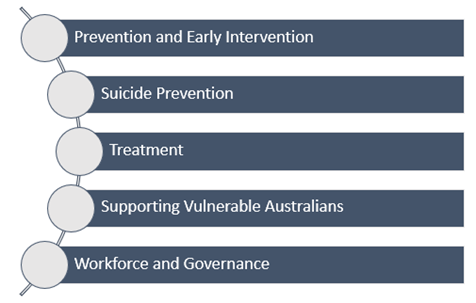
The plan recognises that Australians need a system that acts early to help people before the condition of mental health and suicidal distress worsens. There is a requirement of providing compassionate, preventative, and effective care.
The reform of mental health and suicide prevention is based on five pillars-
Copyright © 2021 Kalkine Media, Source: pmc.gov.au
R U OK? Day in Australia
In Australia, R U OK? Day has been going on since 2009, but this year it is more important than ever before with the increasing mental health issues. On this R U OK? Day, the Australian government urged Australians to reach to the people for whom they are concerned and do an important conversation related to their mental health.
Source: © Cimbala9 | Megapixl.com
The Morrison Government stated that communication related to mental health should not be difficult. It is as simple as asking if someone is okay, listening to the people, as well encouraging them, and checking back in.
Notably, the Australian government has provided support for R U OK? Day and committed funding of AU$2.1 million to work on this between April 2017 and 30 June 2022.
Mental Health Disclaimer: The content in this article is not intended to be a substitute for professional advice, diagnosis, or treatment. Always seek the advice of your mental health professional or other qualified health provider with any questions you may have regarding your condition. In an emergency, call 000. Help is available 24 hours a day, 7 days a week, anywhere in Australia. If you need help now, call:
- Lifeline – 13 11 14
- Kids Helpline – 1800 55 1800
- Mental Health Crisis Assessment and Treatment Team in your state/territory
- Beyond Blue – 1300 224 636.
Find a list of services that can help you right now at Head to Health.
