
 AUS
AUS
 NZ
NZ
 UK
UK
 CA
CA
 USA
USA
 IND
IND








Summary
- According to the Commonwealth Fund report, Norway, the Netherlands, and Australia have the best healthcare system performance.
- The US healthcare system stands last among the group despite spending a significantly higher share of the gross domestic product (GDP) on the system.
- Performance measures were analyzed across five domains: care process, access to care, equity, administrative efficiency, and healthcare outcomes.
The COVID-19 pandemic has imposed unprecedented pressure on all countries’ healthcare and public health systems. The world is still struggling to deal with it because of the emergence of new and contagious coronavirus strains. Besides, success in controlling and preventing infection has significantly varied among the countries. The same goes for the countries’ ability to address the challenges related to financial stability and operations due to the COVID-19 pandemic.
RELATED READ: Five countries that suffered deadliest COVID-19 onslaughts
Not all nations over the world have similar healthcare systems. Even amongst high-income countries that can spend more on healthcare, the approaches to oversee the healthcare system often vary significantly. These options affect the performance of the health system in terms of access to care, health outcomes, and experiences of patients.

Source: © Meatkombinat | Megapixl.com
As per the latest report released by the Commonwealth Fund, the US healthcare system is last on a ranking among eleven of the wealthiest nations across the world, even though the country is spending the highest percentage of its gross domestic product (GDP) on healthcare.
The report compares healthcare system performance in 11 nations, including Australia, Canada, France, Germany, the Netherlands, New Zealand, Norway, Sweden, Switzerland, the UK, and the US. The information is extracted from the Commonwealth Fund international survey in each country, the Organisation for Economic Co-operation and Development (OECD), and the World Health Organization (WHO).
ALSO READ: Digitalisation in healthcare space: A look at the pros and cons
Domains of the survey
The report indicates that 71 performance measures were analyzed across five domains and comprised information extracted from the Commonwealth Fund international surveys done in each country and administrative information from the OECD and the WHO.
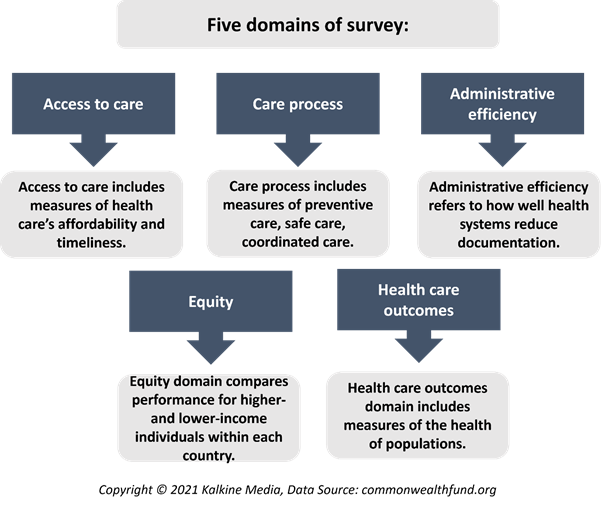
- Access to care: The first domain is access to care which includes measures of healthcare’s affordability as well as timeliness. The US was the poorest performer on the affordability subdomain. The five affordability measures are- having high out-of-pocket expenses, patient reports of dodging medical or dental care due to cost, confronting insurance shortfalls, or having difficulties paying medical bills.
- Care process: The care process comprises the measures related to coordinated care, preventive care, safe care, and patient preferences.
- Administrative efficiency: It refers to how effectively the health systems reduce documentation work and other administrative tasks that clinicians and patients encounter during care. Many nations have simplified processes for insurance coverage, billing, and payment.
- Equity: This domain compares performance for higher- and lower-income people within each country. The equity domain uses 11 selected survey methods from the care process and access to care domains.
- Healthcare outcomes: The fifth domain is healthcare outcomes which include ten health measures of individuals selected to focus on outcomes that can be modified by healthcare. The measures in this domain come under three categories: population health outcomes, condition-specific health outcomes, and mortality amenable to healthcare.
DO READ: What’s impeding global vaccination drive? Debunking myths about COVID-19 vaccines
Features that differentiate top-performing nations from the US
The comparison of the features of top performer nations and poor performers in the healthcare system suggests that top-performing nations primarily rely on four features to achieve better and more equitable health consequences:
- Universal coverage and no cost barriers: Countries other than the US provide universal coverage and eliminate cost barriers so people can obtain care when they require it and in a manner that works for them.
- Investment in primary care systems: They invest in primary care systems to make sure that high-value services are equitably available locally in all communities to all individuals. This reduces the risk of discrimination as well as inadequate treatment.
- Lower the administrative responsibilities: Nations other than the US focus on reducing the administrative workloads on clinicians and patients that cost time and effort and can prevent access to care.
- Investment in social services: Other countries invest in social services that increase equitable access to nutrition, community safety, childcare, transportation, education, housing, and worker benefits that lead to a healthier population and reduces avoidable demands on healthcare.
Bottomline
According to the Commonwealth Fund report, the top-performing nations are Norway, the Netherlands, and Australia. The US ranks last among the 11 wealthiest nations, despite the fact that the country spends far more of its GDP on healthcare. Also, the country remains in the second position on measures of care process but last on access to care, administrative efficiency, equity, and healthcare outcomes.
ALSO READ: Five Healthcare Stocks That May Benefit From Biden’s Drug Policy
