
 AUS
AUS
 NZ
NZ
 UK
UK
 CA
CA
 USA
USA
 IND
IND






As the world is trying to battle its way out of the COVID-19 pandemic, the skepticism towards China has multiplied manifold in the past one and half year. Whether this skepticism is diplomatically right or wrong, is a question of debate.
Many have alleged that the COVID-19 virus was leaked from the Wuhan Institute of Virology – a hypothesis which is now known as Wuhan Lab Leak Theory – rather than natural animal-to-human transmission. One of the earliest proponents of this theory – in April 2020 – was the then US President Donald Trump. Joe Biden, the incumbent US President, has also said that his administration would investigate this angle. However, many top scientists, across the globe have pushed back against this theory.
Whatever it is, China has done one thing successfully – make the world more and more polarised.
That said, the fact of the matter is that whichever side is right, China, on the economic front has a habit of bulldozing their way through things. Using Chinese money and infra expertise as a tool, the country, in the recent past, has gone about its policies of what they call “neo-colonials” in the weaker countries.
How has China expanded its global footprint?
In the terms of value, China’s overseas investment and construction combined since 2005 stands in excess of US$2 trillion, according to the data available from the China Global Investment Tracker (CGIT). Since the tracker was launched in 2005, it has recorded 3,500 transactions across energy, transportation, real estate, technology, and other sectors. Of these, in 300 cases, Chinese companies swooped on distressed entities and acquired projects through restructuring/refinancing transactions. However, despite China recovering faster, the COVID-19 pandemic has hit the world’s most populous country as well, as documented investment and construction both plunged. The famous Belt and Road Initiative (BRI) has become relatively important, though within a smaller Chinese footprint, as the US and other rich countries have discouraged Chinese activities. The Chinese have been smart operators in expanding their footprint. Last year, amid the Galwan Valley stand-off between India and China, when India’s premier shadow bank, Housing Development Finance Corporation (HDFC), reported that the People’s Bank of China (PBOC) owns 1.01% stake in it, the news created ripples in India. However, there was a catch. During the March 2020 quarter, PBOC had upped its stake only by 21 basis points. It has owned 0.8% stake already. However, as per the rules, India’s market regulator – the Securities Exchange Board of India (SEBI) – asks companies to name only the companies that hold more than 1% stake in them – a rule which Chinese banking major used to keep itself under the radar.
Is dissing China the way out?
One might love China or hate China, but no one can ignore it. China was the only major economy to grow in 2020, despite the country’s economic hub – the central Chinese province of Hubei – being in complete lockdown for over two months last year. With US$14.34 trillion annual gross domestic product (GDP), China’s economy is thrice as much as that of Japan – the second largest economy in Asia-Pacific (APAC) region. There have been times, when there have been talks swirling about the world’s powerhouse shifting to APAC – thanks to China. China has had a kind of condescending tone when it comes to its geopolitical interest – from issues in South China to border dispute with India.
On the business level, the Chinese have more and more taken to hostile takeovers. Even as the Sino-US trade war had negatively impacted them, the number of troubled transactions by the Chinese entities stands at 126 in the last five years. To put things in perspective, the number of trans-border troubled acquisitions that Chinese companies have gone for in the past six years, is equal to number it had seen for the entire decade before that. What is more worrisome is the fact that there have been allegations that most of these high-profile transactions are linked to China’s all-powerful Chinese Communist Party (CCP).
That said, it is impossible to isolate China – especially now. Look at the Belt and Road Initiative – the trans-nation economic route conceptualised by China as a revival of the ancient Silk Route. As of January 2021, the number of countries that have joined the Belt and Road Initiative (BRI) by signing a Memorandum of Understanding (MoU) with China is 140. Now that is a big number of bilateral relations to ignore China. Also, when it comes to the fight over resources (usually, the root cause of any war), China has all in its kitty – with huge investments spanning some of the world’s poorest and the most resource rich nations.
So, what should be the way out?
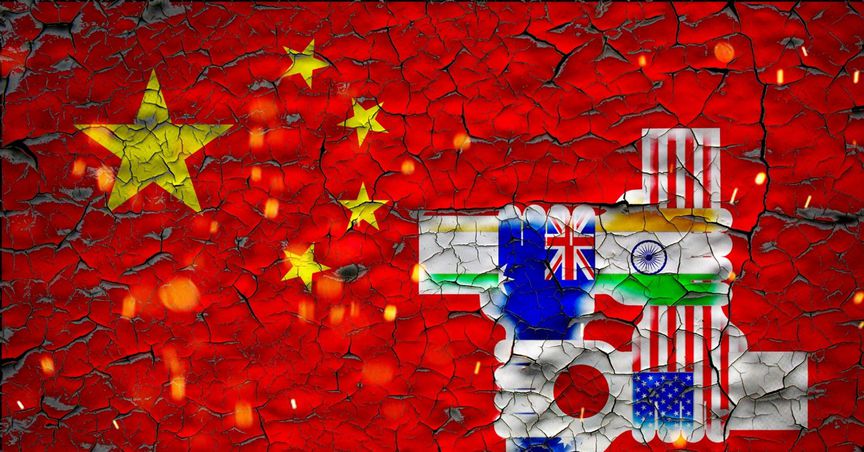
In late 2019, the United States, Japan, and Australia joined hands for a multi-stakeholder initiative – Blue Dot Network (BDN) – largely seen as counter response to the BRI. Although the initiative has made some investments, it somewhere lacks the cutting-edge that BRI has. The US, and China – the world’s two largest economies – have been engaged in a kind of cold war, mostly in the trade sphere. So, this would need an approach much like the one used at the time of Cold War. The Southeast Asia Treaty Organisation (SEATO) – a cold war time multination alliance – has long been abolished. The North Atlantic Treaty Organisation (NATO) would soon be rudderless, as the US and allies pull out of Afghanistan after waging 20 years of unwinnable war. So, in the given circumstances, focus shifts to a multi-nation organisation in Indo-Pacific. And at this point in time, QUAD is the best bet that can build a counter to Chinese economic ambitions. The only way to deal with China seems to be what can be called as “detached engagement”. Nations are compelled to engage with China, since it is too big to ignore. However, that does not mean China should be allowed to browbeat other nations to serve its own end. And the best way for that would be to counter China economically. Remember that the Chinese might stems from its gargantuan economic size.
What does Quad mean?
The Quadrilateral Security Dialogue, popularly known as QUAD, is a strategic dialogue involving the US, Japan, Australia and India – which is maintained by the talks amongst the four countries. Revived in 2017, the initiative was first started a decade ago – in 2007. The advantage of QUAD is that it covers Indo-Pacific and completely surrounds China – India on one side, Australia on other, while flanked by the US and Japan on another. The unfortunate part: the QUAD countries are somewhere still taking it as a diplomatic and military alliance. It is probably the time, when the four countries start thinking economies. To counter the dragon’s might that stems from its economy, you would probably need an economic counter – not a military one.
