
 AUS
AUS
 NZ
NZ
 UK
UK
 CA
CA
 USA
USA
 IND
IND







Highlights
- Australia is experiencing one of the longest periods of low cash rate maintained at 10 basis points.
- The rate hike expected this year would be the first in around 12 years of Australian history.
- The real effects of the government’s policies are likely to be felt in the period following a rate hike.
Australia’s interest rate saga is likely to be engraved in its economic history forever. The country has had one of the longest periods of record-low interest rates among its contemporaries, excluding countries that have maintained interest rates at zero per cent.
While having near-zero interest rates is not necessarily bad, economies with such expansionary monetary setup have been often criticised. However, the pandemic mandated such an extreme stance even from countries that had never implemented it before.
Although most other countries have already embraced monetary contraction, Australia seems to be an outlier who is waiting to meet its inflation and wage growth targets. It is worth noting that Australia has not raised its interest rates in about 12 years. Thus, a rate hike will be a fairly new feat for the country if executed.
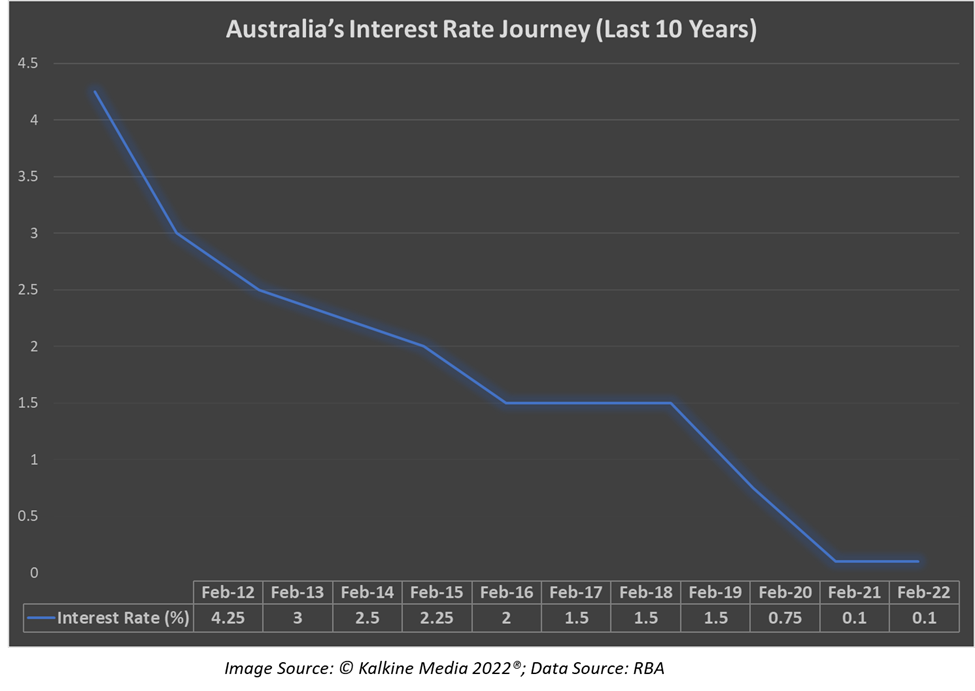
Low-interest rates are generally thought to spur spending in the economy. As lending becomes cheaper, households and businesses typically take out more loans and invest the money. Thus, the policy is considered to be an ideal solution to a contraction in consumer demand, as seen during the pandemic. However, after running at ten basis points for almost 14 months, interest rates are likely to be revived soon to fight back inflationary pressures.
ALSO READ: What does Russia-Ukraine conflict mean for world economy?
A brief history of interest rates
Interest rates have had a gradual but steady path downwards during the last few decades. During the early 1980s, interest rates were as high as 10%, or even above that in some instances. Moreover, during the recession of the 80s, interest rates soared and even reached over 20% in Australia. Interest rates moved below 10% in the 1990s; however, they remained as high as 7.5% in 1996.
Which Sectors will benefit from rising interest rates?
After reaching 7.5% in July 1996, interest rates were brought back down for some time, after which they eventually settled at 4.75% during the early 2000s. However, the real game-changer was the global financial crisis which shook financial systems to the core and caused major upheaval. Many countries adopted the monetarist idea of monetary easing to fight off the slow economic growth during the post GFC era.
Monetarist theory of economics advocated for the usage of the money supply to control the economy’s employment, consumption, and output. A quick way to control the money supply is to use monetary policy tightening and easing, which means increasing or decreasing interest rates, respectively.
When countries adopted monetary easing, they successfully came out of the GFC-induced slowdown in the years following 2008. Thus, when the pandemic struck, central banks across the globe knew which strategy to fall back on to revive spending.
RELATED READ: How well does the Keynesian framework sit in the Australian economy?
What is next for the financial sector?
Industries are poised for an interest rate hike in the country. With economic data showing significant improvements in 2022, speculations of an interest rate hike this year are doing rounds. Unemployment has already reached its 13-year low level at 4.2% in January 2022. Experts predict that the jobless rate can fall further to 3.75% later this year.

Meanwhile, with workers returning to the workforce, employers have been offering incentivising programs to attract skilled staff, along with higher remuneration. Consequently, wages during the December 2021 quarter rose 0.7% on a quarterly basis. For the quarter, the annual growth of wages was 2.3%, reflecting a significant leap over the prior corresponding period’s wage growth of 1.4%.
While this may bring the central bank a step closer to an interest rate hike, the wage growth data has not sparked expectations of a rate hike in the immediate future.
Market pundits are expecting interest rate hikes to occur as soon as the RBA takes the first step in that direction. Essentially, this means that there could be a spell of rate hikes within a short span of time, for which the market may not be prepared.
In a nutshell, the RBA has crucial decisions left to take in the coming months. The real effects of the government’s policies are likely to be felt in the period following a rate hike. Till then, households can enjoy the benefits of record-low mortgage rates.
GOOD READ: Is Australia facing ‘Great Resignation’ in workforce like the US?
