
 AUS
AUS
 NZ
NZ
 UK
UK
 CA
CA
 USA
USA
 IND
IND








Summary
- The sector has come out of its bottom levels seen during the lockdown period but sees no signs of a sharp turnaround, slow growth expected: Make UK/BDO survey
- Manufacturing companies shelving their investment plans, employment output bleak
- Merely one-fifth of the total companies surveyed were operating at their full capacity level
- A no deal exit of the UK from the European Union could also have serious implications for the sector’s overall growth
The manufacturing industry in the UK does not see much signs of a V shaped recovery with the coronavirus pandemic still far from being over around the country.
A recent survey from the Make UK and BDO has suggested that the manufacturing businesses across Britain are planning to cut down on their short-term investment plans, despite a rise in business orders and production output that have taken out the sector from its historic lows.
Make UK is a London based industry association representing the manufacturing sector across the nation. BDO is a global accounting and advisory firm headquartered at Belgium.
Make UK/BDO manufacturing outlook Q3 2020
The Make UK/BDO manufacturing outlook survey for Q3 2020 highlighted that the investment intentions have dropped drastically around the country, with the biggest falls being projected for the locations of Scotland, Wales, and Yorkshire & Humber.
Make UK has said that going forward, the future investment plans could be even more negatively impacted given the uncertainties with respect to a favourable deal being worked out between the UK and EU once the Brexit transition period expires in December 2020. A situation of a no deal with the European Union has grave implications for British manufacturers’ raw material and operational costs, customs and other applicable duties, and a smooth flow the supply chain at the UK-EU borders, said Tom Lawton, head of manufacturing, BDO.

Th survey has forecasted the overall economic output in the manufacturing sector to drop by close to 11 per cent for the year 2020. The output for the next year 2021 is projected to grow by close to 5 per cent, mentioned the outlook.
Almost one-fifth of the total companies surveyed were operating at their full capacity.
The report also disclosed that the employment scenario in the country’s manufacturing sector is bleak, and that businesses are continuing with cutting back on their workforce. The consumption for goods has fallen down drastically. The changing market scenario has forced companies to cut costs of their operations and employ measures to increase productivity with lesser number of employees.
Also Read: Covid-19 Update: The UK Manufacturing Sector
The UK manufacturing sector
The main sub-sectors of the British manufacturing industry are aerospace, automotive, chemicals & pharmaceuticals, construction, defence, electronics, energy, food & drinks, nuclear, plastics, steel, space, and textiles.
The sector employs close to 3 million people, according to market estimates. It contributes to 11 per cent of the nation’s total gross value added (GVA). Further, it accounts for almost half of the nation’s total exports.
The UK manufacturing industry currently makes up for around 13 per cent of the total private sector investment in the nation, according to Make UK statistics.
As per market estimates, the business investment in the manufacturing sector has fallen by the largest proportion during the second quarter of the year 2020, even more than what was experienced during 2008, the year of the global financial crisis.
Project Birch not successful
The government scheme named ‘Project Birch’ was launched during March 2020 as a bailout plan for businesses hit severely due to the coronavirus pandemic. It was aimed to support viable companies who have run out of all other options.
Till now, only one company, Celsa Steel UK, has received support under this scheme in the month of July 2020. It manufactures steel rebars and was given a bailout support worth £30 million.
Many other companies have asked for government support under the scheme but have not got any funding as yet. These include Aston Martin, Jaguar Land Rover, Virgin Atlantic, Loganair, and Tata Steel.
In the foreign lands, France and Germany have also successfully offered such financial bailout to their ailing firms.
The failure of the scheme has gathered criticism from various quarters. Manufacturers said that despite crying out for help and giving warnings of layoffs, the government did not extend the support they deserved.
The Treasury defended its position by clarifying that the firms first need to explore all other schemes and close the available commercial options before asking for financing under the project birch.
More job losses expected
The latest official statistics have revealed that the unemployment in the UK has risen during the three months to July 2020, despite easing of restrictions and ongoing government support schemes such as the coronavirus job retention scheme (also known as the furlough scheme) and the self-employment income support scheme, among others.
The unemployment rate in the UK rose to 4.1 per cent during the three-month period to July 2020, as compared to a level of 3.9 per cent registered during the previous quarter of the same year.
Job losses are expected to be even more pronounced after 31 October 2020, when the furlough scheme comes to an end, as per market experts.
Covid-19 infections heading in the wrong direction
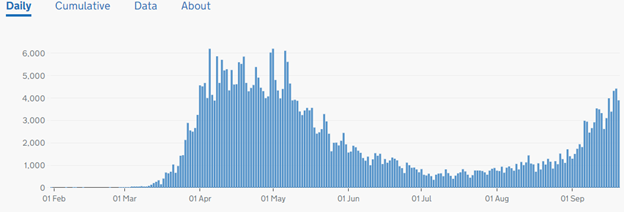
Chris Whitty, Chief Medical Officer is expected to sound an alert to the government very soon as the number of daily coronavirus infection cases is rising in the UK since early August 2020. If the trend continues, there are speculations that a second lockdown might be required in London.
The daily number of cases reported with coronavirus infections was 761 on 1 August, it moved up to 1295 on 1 September, and further to 4422 on 19 September of the year 2020, which is definitely a worrisome trend.
UK coronavirus infections: daily cases reported by date
(Source: Government of UK)
The country has already witnessed the damaging results of the first lockdown where the economic growth was jeopardised greatly. The British economy had shrunk to four-fifth of its size during the second quarter of the year 2020. Therefore, Johnson might be anxious to avoid imposing another lockdown.
To sum up, latest MakeUK/BDO outlook for the third quarter of 2020 presents a dismal picture of the country’s manufacturing sector. Many of its sub-sectors like aerospace and steel and still struggling for survival, cripple due to very low consumption levels. Most of the businesses surveyed have shelved their near-term investment plans, given an uncertain outlook with respect to the Brexit deal and a sluggish economic scenario at the home front. Moreover, if the coronavirus infections rise further and the government is forced to impose another lockdown, the growth of the sector will get further delayed.
