
 AUS
AUS
 NZ
NZ
 UK
UK
 CA
CA
 USA
USA
 IND
IND





(Feature Image Source: Twitter/@cafreeland)
Summary
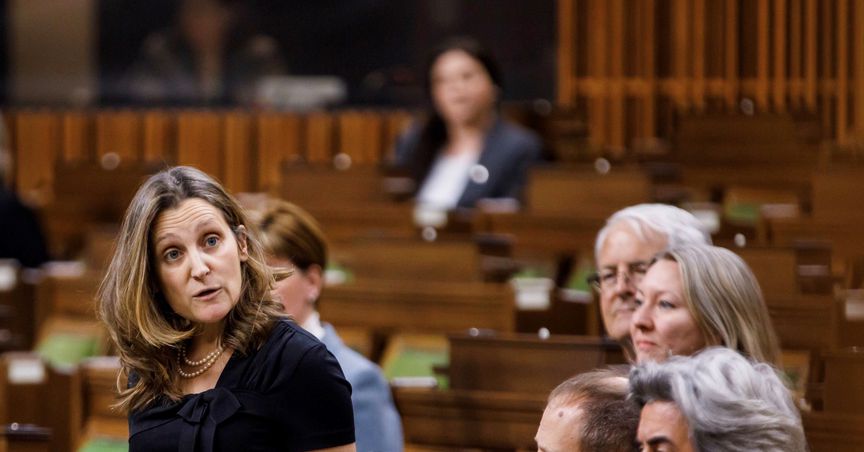
- Chrystia Freeland is the first female Finance Minister in Canada and the second woman to hold the finance portfolio in a G-7 nation after Christine Lagarde of France.
- She succeeds Bill Morneau, who departed amid growing tension with Prime Minister Justin Trudeau over increased spending on coronavirus support programs and green initiatives.
- Counted among Trudeau's most trusted allies, Freeland has previously held key Cabinet portfolios and spearheaded the trillion-dollar trilateral CUSMA free trade pact.
- Freeland is reputed to be a strong negotiator with good political skills and years of financial reporting under the belt.
Canadian Prime Minister Justin Trudeau has named deputy PM Chrystia Freeland as the new Finance Minister, after Bill Morneau stepped down from the post over policy differences. In addition to the cabinet shuffle, Trudeau suspended the Parliament till September 23 and promised to return with a new roadmap outlining economic spending to drive Canada out of the pandemic recession.
Chrystia Freeland, 52, is the first woman to hold the finance portfolio in Canada. She has been serving as the deputy prime minister since 2019 and was first elected as the Member of Parliament in July 2013. She also the second woman finance minister in a G-7 nation, after Christine Lagarde of France.
Counted among Trudeau's most trusted allies, Freeland has previously held key posts of minister of foreign affairs and international trade. She also spearheaded the trillion-dollar trilateral Canada-United States-Mexico (CUSMA) free trade agreement.
A alum of Harvard and Oxford universities and a Rhodes scholar, Freeland is a former journalist who spent quite some time reporting on financial matters at top media houses. She also served as the Financial Times managing editor and Thomson Reuters managing director, before entering politics in 2013.
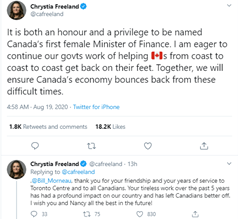
Taking to Twitter, Freeland expressed honour to be named as the first woman Finance Minister of Canada and voiced her eagerness to work towards the country?s economic recovery amid pandemic. Freeland also thanked former finance minister Morneau for his ?tireless work? since 2015.
READ: Bill Morneau resigns from Trudeau cabinet. What went wrong?
Freeland?s appointment came hours after Morneau, who held Canada?s economic portfolio since 2015, quit amid growing differences with Trudeau over the virus recovery spending and proposed green initiatives. The former FM and his team were reportedly sidestepped in key debates over spending and policy decisions on COVID and the multi-billion-dollar green initiative funds.
Morneau and Trudeau are also being investigated by the country?s ethics commissioner in a conflict-of-interest probe concerning the WE Charity.
Freeland has relinquished her role as minister of intergovernmental affairs, which will now be taken up by another Trudeau ally ? veteran Liberal MP Dominic LeBlanc?
Reviving Canada?s Pandemic-Crippled Economy
Freeland?s appointment wasn?t really a surprise in the political corridors of Ottawa. Apart from being counted among Trudeau?s most trusted aides, she?s long been considered as the most likely successor to lead the Liberal Party.
Trudeau, supported by Freeland, will formally present the new economic revival plan after September 23, when the parliament comes out of ?prorogation? (Prorogation is the formal process to end the ongoing session of Parliament). The plan is subject to a vote of confidence and if the Liberals lose, Canada will head for polls.
As the Finance Minister, Freeland is staring at a massive C$ 343.2 billion fiscal deficit and economic depression at levels not seen since the Great Depression of 1930s. She tasked with reviving a crippled economy and developing solutions on how to wean off the heavily oil-dependent country from fossil fuels. She harped on the importance of ?green? restart to the Canadian economy while talking to media.
The country is looking at protracted growth in the coming months as coronavirus scars linger. There will be a string of insolvencies and bankruptcies, business closures and plateauing of job growth.
Amid all this, the new Finance Minister will also have to figure out a way to slowly withdraw the monthly government aid doled out through COVID-support programs that can result in ballooning fiscal deficit.
Freeland is reputed to be a strong negotiator with good political skills and years of financial reporting under the belt. Her appointment is seen as the move in right direct by economists and business leaders. Others feel she has no real Baystreet experience, which could reflect in policy matters at both micro- and macro-economic levels.
She has also been vocal about taxing the country's top one percent rich population to avoid ?divisive populism?, which ?grows parallel to middle class insecurity?.
Freeland may also prove to be a key piece in government?s push for gender diversity, a fact highlighted in her first speech as the finance minister on Tuesday, when she spoke on the disproportionate effect on women in the pandemic economic.
Overall, market insiders expect Freeland to chalk out clear guidelines on the direction of Liberals? fiscal and tax policy.
