
 AUS
AUS
 NZ
NZ
 UK
UK
 CA
CA
 USA
USA
 IND
IND








Summary
- Current account deficit stood at $2.6 billion for the year to September 2020 compared to $11.7 billion in the same period, previous year.
- The primary driver of the current account deficit was the increase in goods imports of $1.1 billion.
- The deficit was in line with Westpac predictions with goods imports staying soft while goods exports remaining resilient.
The current account deficit for NZ dwindled to the lowest level since 2001, in the year to September due to lower imports coming in New Zealand in 2020.
As per Stats NZ, seasonally adjusted current account deficit stood at $0.4 billion in the September quarter, compared to a record surplus of $0.6 billion in the last quarter. The primary contributor to the deficit was an increase in imports of goods of $1.1 billion.
The NZ current account deficit for the year to September 2020 contracted to $2.6 billion, representing 0.8% of the GDP compared to a deficit of $11.7 billion in September last year.
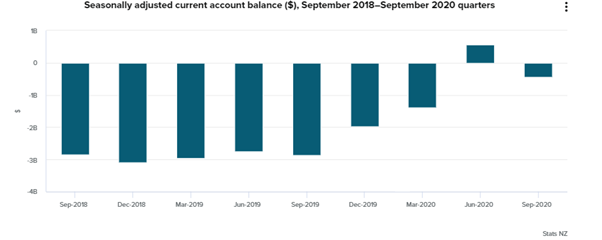
Source: Stats NZ, dated: 16 December 2020
Peter Dolan International Statistics senior manager stated that the rise in car imports was the main driver of the increase in goods imports. He also added that since the country levied border restrictions in March, travel and transportation services trade have dropped while other top services have stayed constant.
In the September 2020 quarter, 52% of total services exports and just over a quarter of imports of services contributed to travel and transportation services.
Other business services (such as consulting fees charged by overseas-owned companies) accounted for 15% of total exports of services, now the second largest contributor to the fall of travel and transportation services.
However, travel and transportation services made up about 68% of the total services exports and just over 50% of the total services imports in the September quarter of last year.
September deficit in line with Westpac predictions
The predictions were in line with Westpac. It expected current account deficit to narrow over the September quarter to 0.8% of GDP, the smallest deficit since 2001.
Westpac bank stated that goods exports stayed resilient, falling by only 2% as the demand for NZ food exports continued to hold up globally, while imports remained well below pre-Covid levels.
Further, higher services exports and lower services imports helped in increasing the services balance.
(NOTE: Currency is reported in NZ Dollar unless stated otherwise)
