
 AUS
AUS
 NZ
NZ
 UK
UK
 CA
CA
 USA
USA
 IND
IND






Highlights
- Australia recorded a 1.9% growth in GDP for the quarter ended 30 June 2021.
- The country began to live the Delta variant nightmare during this period and thus saw a diminishing GDP growth rate.
- The GDP growth rate has been the lowest since the end of September 2020.
As per the latest release by the Australian Bureau of Statistics (ABS), the June 2021 quarter recorded a 0.7% growth in GDP since the March quarter, when the q-o-q growth was 1.9%. The y-o-y national growth was 9.6%. As per a Reuters poll of economists, the number has beat the projections of 0.5% growth in the June quarter. While the rest of the world went haywire since March 2020, 99.9% of the time, Australia managed to fight the virus with speedy identification of the infected and possible contacts, compulsory quarantines and border closures..
Resilient numbers
The June ended quarter saw a 1.1% increase in household spending. The growth in household spending was caused by increased spending on services. Private investments too grew by 2%. Dwelling investments surged by 1.7%, showing the growing demand since the launch of the HomeBuilder scheme.
With the increase in employment and working hours, there was a 1.2% growth in the compensation of employees. Government spending was up 1.3% predominantly due to expenditures in the health sector which recorded a 2% Gross Value Added. In addition, continuing investments in state and local infrastructure projects contributed to increased public demand, which has a 0.7 percentage point share in the growth.
Indicating strong commodity prices, there was a 16.9% increase in mining operating surplus. The q-o-q growth in terms of trade was 7% while the y-o-y increase was 24.1%.
Not an all-rosy picture
The quarter saw declining exports of mining commodities due to the disturbances in coal production and iron ore transport to the ports. The mining production numbers were down 1.3% for the quarter due to a decline in oil and gas extraction due to large LNG plants' maintenance activities and poor weather conditions. Coal mining too was disrupted by weather, logistical and production concerns. The economy also saw a mild dip in the ratio of household savings to income. The retraction of benefit transfers from the government also slowed the growth.
Delta Variant wreaks havoc
In the beginning of May, a couple in the eastern suburbs of Sydney was tested positive for the variant. While there was no community spread detected around that time, it was a forest fire by the end of May. There is an apparent reason for the plummeting growth rate in GDP numbers. By 30 June, there were only two covid free states- Tasmania and Australian Capital Territory (ACT).
Cause for concern
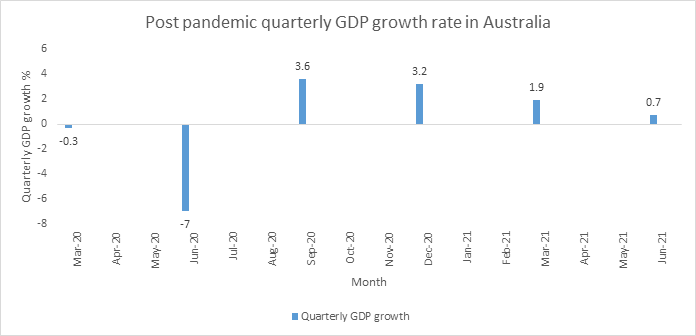
There is 9.6% y-o-y growth in GDP, but as seen from the graph below, the number in isolation is deceptive. From a -7% last year in June 2020 quarter to 3.6% in September 2020 quarter was an improvement. However, the dwindling numbers, especially since 1Q 21 is a cause of concern.
Expert opinion
As per BIS Oxford Economics chief economist Dr Sarah Hunter, the data is backward-looking, especially given the continuing lockdowns in NSW, Victoria, and the ACT. Dr Hunter thinks that the disruption will bring about around 3% contraction in the September quarter. However, even with vaccine rollout at the current pace, eastern states are expected to reopen only by the December quarter, enabling recovery.
Related reads: Lockdowns hurt Australian retail sales; steepest monthly decline in July
Reason for optimism
Despite the challenges posed by the lockdowns, some sectors have shown resilience. There was a 1.3% growth in agriculture, forestry and fishing, while manufacturing was up 0.9%. There was a 1% increase in construction and wholesale trade too. Increased labour hiring for mining, construction, cleaning, pest control and other support services lead to a 6.2% quarterly growth in administrative and support services. Australia also recorded growth in accommodation and food services and transport, postal and warehousing services. However, as per Deloitte Access Economics partner Stephen Smith, the June quarter will not give an accurate picture of the backlashes of lockdowns. This is because, at any given time, only 7% of the population was under lockdown then.
Bottom Line
The technical indicator of recession in an economy is a decline in GDP for two consecutive quarters. While the economy may not be in a recession yet, it would be sound to exercise caution given that the rate of growth seen in quarterly GDP since the quarter ended September 2020 has been on a decline.
In addition, while only 7% of the population was under lockdown during the reported period, the numbers later jumped up as high as 45%. As per Jim Chalmers of the Australian Labour Party (ALP), the actual grim picture will be out only in the next quarter with deep-rooted impacts of the NSW, Victoria and ACT lockdowns. Chalmers claims that the Morrison government's incompetence in vaccine rollout is the cause of this mess.
With a 2.7% dip in retail sales and a record high trade surplus of AU$12.1 billion recorded in the month of July, it will be interesting to see how the running quarter climaxes.
Related Read: Australia sees 277,674 business exits amid COVID-19 pandemic
