
 AUS
AUS
 NZ
NZ
 UK
UK
 CA
CA
 USA
USA
 IND
IND


.jpg)





Source: Portrait Image Asia, Shutterstock
Summary
- The Bank of Canada (BoC) said on Tuesday that it will be rolling back the support programs it had extended to help the economy through the pandemic.
- The central bank plans to suspend or discontinue a number of its liquidity programs around April and May.
- As market conditions started reflecting signs of improvement in late 2020, the BoC began adjusting its liquidity programs around fall.
The Bank of Canada (BoC) said on Tuesday, March 23, that it will be rolling back the support programs it had extended to help the economy through the pandemic.
BoC Deputy Governor Toni Gravelle said in the latest address that the central bank plans to suspend or discontinue a number of its liquidity programs around April and May.
The BoC stressed that while its job as the “lender of last resort” includes supporting the financial system through crisis, it needs to ensure that market participants do not indulge in “unnecessary risk-taking”.
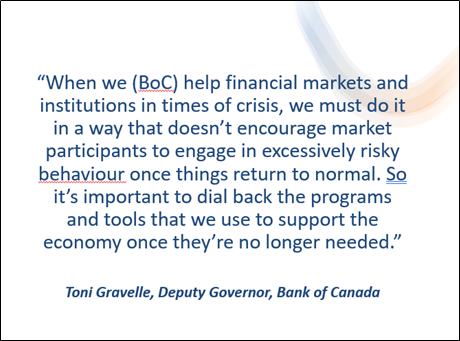
©Kalkine Group 2021
So, what is the Bank of Canada saying? Let’s find out.
Bank of Canada’s Liquidity Programs Roll-Back Plan
In its efforts to pump cash into the financial system amid the raging COVID-19 pandemic, the Bank of Canada introduced several liquidity programs which ended up inflating its balance sheet to C$ 575 billion, which was over four times its pre-COVID size.
As market conditions started reflecting signs of improvement in late 2020, the BoC began adjusting its liquidity programs around fall. Deputy Governor Gravelle noted that as some of its shorter-term loans matured, the central bank’s balance sheet expected to reduce to C$ 475 billion by April-end.
BoC’s Quantitative Easing Plans
In order to maintain the historic low key interest rates amid the pandemic, the Bank of Canada had to bulk up on its bond purchases from the federal government. As the economy strengthens, the bank plans to adjust the pace of its quantitative easing so that it can maintain, but no longer expand, the economic monetary stimulus.
The top lender expects the Canadian government bonds, at a value of roughly C$ 350 billion, to comprise more than 70 per cent of its balance sheet by the end of April.
‘Access To Debt Markets’
Mr Gravelle announced on Tuesday that asset purchase programs for provincial and corporate bonds as well as commercial paper will not be prolonged beyond their end dates. The deputy governor stressed that these “extraordinary facilities” are no longer necessary as borrowers can now gain unrestricted access to “fully functional debt markets”.
The top bank, however, noted that these programs will be reactivated in case market conditions worsen at any point.
What About Key Interest Rates?
While the support programs will soon discontinue, Mr Gravelle assured that the Bank of Canada does not foresee increasing its key interest rate from the current record low of 0.25 per cent until 2023.
