
 AUS
AUS
 NZ
NZ
 UK
UK
 CA
CA
 USA
USA
 IND
IND






Highlights
- Business investment inched higher during the December 2021 quarter, with buildings and structures taking the lead.
- The private new capital expenditure rose 1.1% during the December quarter.
- The lower-than-expected rise in capital expenditure may impact GDP forecasts.
The December 2021 quarter has been a turning point in Australia’s economic recovery from the pandemic. Improving statistics during the quarter have indicated the sheer resurgence of business activity and recuperating consumer confidence. The latest data released by the Australian Bureau of Statistics (ABS) showed a modest jump in business investment during the December 2021 quarter.
As per ABS, the total private capital expenditure stood at AU$33.3 billion in the last quarter, suggesting the resilience of local businesses. The private new capital expenditure rose 1.1% during the quarter and a massive 9.8% over the last year.
Good Read: Australia sees strong wage growth in December 2021 quarter
The large annual rise in business investment essentially marks a period of transition for the Australian economy as the country is finally emerging out of the pandemic-induced slowdown. However, the quarterly gain in business investment was weaker than anticipated for the economy.
As the economy advances into the new year with decent performance, several new measures are expected to take shape within the country, starting from interest rates. Though talks of an interest rate hike seem hasty at this stage, improving numbers seem to be steering the economy in the right direction.
Buildings and structures take the lead
The growth in expenditure on buildings and structures has been impressive over the last year. From December 2020 quarter, investment in buildings and structures has increased significantly by 11.2% in December 2021 quarter. The segment also posted a modest quarterly gain of 2.2% in the December quarter.
The significant rise in business and structure investment allowed the segment to reach closer to its pre-pandemic levels. The segment has seen rising investment since September 2020, with December quarter results observing private capital expenditure worth AU$17.45 billion in the segment.
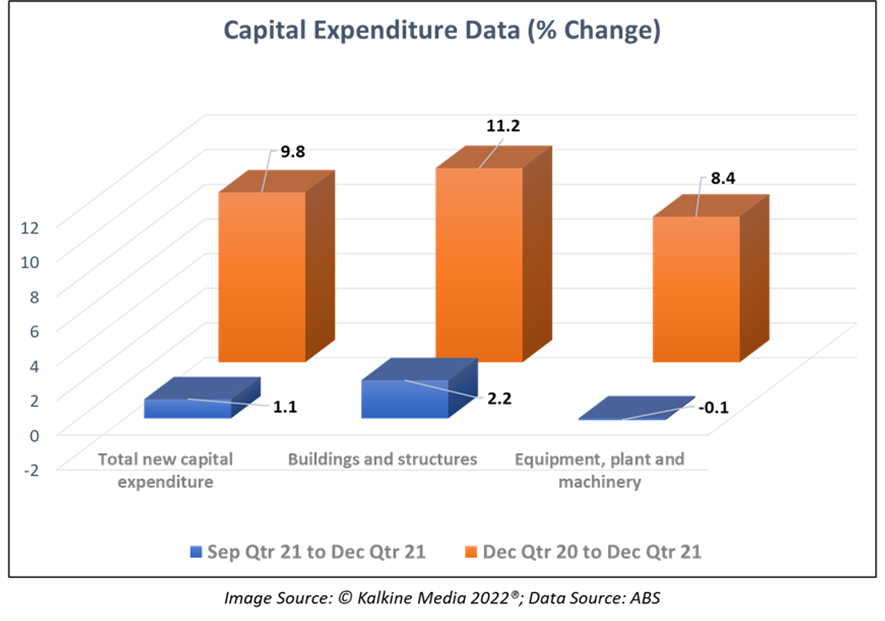
Alternatively, equipment, plant and machinery saw declining investment during the December quarter. The expenditure on equipment, plant and machinery fell by 0.1% on a quarter-on-quarter basis, while it posted a significant gain of 8.4% from the December 2020 quarter.
Must Read: Deciphering the impact of Russia-Ukraine crisis on Australian economy
The private capital expenditure in the equipment and machinery segment stood at AU$15.89 billion in the December quarter. Mining activities saw an increase in capital expenditure of 2.6%, while non-mining activities rose slightly by 0.5% during the December quarter.
A revision of estimates
ABS reported a revision in its total capital expenditure estimates for the 2022-23 period, with the new estimates being higher than the previous one. In terms of total private capital expenditure, firms intend to invest about AU$116.7 billion in 2022-23, which is 10.8% higher than the estimate for 2021-22.
The expenditure on buildings and structures is estimated to be AU$71 billion in 2022-23, which is 7.4% higher than the estimate for 2021-22. Moreover, the investment in equipment, plant and machinery is estimated to be AU$45.7 billion for 2022-23, which is 16.7% higher than the estimate for 2021-22.
Is the Australian economy on the brink of hyperinflation?
Interestingly, the expenditure on mining and non-mining activities has also been revised to AU$38.5 billion and AU$78.2 billion, respectively, for 2022-23. These are 5.7% and 13.5% higher than estimates for 2021-22, respectively.
Bottom Line
It is worth noting that the private capital expenditure data for the December 2021 quarter was lower than economists’ expectations. Thus, revisions might be made in the GDP forecasts for the period, which will be released next week.
Additionally, even as domestic developments are going strong, uncertainty on the international front can prompt obstructions in the coming months. Specifically, rising fuel prices and soaring demand for goods against a restricted supply may impact economic recovery in the coming months.
Interesting Read: How well does the Keynesian framework sit in the Australian economy?
