
 AUS
AUS
 NZ
NZ
 UK
UK
 CA
CA
 USA
USA
 IND
IND








Highlights
- Total dwelling approvals fell in January 2022, with private sector dwellings excluding houses leading the fall.
- The value of total approvals also declined, indicating a cool down in the red-hot property market.
- The balance on international goods and services increased by AU$4.06 billion in January 2022.
This morning, the Australian Bureau of Statistics (ABS) released dwelling approvals and international trade data for January 2022. While trade surplus improved in January, dwelling approvals took a sharp downturn during the month. According to the ABS, the number of total dwellings approved fell 27.9% in January, with private sector dwellings excluding houses observing a significant drop of 43.6%.
The steep downward turn in dwelling approvals came after a 9.8% rise in December. While non-residential buildings led to this decline, the approvals for private sector houses also plummeted sharply by 17.5% over the month. In December 2021, private sector houses demonstrated a slight decline of 0.3%. However, the January result brings the series closer to its historic levels, with the January outcome 0.8% higher than the pre-pandemic level in January 2020.
ALSO READ: No cash rate change for another month in Australia
Dwellings approved across states
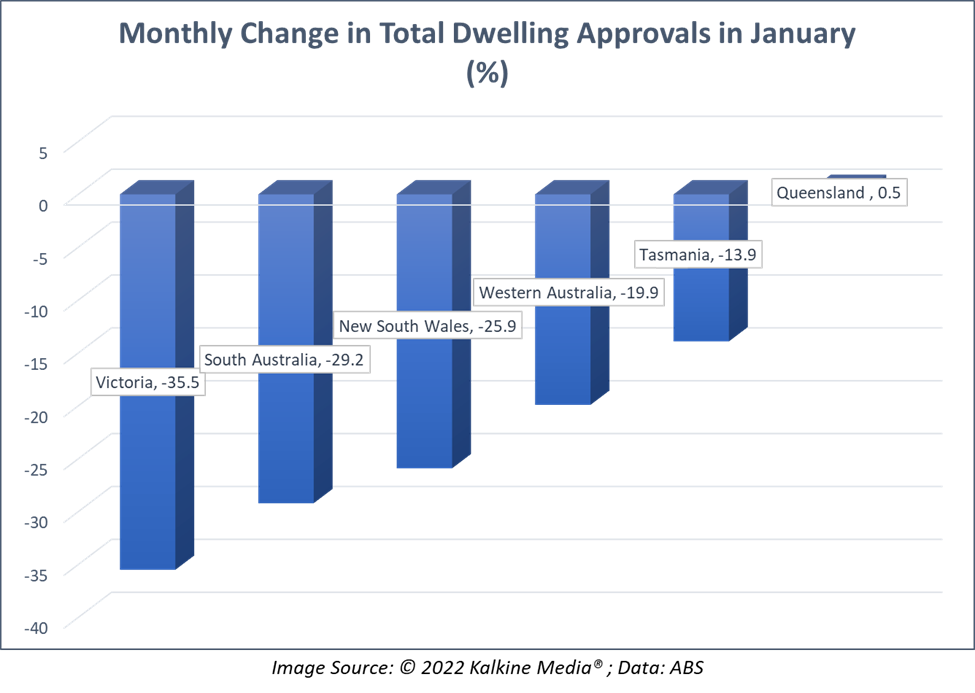
Most Australian states resonated with the national trend as they recorded a drop in total dwelling approvals during January 2022. Dwelling approvals fell 35.5% across Victoria, 29.2% in South Australia, 25.9% in New South Wales, 19.9% in Western Australia and 13.9% in Tasmania. Queensland was the only region where dwelling approvals rose 0.5%.
For private sector houses, approvals fell across all mainland states, with approvals in South Australia dropping by 19.9%, Victoria by 18.6%, Western Australia by 16.5%, Queensland by 15.7% and New South Wales by 14%.
ALSO READ: ABS update: Australia sees robust investor lending in January
The value of total buildings approved fell 27.7% in January, with non-residential building approvals leading to this decline. The value of non-residential buildings approved declined 36.8% during the month. This highlights the gradual yet slow return to lower price levels across non-residential real estate.
The value of dwelling approvals fell 22.8% for residential buildings, which included a 24.9% drop in the value of new residential housing. Also, the value of alterations and additions dropped by 10.3% in January.
What does international trade data say?
Along with dwelling approvals data, the ABS also released the balance on goods and services surplus for January 2022, which increased by AU$4.06 billion to AU$12.89 billion. The rise in surplus stemmed from rising exports, alongside slowly decreasing imports.
In January, the value of exports rose by AU$3.48 billion to AU$49.25 billion, primarily due to rising exports of metal ores and minerals. Meanwhile, the value of imports fell AU$581 million to AU$36.35 billion, majorly affected by a decline in telecommunications equipment and capital goods. This marked an 8% rise in the value of exports alongside a 2% fall in the value of imports.
What is meant by Balance of Trade?
Exports of goods were 9% higher in January 2022, compared to December 2021 on a seasonally adjusted basis. However, there was not much change in the services exports, which fell only marginally from AU$4.86 billion in December 2021 to AU$4.85 billion in January. Exports of travel and tourism services showed a decline of 1% each from December 2021 to January 2022.
Bottom Line
The recent decline in dwelling approvals highlights the imminent return of the real estate sector to normalcy, with demand gradually returning to pre-pandemic levels. Consequently, housing price growth has taken a hiatus by showing the first signs of a decline since 2020. Additionally, soaring prices of commodities and an overall increase in global demand has helped the Australian economy observe a large surplus in international trade of goods and services.
INTERESTING READ: Will industry-wide sanctions be able to cripple Russian economy?
