
 AUS
AUS
 NZ
NZ
 UK
UK
 CA
CA
 USA
USA
 IND
IND







Summary
- Bitcoin has fallen more than 15 per cent in the last 24 hours on Friday.
- The recent drop in bitcoin has apparently triggered a drop in other crypto assets as well.
It seems the trading in cryptocurrency market will remain uncertain unless and until it comes under a regulatory body or the crypto assets being exchanged on the platform are modulated by a government-controlled entity. Bitcoin, the most popular crypto asset, has retreated sharply in the last 24 hours following the marketwide plunge in the equities, currencies, oil, gold, other crypto assets including Ethereum.
Bitcoin slumps
According to the data available with Binance, bitcoin has fallen a little more than 15 per cent in the last 24 hours session to $28,800.19 from 24-hour high of $33,909.40. Bitcoin touching a low below $30,000 has once again raised the concerns of market participants dealing in the cryptocurrencies with a much anticipation of stabilisation in the crypto market.
With a 15-per cent drop in 24 hours, bitcoin is showing no signs of stabilisation as earlier predicted by several punters and market pundits. In the recent past, bitcoin has recorded a never-seen-before rally with the crypto asset ballooning to a record high of $42,000 apiece on 8 Jan.
Regulation fear
The uncertainty around the cryptocurrency market has apparently fallen due to the worries overregulating the decentralised framework.
This week itself, European Central Bank President Christine Lagarde called for a global regulation of bitcoin, while the current Federal Reserve Chairperson Janet Yellen cited her concerns over cryptocurrencies and has stated that cryptocurrencies can be utilised for financing illegal practices.
It is quite evident from the past that monetary malpractices among the systems and terror financing have been done via unlawful channels of black money siphoned through hard-to-trace routes. But with the digitisation of money, the regulatory bodies have imposed multiple checks on large-quantum withdrawals with the systems perpetually validating the source of big deposits.
With such a regime, it can be hard for people who are involved in monetary wrongdoings. The decentralised structure of the crypto asset market, far away from the sight of regulators, can be a potential means of conducting illegitimate and unauthorised transactions.
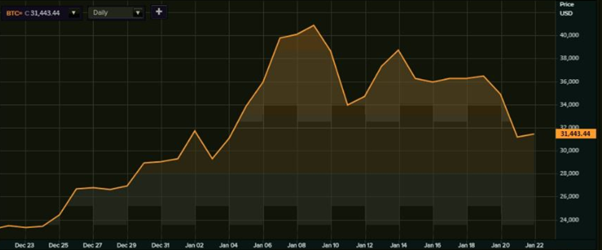
(Source: EODHD/Others, Thomson Reuters)
Crypto market witnesses ‘mini crash’
A substantial wipe-out in bitcoin has triggered a plunge in other cryptocurrencies as well including Litecoin, Ethereum, Ripple, Stellar and Chainlink. Now with the recent drop of more than 15 per cent, bitcoin is down 31.43 per cent from the all-time high of $42,000.18 recorded on 8 January last year.
In the last one-month bitcoin breached more than a dozen of psychological levels to reach at $42,000 from around $24,000 per unit. With the movement of cryptocurrencies hard to gauge, some irrationally inclined market participants predict the bitcoin can again bounce back after treading some ground that used to be the roof a year earlier.
Surprisingly, bitcoin is still trading at a premium of nearly 650 per cent, even if we consider the last 24-hour low as the numerator, from the yearly closing low of $3,850 apiece. Bitcoin recognised a low below $4,000 in March 2020 during the pandemic-induced crash.
At 0926 GMT, bitcoin staged a partial comeback but was still trading 5 per cent lower at around $31,440 per unit.
