
 AUS
AUS
 NZ
NZ
 UK
UK
 CA
CA
 USA
USA
 IND
IND






_01_22_2025_07_55_26_045637.jpg)

Summary
- Student loans can be obtained from the government or private lender.
- The student loan amount changes each academic years and grants are also offered to students with financial problems, disabilities, and others.
- The government student loans are often offered at low interest or subsidised rates.
Student Loan is a type of loan granted to students to help them finance their post-secondary education or Higher education related cost which includes tuition fees, books, supplies and living expenses. Its interest rate may be substantially lower, and the repayment period may defer than other loans. These loans can be obtained from the government or private lender. The government student loans are often offered at low interest rates or subsidised interest, while private student loans are offered at a typically higher interest than the government student loans.
The student loan amount in the UK changes each academic years and grants are also offered to students with financial problems, disabilities, children or dependent adults. The amount of monthly repayment of student loan depends how much the student earns, and it starts once the borrower earn a certain amount. The qualification for student loan depends upon that age, nationality, university or college, course and if student have studied a higher education course before.
STUDENT LOAN COMPANY
In the UK, student Loans are primarily provided by the government through the Student Loans Company (SLC). It is a non-profit government owned organization that provides Loans and Grants to college and universities students in the UK. SLC aims to help students to invest in their future and education by delivering reliable, transparent, flexible, and accessible student finance services. It provides maintenance loan and tuition fee loans higher education and further education.
It closely works with the Department for Education, Student Awards Agency for Scotland (SAAS), Education Authority for Northern Ireland (EANI), Higher education and Further education provider and other delivery partners. It is responsible for paying the loans for English, Welsh, Northern Irish, Scottish and European Union students.
Further, it manages account which includes adding interest, applying repayments collected through the UK tax system and refunding any over-repayment and also collects repayments from overseas re-payers.
HOW TO GET ONE
The process to avail loan for students living in England, Scotland, Wales, Northern Ireland, Isle of Man, and the Channel Islands (Jersey and Guernsey) are different.
The student living in England and studying in England can apply for loan to cover their tuition fees. For the academic year 2020/21, the maximum fee for full-time undergraduate course annually is £9,250.
If the student is living in Scotland and is eligible for loan, the tuition fees for the full-time first undergraduate course at publicly funded Scottish Higher Education Institutions (HEIs) are provided by the Student Awards Agency Scotland (SAAS) that is currently set at £1,820 and it is paid directly to HEI. The loan for tuition fees is not provided to postgraduate students and courses run by the private HEIs in Scotland. The loan for tuition fees in Wales is provided by the Student Finance Wales to students studying at a Regulated University. The maximum tuition fees charges for a full-time course are £9,000 in 2020/21.
The students living in Northern Ireland can apply for loan to cover their tuition fee through Student Finance Northern Ireland. The maximum tuition fee for 2020/21 for full time course is £4,395.
If the student lives in Scotland, Wales or Northern Ireland, taking full-time undergraduate course at publicly funded universities in England the maximum fee university can take is as similar to the student living in England.
Student Loan for English students
The English students can avail Tuition fee loan and maintenance loan. For the postgraduate and doctorate courses different support are given.
Student Loan for Scottish students
Full-time Undergraduate support
Students living in Scotland and EU students can avail for tuition fee loan through Student Awards Agency Scotland (SAAS) and it depend upon the mode of the study, like distance learning, full-time, part-time.
- Student taking full-time degree or equivalent from the publicly funded Scottish HEI- tuition fee contribution of £1,820.
- Higher National Certificate (HNC) and Higher National Diplomas (HND) courses from publicly funded Scottish HEI- Tuition fee contribution of £1,285.
- Higher Education course provided by private institutes in Scotland- Tuition fee contribution of £1,205.
- Student studying in the rest of the UK at publicly funded HEI- Tuition fee loan of maximum £9,250.
- Student taking accelerated degree course from publicly funded HEI in rest of the UK- Tuition fee loan of maximum £11,100.
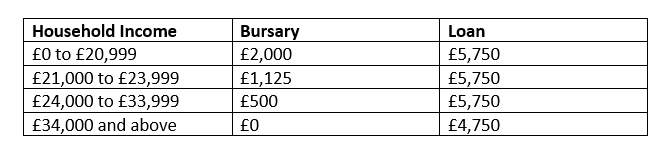
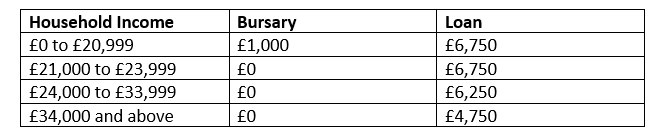
Depending upon household income the amount of Bursary and student Loan may depend.
For Young Students – single and under the age of 25 with no dependent children
Independent students over the age of 25
FOR PART-TIME STUDENTS
Depending on number of credits and the course, Scottish domiciled students can apply for part-time fee grant (PTFG) to pay their tuition fee. The maximum grant students taking course from publicly funded university/colleges is £1,805, 120 eligible credit university courses which are not campus based is £1,820, £1,274 for publicly funded Higher National awards and £1,195 for all courses at private providers.
POSTGRADUATE STUDENTS
Student living in Scotland and taking any postgraduate course, including distance learning and part-time course, can avail for tuition loan of maximum £5,500 and living cost loan of maximum £4,500 through Student Award Agency Scotland (SAAS). If no equivalent course is available at an institute in Scotland, then full-time course provided outside Scotland is eligible and no loan is provided for Research Masters and PhD courses.
OTHER FUNDINGS
Depending on the financial condition of a student, they can avail for other fundings, such as living cost grants for lone parents and those with adult dependents, bursary, and grant for full-time students under 26 years who have been looked after by local authority, disabled students’ allowance and Discretionary funds for student in financial difficulties.
STUDENT LOAN FOR WELSH STUDENTS
LIVING COST
Welsh students can avail for grants and loans taking first time full and part-time under graduation, this amount depend upon student’s household’s income and where the student is living during term time.
LIVING WITH YOUR PARENTS
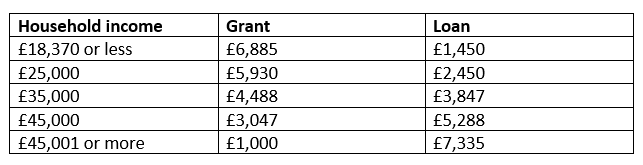
LIVING AWAY FROM HOME AND STUDYING OUTSIDE LONDON
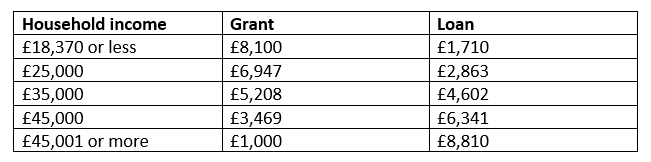
LIVING AWAY FROM HOME AND STUDYING IN LONDON
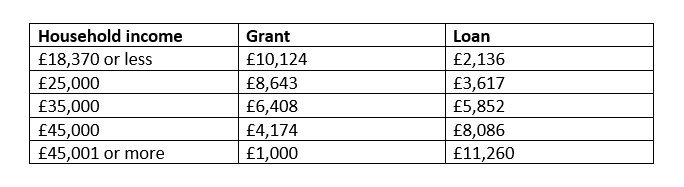
POSTGRADUATE STUDENTS
Postgraduate students starting course after 1 August 2020 can avail financial support that will depend upon household income. However, the maximum support can be availed by student is £17,489 as a combination of grant and loan. Postgraduate students starting course after 1 August 2019 can avail for the maximum support can be avail by student is £17,000 as a combination of grant and loan.
TUITION FEE LOAN
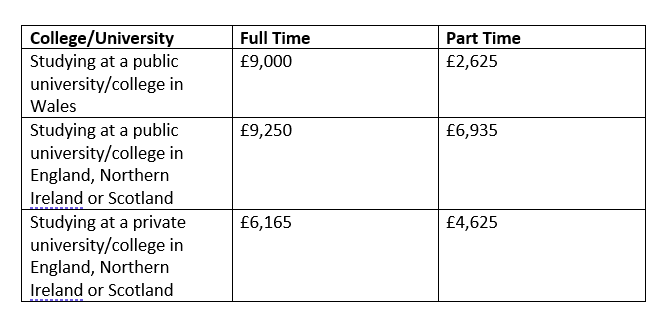
Other financial support is also provided to the students having children, dependents, or disabled students.
STUDENT LOAN FOR NORTHERN IRELAND STUDENTS
Two types of non-repayment financial support of which only one grants can be provided depending upon household income are provided to the Northern Ireland students studying in UK, that include Maintenance Grant and Special Support Grant. Student can avail for both grants for student loan. Both grants give same amount but maintenance grant gets reduced.
SPECIAL SUPPORT GRANT
This amount is paid at the top of the student loan, which is not repayable and is not counted as income. If the borrower is a single parent, has a partner who is also a student or have a disability or learning difficulties this grant can be availed.

MAINTENANCE GRANT

This Maintenance grant replaces part of the student loan. So, if the student received the full £3,475 grant, he or she will receive £3,475 less in Loan.
REPAYMENT OF LOAN
Students who have taken loan in England or Wales after September 2012 must repay once the student starts earning £26,575+ a year.
Students taken Loan in Scotland have to repay once they start earning £18,330 a year and in Northern Ireland when student starts earning more than £18,935 a year. If the student is self-employed then repayment will be made through self-assessment tax return and if the student did not make any payment in full 30 years after first payment, then the remaining balance will be written off.
