
 AUS
AUS
 NZ
NZ
 UK
UK
 CA
CA
 USA
USA
 IND
IND








The trading education industry has expanded rapidly over the past decade, yet most retail traders still struggle to reach consistent profitability. Industry risk research shows that a large portion of retail trading accounts lose money. That gap between the volume of available education and the actual outcomes deserves a closer look. The problem is rarely intelligence, capital, or effort. More often, it is the educational model itself.
Static video libraries have dominated this category for years. A growing number of programs, however, now develop traders very differently. Among the more visible examples, the WR Trading course and mentorship are built around live coaching, individual trade reviews, and a progression structure based on demonstrated competence. Examining what distinguishes these two models reveals why one consistently outperforms the other in producing real traders.
Why Do Most Trading Courses Fail to Produce Profitable Traders?
The dominant model in retail trading education is the video library. A new student pays for access, receives a series of recorded lessons, and works through them at their own pace. The format scales beautifully for the seller, yet the outcome for buyers tends to be disappointing.
Several structural weaknesses are responsible for this. To begin with, recorded content cannot adapt to the learner. It cannot see when someone misunderstands a concept, applies a setup incorrectly, or misjudges market context. Furthermore, the absence of accountability allows students to drift, postpone practice, and quietly stop engaging without consequence.
A second weakness becomes obvious once a student tries to apply what they have learned. Trading involves split-second judgment under uncertainty, and that judgment cannot form simply by watching someone else exercise it. Skill develops through corrected attempts rather than passive observation, which is why the typical course graduate often freezes the moment real money is on the line.
Common shortcomings of the standard course model include the following:
- Content delivered in one direction, with no real interaction
- Generic examples that never reflect the learner's specific mistakes
- No mechanism for measuring progress or readiness for live trading
- Limited or recorded community access, which removes real-time discussion
- Pricing structures that reward enrollment, not student outcomes.
Consequently, most courses produce graduates who can describe trading concepts but cannot execute them under live conditions. Knowing what a head-and-shoulders pattern looks like is not the same as trading it profitably when markets move fast. That gap is where most retail traders lose money.
Why Feedback Loops Matter More Than Content Volume
If recorded content is the wrong vehicle, what works instead? The answer lies in how human beings actually acquire complex skills. Decades of research on expert performance point to one consistent factor, which is deliberate practice with corrective feedback.
Lessons from Other Skill Domains
Almost every field that produces consistent professionals relies on the same model. For instance, chess grandmasters work with coaches who review individual games and challenge specific decisions. Likewise, surgical residents perform supervised procedures and receive structured feedback after each one. Musicians who reach a professional level almost always train under teachers who correct posture, timing, and technique in real time.
In each case, content alone is freely available. Books, recordings, and online tutorials are everywhere. Yet experts in these fields still pay for coaching because passive consumption does not develop precise execution. Feedback closes the loop between intention and result.
Translating This to Trading
Trading rewards the same kind of structured development. Pattern recognition, risk sizing, emotional control, and trade execution all improve through corrected repetition. A student who places 50 trades and reviews each one with an experienced trader develops faster than a student who watches 50 hours of video.
Moreover, real feedback prevents the costly habit of reinforcing flawed behavior. Without correction, a trader can spend years repeating the same mistake and calling it experience. With feedback, those mistakes become teaching moments rather than recurring losses.
Coaching through Real Market Conditions
Markets do not behave like textbook examples. They surge, stall, gap, and reverse for reasons that often defy clean technical patterns. As a result, education built only on past charts misses the most important part of trader development, which is decision-making under live pressure.
Consider how seasonal narratives are challenged once data is examined carefully. Conventional ideas like the sell in May effect often turn out to be unreliable when tested against long-term market behavior. A trader who learns only the popular version of these patterns is poorly prepared for moments when markets behave differently. A coach, by contrast, can walk the trader through what is actually happening in real time and explain why the textbook expectation has failed.
Beyond pattern interpretation, a coach also helps with sequencing decisions. For example, when a session opens with a gap and immediately reverses, the right action is rarely written down in any course. The decision depends on volume, the prior session's structure, the broader index move, and the size of the trader's existing positions. A mentor can bring all those threads together in real time, which is something a static lesson cannot replicate.
Live coaching adds three things that recorded courses cannot:
- Real-time interpretation of evolving price action and order flow
- Direct review of the trader's own decisions, not generic ones
- Calibration of risk and position sizing under current market conditions.
Therefore, the value of mentorship is highest precisely in moments when the market is unpredictable. Those are the moments that decide whether a retail trader survives or quits.
What Real Mentorship Actually Includes
The word mentorship is used loosely across the industry, often as a marketing label for what is really still a course. To distinguish genuine coaching, it helps to look at the structural components that separate the two models.
Comparing the Two Models Side by Side
The table below summarizes the practical differences between a typical course and a real mentorship.
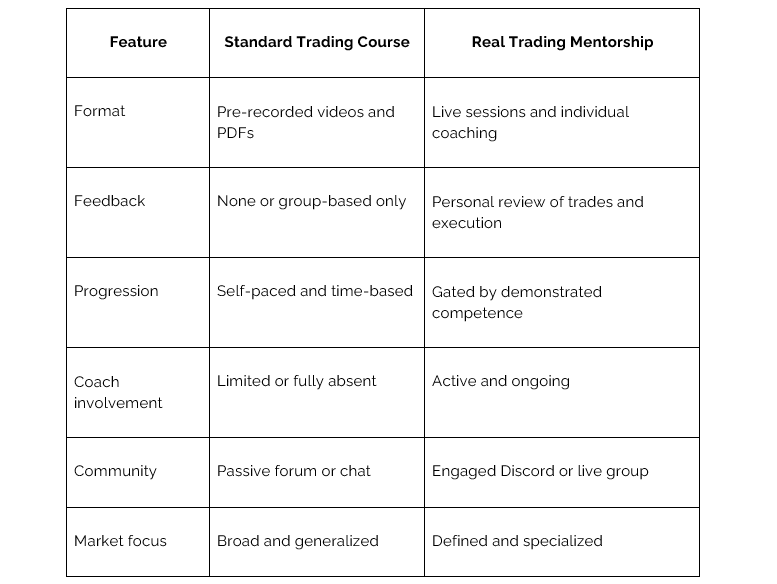
Core Components of Genuine Coaching
A clear example of how this applies is the case of a trader learning to read intraday S&P 500 movement during an active session. A static course can describe what to look for, but only a live coach can sit alongside the trader as price action develops, point out the cues that matter, and ignore the noise that does not.
In addition, genuine mentorship typically involves these elements:
- Named coaches with publicly traceable trading records
- Structured phases that move from chart reading to demo trading to live execution
- Individual review of executed trades, not just hypothetical setups
- Live webinars during real market hours rather than pre-recorded sessions
- Defined market focus, often a few highly liquid instruments rather than dozens.
Each of these elements addresses a specific weakness in the standard course model. Named coaches restore accountability, structured phases prevent traders from going live too early, and individual reviews catch the repeated errors that no recorded course can identify.
Notably, this is the model used by some of the more credible programs in the trading education space today. WR Trading, for instance, runs its mentorship. Their structure progresses from pure chart reading through an extended demo phase before any live capital is committed, with live webinars and Discord-based community support throughout the journey.
What Should You Look for in a Trading Mentor?
Choosing a mentor is one of the most consequential decisions a developing trader can make. The wrong choice can waste years and significant capital. The right one can compress the learning curve dramatically. As a result, the evaluation deserves careful thought.
The following criteria provide a useful starting point:
- The coaches are named individuals with public trading histories, not anonymous brand voices
- The program defines a specific market focus rather than promising mastery of every instrument
- Progression is structured and gated by competence, not unlocked simply by paying for the next tier
- Individual feedback on actual trades is part of the offering, not an optional add-on
- Live components exist during real market sessions, not only in recorded form
- The community involves active traders, not just other beginners cycling through the material
- Risk management and trading psychology are treated as core curriculum, not afterthoughts.
A short evaluation framework can also help compare offerings side by side.
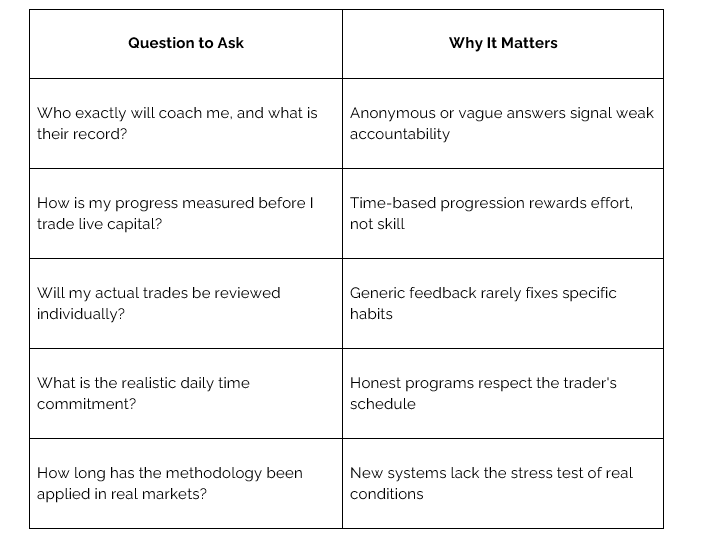
Above all, beware of programs that emphasize lifestyle imagery and aspirational marketing more than the actual structure of the education. Serious traders are built quietly, through structured repetition and honest feedback, not through promotional content.
The Bottom Line for Aspiring Traders
The high failure rate among retail traders is not a mystery. It is a predictable outcome of an education model that prioritizes content delivery over coached development. Static courses can introduce concepts, define terms, and outline strategies. They cannot, however, build the judgment that separates traders who survive from those who do not.
Genuine mentorship works because it changes what the learner is actually doing. Instead of consuming information, the trader practices, receives feedback, makes adjustments, and practices again. Over time, this loop produces the skill that no amount of video can deliver. That difference is exactly why real coaching exists in chess, music, surgery, and every other field where consistent execution matters.
For anyone serious about trading, the lesson is straightforward. Look past the marketing language and examine the structure of what is being offered. Ask who the coaches are, how progress is measured, and what kind of feedback is included. A course can teach you to recognize trading patterns. Only a mentor can teach you to trade them well, which is the foundation of building consistent results in any market.
The content has been authored in collaboration with our guest contributor, Evelyn Carter.
