
 AUS
AUS
 NZ
NZ
 UK
UK
 CA
CA
 USA
USA
 IND
IND








There are over 150 currencies in the world, but the pairs they form don’t move independently. Global economies are deeply interconnected, as countries trade with one another and investors move capital across markets.
If you understand the correlation between Forex pairs, you can respond proactively to unexpected market shocks or scheduled events. You can incorporate this factor into your trading strategy by opening positions on multiple pairs from the same Forex trading platform.
Currency correlations are not static — they shift alongside macroeconomic cycles, central bank policy divergence, and geopolitical realignments. According to the Bank for International Settlements' 2025 Triennial Survey, the US dollar was present on one side of 89% of all FX trades in April 2025,
You’re about to discover what pairs are closely related and how to benefit from that.
What Is Correlation in Forex?
In Forex, correlation refers to the relationship between two currency pairs, which can be positive, negative, or neutral. Note that negative doesn’t mean the pairs have no correlation at all.
Sometimes two pairs can have no distinguishable relationship at all, but in reality, any two pairs usually have at least some level of correlation.
In the case of a positive correlation, the two currency pairs move in the same direction. If there is a negative correlation, or inverse correlation, then the pairs move in opposite directions.
Traders use the so-called correlation coefficient, which ranges from 1 to -1. Here, 0 means no correlation, 1 means identical movements, while -1 suggests the pairs move identically but in opposite directions.
We can observe a situation of perfect positive correlation when the quote currency of one pair is pegged to the quote currency of the other pair. Elsewhere, a perfect negative correlation can be seen when the base currency of one pair is pegged to the quote currency of the other pair.
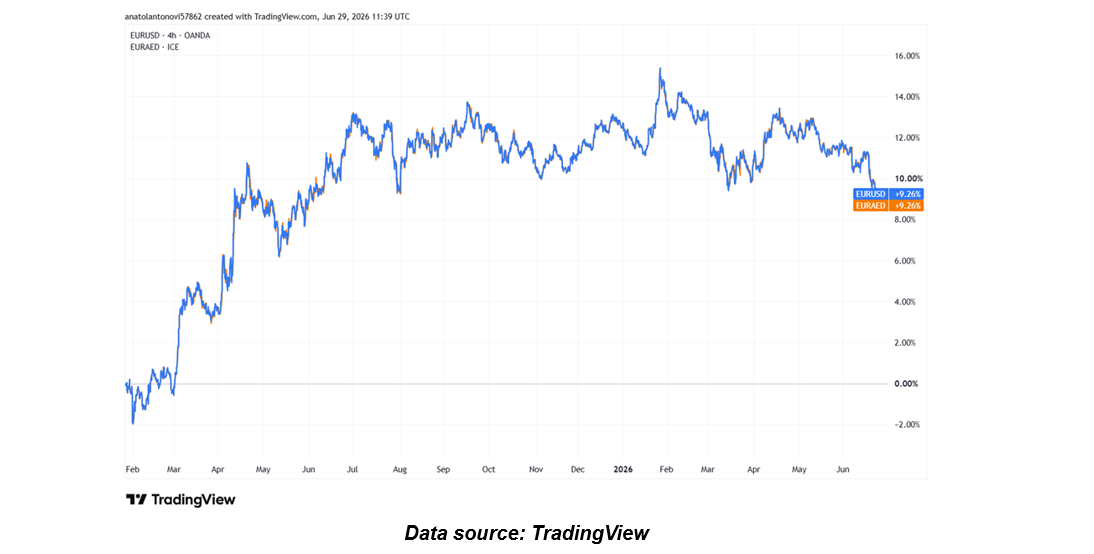
For example, EUR/USD and EUR/AED move in tandem because the price of AED is pegged to USD.
Which Pairs Show Correlation?
If we don’t count situations where currencies are pegged to other currencies, two Forex pairs can be highly correlated when their components represent countries with close economic ties.
For example, EUR/USD shows a positive correlation with GBP/USD because the euro and the British pound are closely related due to the economic ties between the European Union and the U.K. The two economies also share geographic proximity, and both have the status of major currencies.
As mentioned earlier, the correlation coefficient between the same two pairs may differ depending on the timeframe used and the tracked period - it’s not static.
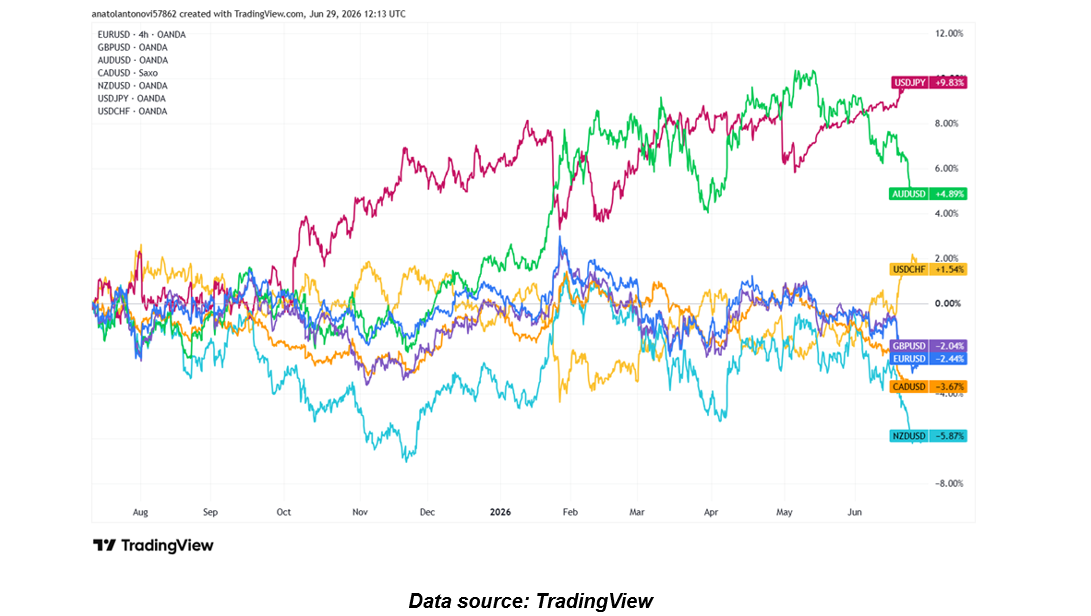
Here is the performance of the Forex majors since July 2025:
What Factors Drive Currency Correlation?
As mentioned in the intro, economies are deeply tied, especially as globalization has touched upon all layers of the economy.
This is the most important factor, and this is why economies tied to certain resources show correlation.
For example, CAD and NOK, the currencies of the Canadian dollar and the Norwegian Krone, are closely related to the price of oil futures.
Elsewhere, the Australian dollar has been closely related to the price of gold, since Australia is a major net exporter of the precious metal.
Why Should I Care about Correlation?
Ignoring the correlation between forex pairs can put you in a situation where you go long on two pairs showing a negative correlation, in which case the profit of one position will be offset by the loss in the other one. Thus, understanding this aspect can make a difference in your trading journey by helping you combine profitable positions or hedge your existing positions to better control risk during market volatility.
With understanding correlation, you can amplify gains by identifying two pairs that move closely with each other and open two of the same positions, e.g., long or short. You can also amplify profits by opening two different positions, a long and a short, on pairs that show negative correlation.
Another approach is to use correlations to hedge your risk on existing positions. For example, if you’re long on EUR/USD and the price goes against your prediction, you can go long on USD/CHF, which is negatively correlated and can offset part of the loss caused by the potential decline in EUR/USD.
Whether you plan to use correlation strategies or not, you have to know how the major pairs relate to each other because otherwise, you can end up trading against the trend.
The content has been authored in collaboration with our guest contributor, Daniela.
