
 AUS
AUS
 NZ
NZ
 UK
UK
 CA
CA
 USA
USA
 IND
IND







Institutional participation in digital asset markets has expanded significantly over the past few years, with major financial firms increasingly exploring different blockchain-based assets and infrastructure. Rather than focusing on a single cryptocurrency, many institutional strategies now consider a range of digital assets that serve different roles within the broader ecosystem.
Large-cap cryptocurrencies such as Bitcoin and Ethereum etc often receive the most attention due to their market size and liquidity. However, institutional interest typically reflects broader market developments, including regulated investment vehicles, tokenised financial products, and blockchain-based settlement systems. Investors should note that references to cryptocurrencies are for informational purposes only and do not constitute a recommendation, endorsement, or solicitation to invest in any digital asset.
Market Movements Reflect Broader Risk Sentiment
Digital assets experienced notable volatility in early 2026, reflecting broader movements in global financial markets.
Bitcoin declined roughly 7.04% year-to-date and is trading near $81, 261 (May 12, 2026), while Ethereum recorded a steeper decline of approximately 22.08% during the same period, trading near $2,312.06.
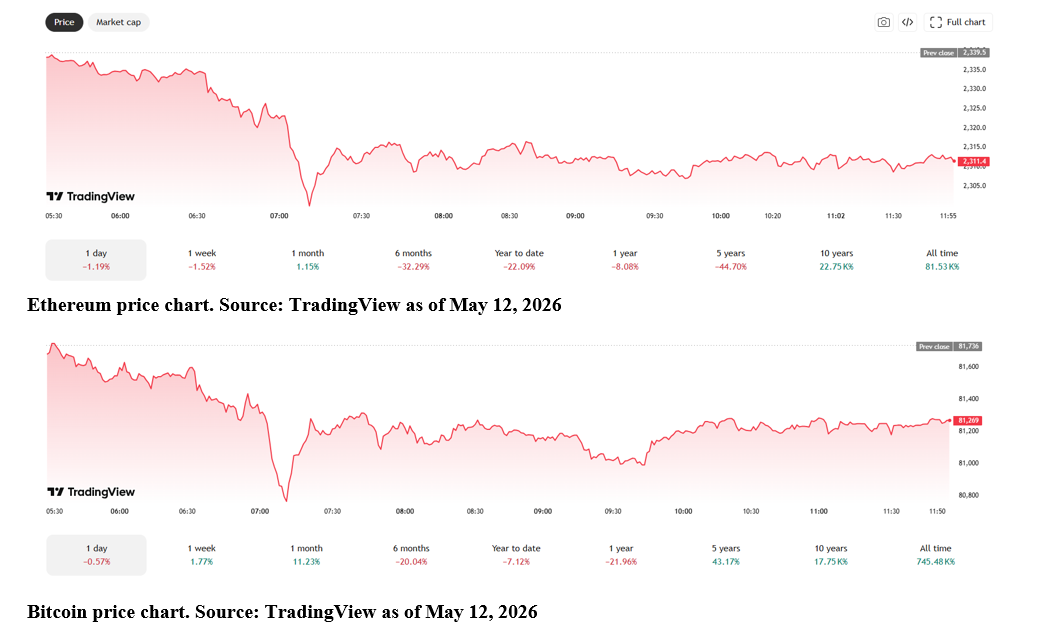
However, these movements have not occurred in isolation. Many risk-oriented assets across global markets have experienced periods of volatility as investors reassess macroeconomic conditions, interest rate expectations, and liquidity trends. As a result, price fluctuations within the digital asset sector often mirror broader shifts in investor sentiment. The broader market leaves them hedging their assets in the digital asset sphere, so we’ll never know.
Growing Interest in Tokenised Financial Infrastructure
Over the past year, financial institutions have increasingly explored blockchain networks as infrastructure for issuing and managing tokenised financial instruments.
Tokenised money market funds, stablecoins, and other blockchain-based financial products have continued to develop as part of broader experimentation with distributed ledger technology. Some of these initiatives have been launched by large financial institutions seeking to test the efficiency of blockchain-based settlement and asset management processes.
Infrastructure providers and regulated transfer agents have also played an important role in enabling tokenised asset issuance by integrating compliance tools and regulatory reporting mechanisms into blockchain-based financial products. Any reference to such products or initiatives is provided solely for informational and educational purposes and should not be interpreted as an endorsement, recommendation, or invitation to participate or invest.
Regulated Investment Vehicles Continue to Expand
Institutional exposure to digital assets has also grown through regulated investment products such as exchange-traded funds (ETFs), structured products, and derivatives markets.
In particular, spot cryptocurrency ETFs introduced in several jurisdictions have allowed asset managers, pension funds, and wealth advisers to gain exposure to digital assets without directly holding the underlying tokens. These products typically rely on regulated custodians and established market infrastructure, which can reduce operational and compliance challenges for traditional financial institutions. Investments and participation in blockchain-based financial products and digital assets involve significant risks, including regulatory uncertainty, market volatility, technological vulnerabilities, and the potential loss of capital.
Derivatives markets have also expanded, with trading activity increasingly concentrated on regulated exchanges offering futures and options contracts linked to major digital assets.
Digital Assets Serving Different Institutional Roles
As institutional engagement evolves, different digital assets are increasingly associated with different use cases within financial markets.
Some cryptocurrencies are primarily viewed as macro-allocation assets due to their liquidity and limited supply models, while others are being explored as programmable platforms that support tokenised financial products and blockchain-based settlement systems.
These distinctions reflect structural differences in blockchain design and functionality rather than direct competition between individual cryptocurrencies. Institutional investment decisions therefore, often depend on the specific objective, whether that involves portfolio diversification, technological experimentation,
Institutional Adoption Continues to Develop
Overall, institutional involvement in the digital asset sector has expanded beyond speculative trading into areas such as regulated investment products, custody services, derivatives markets, and tokenised financial instruments.
While price movements and market cycles remain a defining characteristic of the sector, the long-term trajectory of institutional participation is increasingly tied to infrastructure development, regulatory clarity, and the integration of blockchain technology within traditional financial systems.
The content has been authored in collaboration with our guest contributor, Amy Wilson.
Risk Disclosure: Trading in cryptocurrencies involves high risks including the risk of losing some, or all, of your investment amount, and may not be suitable for all investors. Prices of cryptocurrencies are extremely volatile and may be affected by external factors such as financial, regulatory, or political events. The laws that apply to crypto products (and how a particular crypto product is regulated) may change. Before deciding to trade in financial instrument or cryptocurrencies you should be fully informed of the risks and costs associated with trading in the financial markets, carefully consider your investment objectives, level of experience, and risk appetite, and seek professional advice where needed. Kalkine Media cannot and does not represent or guarantee that any of the information/data available here is accurate, reliable, current, complete or appropriate for your needs. Kalkine Media does not guarantee the completeness, timeliness, or reliability of the information provided, including content sourced from third-party websites. Kalkine Media will not accept liability for any loss or damage as a result of your trading or your reliance on the information shared on this website.
