
 AUS
AUS
 NZ
NZ
 UK
UK
 CA
CA
 USA
USA
 IND
IND








India’s taxpayer base has expanded rapidly over the past decade, reflecting a more digitally connected economy. For FY 2024–25, a total of 9.19 crore income tax returns were filed. This rise in the taxpayer base reflects both stronger enforcement and a steady move of the economy towards formal, trackable income. This blog explains the latest taxpayer numbers, the main types and categories of taxpayers, and what these patterns reveal about India’s tax system.
Taxpayers Over the Years
- The official data shows that income tax return (ITR) filing has reached new highs in the last few years. For Assessment Year (AY) 2023–24, more than 8.18 crore ITRs were filed, and by 31 July 2024, over 7.28 crore ITRs had already been filed for AY 2024–25, indicating that annual filing is stabilising in a band of about 7–9 crore returns.
- When discussing how many taxpayers exist, there is a useful difference between those who are merely registered and those who are active filers in a particular year.
- A registered taxpayer is usually someone who holds a Permanent Account Number (PAN) or is otherwise on the tax department’s records, while an active taxpayer is someone who either pays tax or files a return for that assessment year.
- Many individuals file returns even when their final tax liability is zero because they want to claim refunds, report exempt income, or keep their financial history clean for future loans and investments.
- Government measures such as faster e-verification, pre-filled forms and a more user-friendly portal have made filing simpler, which encourages more people and small businesses to come into the system for the first time.
Main Types of Taxpayers in India
Indian tax law does not treat all taxpayers as one uniform category; instead, it defines specific “persons” for tax purposes. These legal categories help the Income-tax Act apply appropriate rules to each group.
Key types of taxpayers include:
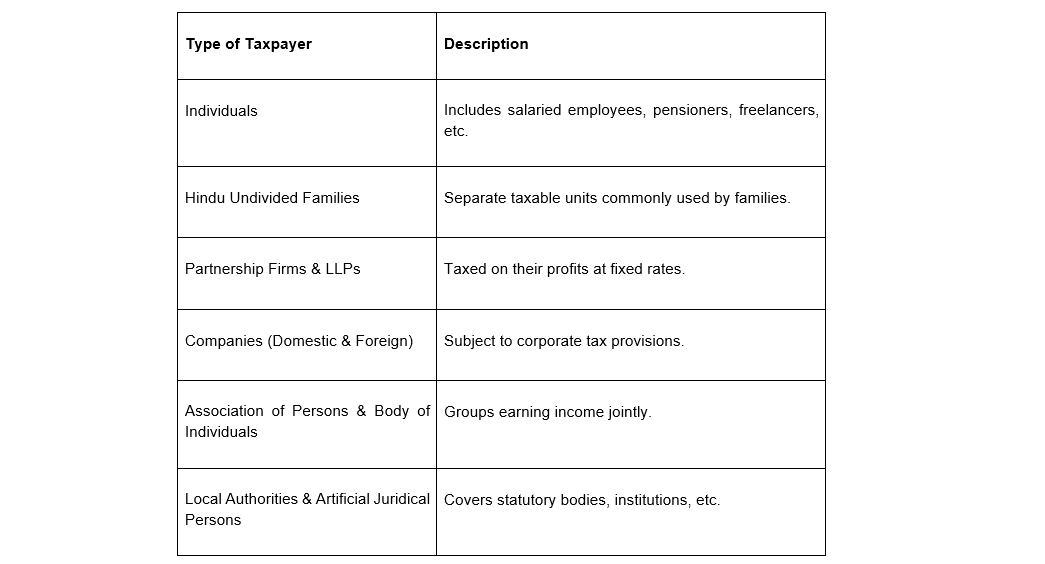
Educational and compliance materials frequently use the phrase ‘types of taxpayers’ to explain how these categories differ in terms of applicable rates, deductions and documentation. Although the law recognises all of them, most of the growth in filing volumes over the last decade has come from individual taxpayers, who account for the bulk of ITRs each year.
Slabs, Regimes and Tax Calculation
For individual taxpayers, the amount of tax finally payable depends mainly on annual income, the tax regime chosen and eligibility for deductions and exemptions. While income tax does not directly depend on a person’s CIBIL score, maintaining a strong credit profile often helps taxpayers plan finances more efficiently and stay disciplined with repayments, both of which influence how they approach tax-saving investments. Tax is computed using progressive income tax slabs under either the old regime or the new regime, each with its own slab structure and rules.
- Since AY 2024–25, the new regime has been made the default for individuals, HUFs, AOPs, BOIs and some other non-corporate taxpayers, although they may still opt for the old regime if that results in lower tax.
- Understanding the layout of income tax slabs and the basic steps of income tax calculation helps taxpayers estimate their liability more accurately and make informed choices on investments, savings and declarations.
- For companies and certain specialised entities, separate concessional tax regimes have been introduced in recent years to simplify the structure and encourage fresh investment in manufacturing and other priority sectors.
- These regimes coexist with the regular provisions, so businesses often evaluate both options before deciding which route to follow for a particular financial year.
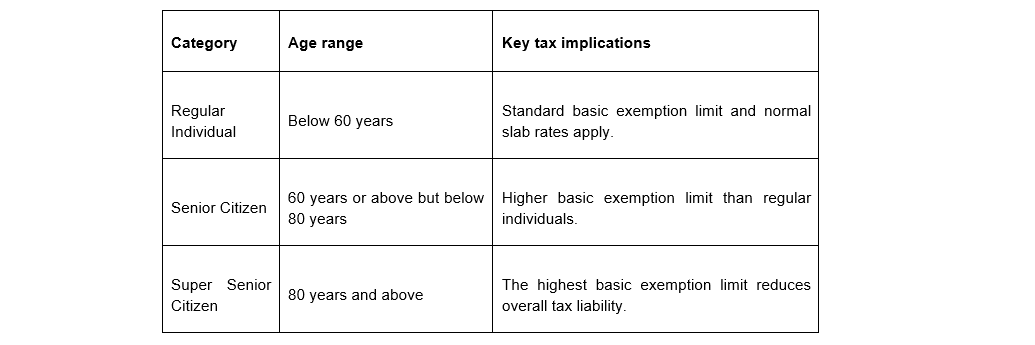
Age-wise Classification of Individual Taxpayers
India has a progressive tax system. Here is a representation of the types of taxpayers based on age –
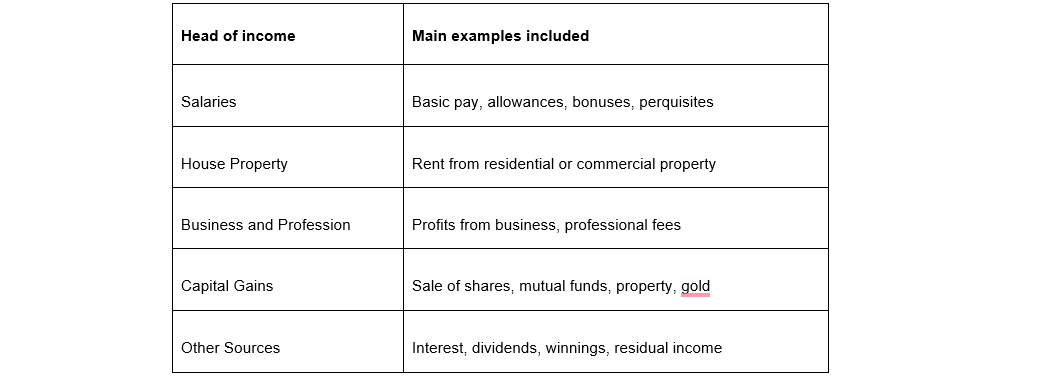
Here are the five heads of income under the Income-Tax Act –
As more people use digital payments, formal banking channels and documented employment contracts, their incomes naturally become visible to the tax system, which in turn adds to the number of recognised taxpayers year after year.
Wrapping Up
The steady rise in the number of taxpayers is the result of several long-term policy and technology changes. Over the past decade, the government has focused on widening the tax net through monitoring of high-value transactions and better use of data analytics to identify potential non-filers.
FAQs
How many income taxpayers are there in India right now?
Around 8–9 crore returns are filed annually, though exact figures change each year as filings are updated.
Who is treated as a taxpayer under the Income-tax Act?
Any person or entity with taxable income above the basic exemption limit, or who is otherwise required to file a return, is treated as a taxpayer under the Act.
Why is India’s taxpayer base increasing every year?
Digital filing and improved enforcement have encouraged more individuals to file returns regularly.
The content has been authored in collaboration with our guest contributor, Sharat K.
