
 AUS
AUS
 NZ
NZ
 UK
UK
 CA
CA
 USA
USA
 IND
IND








Highlights
- A Canadian auto parts supplier's consolidated sales grew 10.7 per cent year-over-year in Q1 2022
- This TSX auto stock gained by approximately 34 per cent year-to-date
- The TSX benchmark Index dipped by over 13 per cent this year
The Canadian stock market seems to have slipped into a selloff mode following the Bank of Canada (BoC)’s decision to raise interest rates to 2.5 per cent on July 14. Although the TSX main equity index scaled by 1.09 per cent on Monday, July 18, from a record low seen last week, it remains in the red territory on a year-to-date (YTD) basis.
But while concerns around further interest rate hikes and a possible recession prevail, some investors are on the lookout for hidden stocks that are soaring despite market uncertainties. One such TSX player is a Canadian consumer company that saw its stock price skyrocket by nearly 143 per cent in a year.
This auto parts enterprise operates a distribution network of automotive products, including automotive refinish, industrial coatings and related products across Canada, the United Kingdom and 33 states in the United States. Founded in 1968, this company also has an aftermarket parts business and holds a network of 15 distribution centres and over 390 corporate stores.
Notably, the TSX-listed auto stock has outperformed the TSX benchmark Index, which dipped by over 13 per cent this year, with a gain of approximately 34 per cent YTD.
We are talking about Quebec-headquartered company Uni-Select (TSX:UNS), which seems to reflect a sturdy financial and overall stock performance.
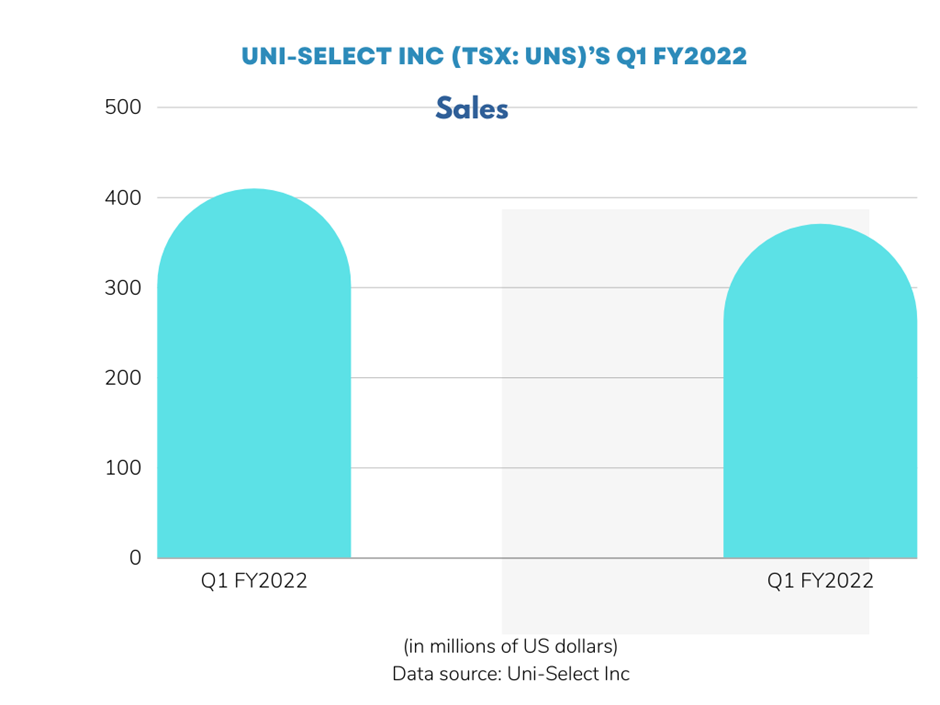
Uni-Select Inc (TSX:UNS) recorded a double-digit surge in sales in Q1 FY2022
The Boucherville-based auto part supplier recorded double-digit organic growth of 11.6 per cent from all its three segments leading to an increased consolidated sales of US$ 409.6 million in Q1 2022. The smallcap company said sales in the latest quarter represented a year-over-year (YoY) surge of 10.7 per cent.
Uni-Select noted EBITDA of US$ 28.2 million in the first three months of 2022, marking a YoY jump of 14.6 per cent, helped by gross margins and other adjustments.
The C$ 1.5-billion market cap firm posted a growing net profit of US$ 7.73 million in Q1 2022, which was significantly higher than US$ 0.21 million a year ago. Free cash flow also amounted to US$ 1.91 million in Q1 2022 as against a loss of US$ 6.15 million in Q1 2021.
©Kalkine Media®; ©Garis Studio via Canva.com
The vehicles and parts company reduced its total net debt by 56.2 million in Q1 2022. The company said that ‘strong’ operating results drove its Total net debt-to-adjusted EBITDA ratio down to 2.02.
Uni-Select saw its stock catapult by 143 per cent in a year
Stocks of Uni-Select surged by over three per cent to close at C$ 34.5 on Friday, July 14. On Monday, the auto stock jumped by another two per cent to end the session at C$ 35.21 apiece and was ranked among the top price performers and top consumer stocks on the TSX.
According to its data on EODHD/Others, UNS stock appears to be on an upward trajectory at the moment, with the Moving Average Convergence Divergence (MACD) indicator rising above the base line and heading upward. Uni-Select stock, as per the data, recorded a Relative Strength Index (RSI) value of 77.47, supported by volume in the green on Friday, July 14, signalling an overbought market situation.
Where does Uni-Select stock stand?
Uni-Select has said that it expects an improvement in sales and profitability this year as compared to its performance in 2021. Notably, the auto part company added that a large part of this projected improvement is expected to take place in the first half of this year due to the timing of certain rebates.
Uni-Select had a debt-to-equity (D/E) ratio of 0.87 as of writing this. The D/E ratio of less than one generally indicates relatively less financial risk. Hence, investors aiming for growth exposure and moderate risk could explore this under-C$ 35 if they are aiming for a long-term value.
Please note, the above content constitutes a very preliminary observation based on the industry, and is of limited scope without any in-depth fundamental valuation or technical analysis. Any interest in stocks or sectors should be thoroughly evaluated taking into consideration the associated risks.
