
 AUS
AUS
 NZ
NZ
 UK
UK
 CA
CA
 USA
USA
 IND
IND


.png)





Canada's main stock index declined on Wednesday, December 8, to 21,077.35. The S&P/TSX Composite Index was down by 85.3 points, 0.4 per cent.
The decline came after surging 2.6 per cent in the first two days of the week. The technology sector continued to pressure the main stock index and fell by 2.2 per cent.
The market had opened lower as investors were waiting for the Bank of Canada's (BoC) decision and it has kept the borrowing costs unchanged. However, the central bank expressed worries over inflation and this could mean that the BoC may increase the interest rate in future.
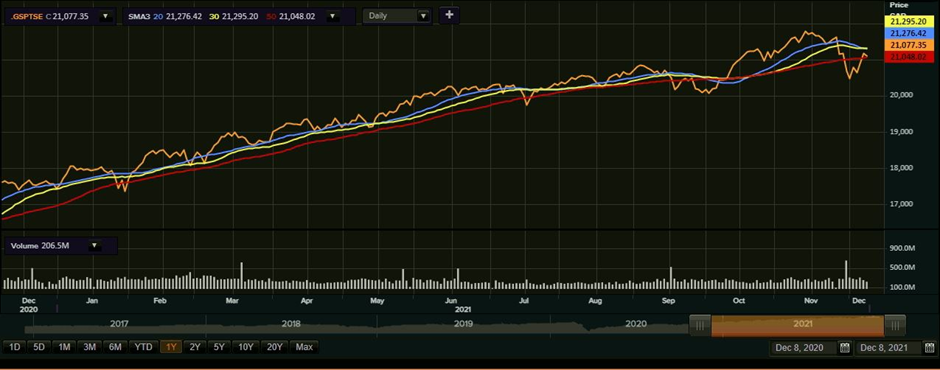
One-year price chart (December 8). Analysis by © 2021 Kalkine Media®
Canada's energy sector declined 0.5 per cent and the Industrials sector was down by one per cent. Meanwhile, only the healthcare and base metals sector was up by 1.4 per cent and 0.9 per cent, respectively.
The basic materials sector commands volume actives
The basic materials sector dominated the market in terms of volume of trade, which was followed by the energy sector.
B2Gold Corp. (TSX:BTO) saw about 9.3 million shares traded on the TSX and it was the most active stock on Wednesday. Meanwhile, the Canadian Natural Resources Limited (TSX:CNQ) from the energy sector was the second most active stock and a little over eight million CNQ shares traded hands.
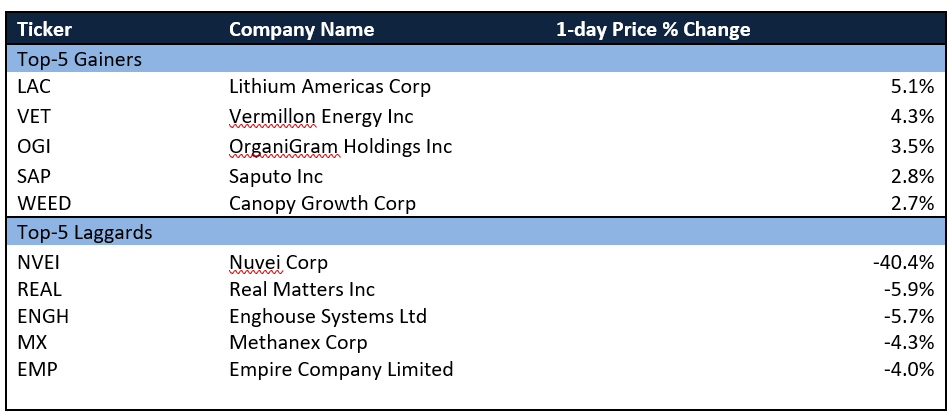
Movers and laggards
Wall Street closes higher on positive vaccine news
Wall Street closed higher on December 8 and the S&P 500 increased by 14.46 points or 0.3 per cent to 4,701.21. Meanwhile, the Nasdaq rose 100.07 points and Dow Jones Industrial Average climbed 35.32 points.
Investors responded positively to the latest development about coronavirus vaccines from Pfizer and BioNTech. Both the companies have said that their three-shot vaccine course is capable to neutralize the new omicron variant.
Oil prices steady
The oil prices remained steady on Wednesday and did not witness a significant increase or decline. The Brent Crude Futures was up 0.5 per cent at US$ 75.82 per barrel and the US West Texas Intermediate crude ended 0.4 per cent higher at US$ 72.36 per barrel.
How did the currency perform?
The loonie was a little unchanged against the US dollar on December 8. It was holding near its high in about three weeks as fears over the economic impact of the omicron variant eased.
The Canadian dollar was nearly unchanged at 1.2641 to the US dollar. On November 19, the loonie had hit its strongest intraday level at 1.2616.
Money market
The Canada 10-year bond yield was 1.59 per cent and its US counterpart had a yield of 1.53 per cent.
