
 AUS
AUS
 NZ
NZ
 UK
UK
 CA
CA
 USA
USA
 IND
IND







Highlights
- The Canadian stock market is filled with numerous public companies from different sectors.
- Bonds are often considered by low-risk investors who wish to avoid stock market fluctuations.
- Proper tax planning can help ensure that the profits earned are not eroded by taxation.
People can build a financially stable life by taking appropriate investment decisions. Not all the investors have same investment objectives, return expectations and risk tolerance. Also, these requirements could evolve for a particular investor from time to time.
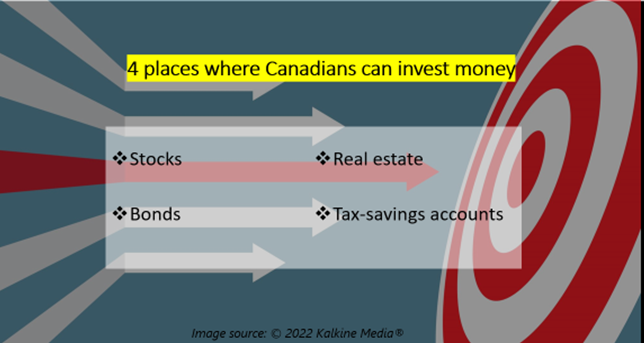
Knowing about different investment options can help one take better calls regarding your portfolio. So, let’s discuss four places where Canadians investors can put their money.
Stocks
The Canadian stock market is filled with numerous public companies from different sectors like financial services, industrial, mining, etc. However, considering fluctuations in stock prices, these can be risky and can affect your investment in the case of a bearish market situation.
Also read: How to handle a bearish phase in the market?
Investors can implement different strategies based on their risk-reward profile, such as growth and value investing. Some investors also focus on dividend-paying stocks and other options like exchange-traded funds (ETFs).
Stocks are not time-bound and can be traded at any point. However, any decision about their trading should ideally be taken carefully to mitigate possible losses.
Bonds
Bonds are basically loans to companies and governments that can offer interest when held for a specified time. Bonds are often considered by low-risk investors who wish to avoid stock market fluctuations, as these are debt instruments where the invested funds cannot depreciate.
However, one should note that bonds generally have lower return potential in the form of interest.
Real estate
Canadians can invest in real estate by owning different properties. But investors who do not wish to dig too deep into the market can explore real estate stocks and/or Real Estate Investment Trusts (REITs).
Real estate stocks and REITs are sometimes preferred by investors looking for options that are more liquid and easier to manage than an actual property.
Tax-savings accounts
Simply putting your funds into investment vehicles is not enough. Tax planning is an important factor too. Proper tax planning can help ensure that the profits earned are not eroded by taxation.
Hence, certain tax-savings accounts like Tax-Free Savings Account (TFSA), Registered Retirement Savings Plan (RRSP), etc., can help ease your tax bills and prepare you for retirement life.
Also read: 8 reasons why you can save your retirement income in TFSA
Bottomline
Depending upon their financial needs, return targets and risk levels, Canadian investors can consider these four investment options—or even a mix of them—to diversify their exposure and try and maximize profitability in the long run.
