
 AUS
AUS
 NZ
NZ
 UK
UK
 CA
CA
 USA
USA
 IND
IND








Highlights:
- Anson Resources has reported lithium-rich brines intersection in four clastic zones at the Paradox lithium project, located in Utah, USA.
- The brines were discovered in the recently completed resource-definition drilling at the Crane Creek 32-1 well.
- In last one year, Anson share price has appreciated by 255%.
Junior mineral resource company, Anson Resources Limited (ASX:ASN) on Thursday (29 September 2022) shared that it has discovered numerous new lithium-rich zones in the resource definition drilling at the Cane Creek 32-1 well at the Paradox Lithium Project.
Paradox Basin Brine Project of Anson is located in Utah, USA and covers total area of 95km square.
Anson’s share price was up 12.28%, trading at AU$0.32 per share at 12:15 PM AEST. Anson’s share price has marked a surge of 14.29% in a month. Talking about the year-to-date share performance, Anson shares have zoomed up 128.57%. In last 52 weeks, the share price has shot up by 255.56%, and in the past five years, it has skyrocketed by a whopping 966.67%.
Meanwhile, the benchmark index, ASX 200 Materials, was 2.63% up, at 15,216.70 points.
New lithium-rich brines reported by Anson: details here –
Anson informed via ASX announcement that:

This is an addition to the lithium-rich brines recently reported in Clastic Zone 43.
The company undertook drilling to extend the well to the Mississippian unit. According to the company’s release, while extending the well, these new clastic zones were intersected. Reportedly, the assay results are pending from the 121-meter-thick Mississippian units.
Talking about the average grade of the assay results, Anson said that
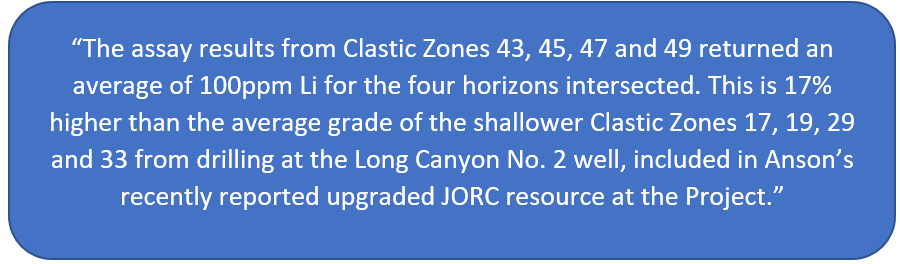
These newly discovered lithium brines have the capability to add quantity (tonnes) to the inferred and indicated resources. In addition to this, the new discovery offers significant upside to turn existing exploration targets into indicated and inferred JORC estimates.
Plan ahead
Anson highlighted that some of the additional clastic zones have higher thicknesses than the zones which were previously sampled. This extra thickness has the potential to offer a significant increase in the planned mineral resource upgrade.
The sample and assay data collected from the horizons during the drilling program would extend further geological information about the brine horizons. The geological information can be utilised in future JORC estimates and also in developing targets for future exploration projects.
