
 AUS
AUS
 NZ
NZ
 UK
UK
 CA
CA
 USA
USA
 IND
IND







Highlights
- A media release by the ABS highlighted a 3.4% fall in Australia’s unemployment rate in October 2022.
- Australia’s employment rate, in seasonally adjusted terms, grew by 0.2% in the same month.
- Australians worked for 1,897 million hours in October, a rise of 2.3% compared to September 2022.
The Australian Bureau of Statistics (ABS) on 17 November published the October month labour force data for Australians. According to the report, Australia's unemployment rate fell by 3.4% in seasonally adjusted terms last month, while the employment rate rose by 0.2%. In trend terms, the unemployment rate dropped by 3.4% in October, but the employment rate grew by 0.1%. The youth unemployment rate, on the other hand, decreased even further by 7.5%.
The ABS mentions that the seasonally adjusted unemployment rate for Australian men fell to 3.4%, but for women, it remained at 3.6%.
"With employment increasing by around 32,000 people, and the number of unemployed decreasing by 21,000 people, the unemployment rate fell by 0.1 percentage point to 3.4%,” said Bjorn Jarvis, head of labour statistics at the ABS.
A glance at ABS’ labour data graphs
As per the ABS data, in October, the number of unemployed people decreased by 2,600, totalling 483,800, while the number of employed people increased by 16,800 to 13,617,900 in trend terms.
Australia saw an increase in its full-time employment rate; the number of employed people reached 9,515,400, with an increase of 16,800. According to the ABS release, Australia now has 4,108,300 part-time employees. The percentage of part-time employment in October 2022 was 30.2%.
In accordance with this employment increase, the employment-to-population ratio grew by 0.1% to 64.3% in October.
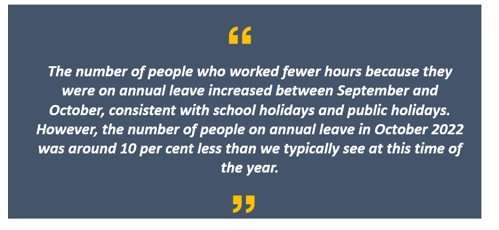
Let’s come to the hours worked in October in seasonally adjusted terms. Seasonally adjusted monthly hours worked were greater than the growth in employment. While the employment rate only rose by 0.2%, hours worked increased by 2.3%. The ABS states that this significant increase in hours worked was partially triggered by fewer employees being on leaves in October.
Besides, over 30% more people than usual worked fewer hours in October due to illness. Also, adverse weather conditions during flood occurrences in New South Wales, Victoria, and Tasmania, drove more employees to work fewer hours. In just a month, the number of employees working fewer hours increased from 66,000 in September to 100,000 in October.
In a statement, Jarvis said:
The participation rate stayed constant at 66.5% as of October 2022. This was 0.7 percentage points higher than before the COVID-19 pandemic situation but was marginally lower than a historical high of 66.7%. The participation rate for Australian men fell by 70.9% while remaining the same for women at 62.3%.
