
 AUS
AUS
 NZ
NZ
 UK
UK
 CA
CA
 USA
USA
 IND
IND






Highlights
- In a recently held energy and climate summit, it was highlighted that Australia’s retail power bills might increase by 35% next year.
- State of the Energy Market 2022, AER talks about significant transformation of the Australian retail market.
Retail electricity costs in Australia might increase by more than 35% next year, according to Jeff Dimery, CEO of Alinta Energy, who made the statement during an energy and climate summit earlier this week. Dimery further added to his statement by saying that the rising cost of wholesale energy would be to blame for this significant increase. But a few other factors would also be a part of the escalating pricing pressures in the coming years.
AA glance at the 2022-23 retail market
The Australian Energy Regulator released a snapshot of retail markets (2022-23) in its State of the Energy Market report of 2022. According to AER, the Australian retail markets are undergoing a significant transformation. The cost of energy, which had been decreasing until the end of 2021 based on subdued wholesale market conditions, is projected to rise as the effects of high wholesale prices during 2022 move on to retail markets, as also quoted by Jeff Dimery (CEO, Alinta Energy).
Additionally, spot and contract prices are also anticipated to continue high due to the timing and impact of additional coal closures and international pressures, as stated by AER. That would certainly influence retail electricity costs.
Main components of retail power bills: AER
Below are the primary components of a conventional retail electricity bill:
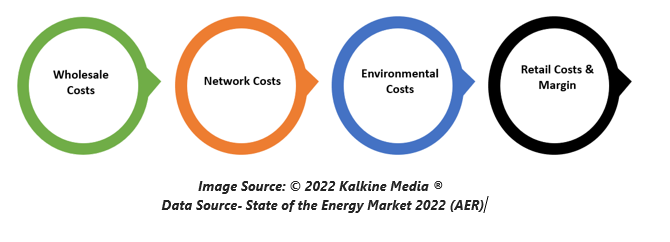
Even if the pressure of rising wholesale prices may have contributed to the anticipated increase in retail power bills, the cost of wholesale energy only accounts for a small portion of the overall bill. They only represent roughly 33% of the total bill, according to AER.
The network costs will also have a significant impact on how much retail electricity prices rise. Over the next ten years, the energy network will undergo a very costly transition as it converts to large-scale renewable energy. Also, the high inflation outcomes will affect network prices, which could result in increased capital-raising costs for networks.
In addition to this, the factors listed below will also contribute to rising retail power prices:
- Wholesale costs of the retailer for buying electricity in hedge and spot markets
- The price of environmental costs, such as carbon emission, renewable energy production, and energy efficiency
- The profit margin of retailers
- Transportation costs of electricity through transmission and distribution networks
- Total cost of servicing customers
