
 AUS
AUS
 NZ
NZ
 UK
UK
 CA
CA
 USA
USA
 IND
IND







A heavy sell-off can be understood simply by taking an example of a vegetable market, consider a market where there are many different sellers who are selling the same veggies for $5. If for some reason there are not many customers in the market on a given day, all the sellers will be eager and desperate to sell their vegetables. As they know that if they donât sell of their goods which is vegetables in this scenario the veggies get spoiled and loses its value.
If now from somewhere a buyer comes at this place, certainly it is a case where buyers are outnumbered from the sellers. Now this leads to a price competition among the sellers, as soon as the buyer approaches one of the carts another seller offers the same vegetable at a price of $4.5 lower by 50 cents. Now if at the same place another customer arrives who had seen the person before him had bought the fruit at $4.5 and obviously wouldnât pay more than that for the vegetable. Once again, the customer 2 approaches cart and another seller offer the same vegetable at a price of $4 and the process repeats with every new customer arriving. All along the price of the veggies goes down and down, while the sellers wonât stop cutting the price off until they feel that letting the fruit rot is no less than selling the fruit at that price.Â
Here the vegetable market is the stock market, and a particular vegetable is a stock, whenever there is a heavy sell off, in order to attract the small number of buyers the prices are lower as they go down and buyers benefit from this simple case of supply and demand. In stocks there is bid and ask the former is what someone is willing to pay for a stock while the latter is what the seller is willing to sell it at. In case of excessive or heavy selling there are more asks than bids, and hence as discussed above the bid will fill the asks at smaller prices increasingly.
For example, AMP Limited closed at price of $3.48 as at August 8, 2018, for this the prices should stabilize after falling for a long time and then may increase when the bid tends to outweigh the asks. If there are not enough buyers which is the case now for AMP Limited, the price continues to fall down until agreeing on a price which is the floor and eventually gives a leeway to buying. As show in in the chart below:
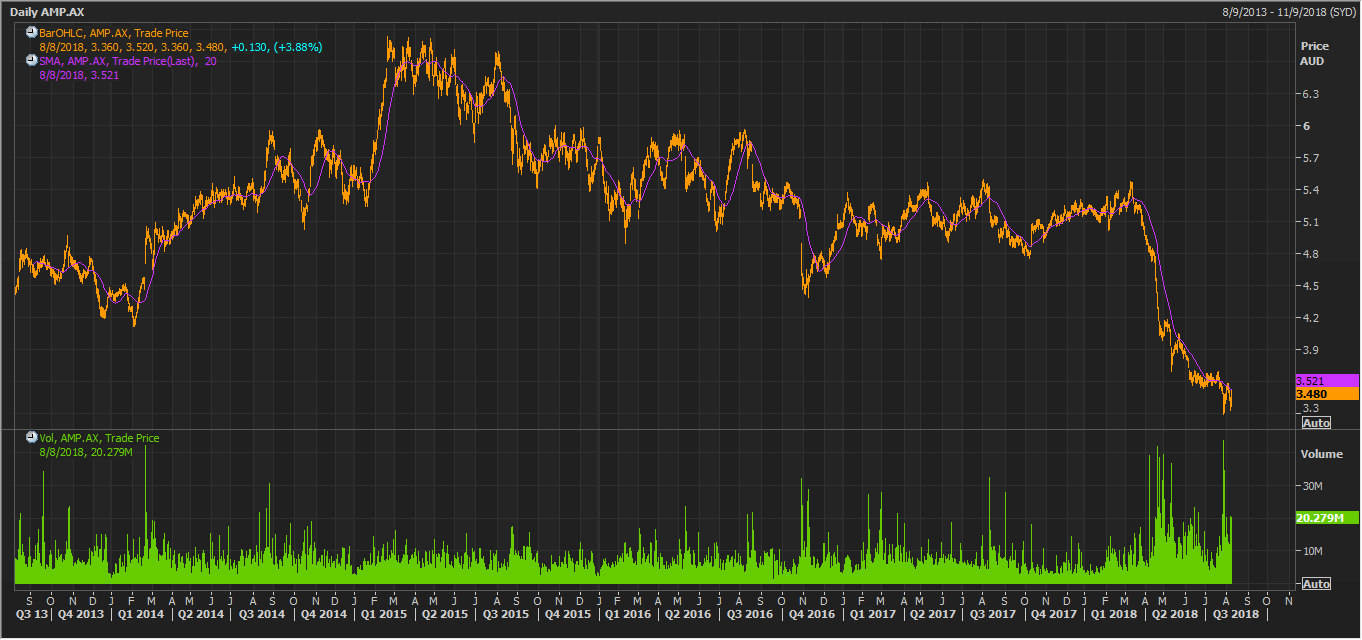 Daily Price Chart of AMP, Source: Thomson Reuters.
The Income available from dividends remains attractive for many investors.
We take a look at the best yields on the market and assess what they say about a companyâs prospect.
One Thing is certain, though, Australia interest rates are still low, making income difficult to come by and keeping the focus for many investors on high yielding stocks. Kalkineâs team of analysts bought you handpicked report for âTop 25 Dividend Stocks For 2018.â
ASX-relevant Special Reports are published year-round to provide a detailed analysis into an investing opportunity or a potential risk to your portfolio.
Click here to get your free report.
Disclaimer
The advice given by Kalkine Pty Ltd and provided on this website is general information only and it does not take into account your investment objectives, financial situation or needs. You should therefore consider whether the advice is appropriate to your investment objectives, financial situation and needs before acting upon it. You should seek advice from a financial adviser, stockbroker or other professional (including taxation and legal advice) as necessary before acting on any advice. Not all investments are appropriate for all people. Kalkinemedia.com and associated websites are published by Kalkine Pty Ltd ABN 34 154 808 312 (Australian Financial Services License Number 425376). website), employees and/or associates of Kalkine Pty Ltd do not hold positions in any of the stocks covered on the website. These stocks can change any time and readers of the reports should not consider these stocks as advice or recommendations.
Â
Â
Â
