
 AUS
AUS
 NZ
NZ
 UK
UK
 CA
CA
 USA
USA
 IND
IND






Copper prices are holding near eight-month in events of supply shortage and other supportive factors such as of high demand in China, slight recovery in global economic figures, and tighter import policy adopted by China over copper scrap to counter environmental issues.
Copper futures (Jan expiry) on COMEX soared from USD 2.494 (low in September 2019) to the present high of USD 2.886 (Day’s high on 16 January 2020) and is currently racing towards its previous eight-month high of USD 2.933 (high on May 2019).
The prime rally in copper from September 2019 to the current price underpins a price appreciation of ~15.71 per cent, which is now providing an opportunity for copper mining companies to reconsider expansion and production plans for their copper prospect.
To Know More, Do Read: Tesla and Others are Back for Cobalt; Australian Mines’ Sconi Project To Lead the Australian Front?
Apart from improving copper prices, the global penetration by EV sector in the automobile industry is also supporting the demand for copper and other battery base metals such as nickel and cobalt, and is now providing support for base metals mining.
Also Read: Indonesia Export Ban to Create a Nickel Boom while Mincor and Independence Develop Assets?
The Improving Economic Figures
China witnessed a slow December 2019 quarter with quarterly GDP increasing by just 6 per cent against the previous corresponding quarter in 2018. The growth of 6 per cent in December 2019 quarter witnessed the slowest change since the peak growth change of 11.9 per cent in March 2010.
However, despite slower growth, China witnessed a high demand for copper amid infrastructure push and energy grid development by the government, which in turn, supported the demand for copper. While the demand rose in China, supply constraints also played a vital part in supporting the copper price.
Also Read: Copper Surpasses December High; Strong Demand from China and Supply Constraints Propel Prices
In the status quo, China published supportive figures for base metals-
- The year-to-date fixed asset investment in China, which includes infrastructure investment such as of power grid, factories, roads, surged to stand at 5.4 per cent for December 2019, as compared to the previous month YTD change and market expectations of 5.2 per cent.
- The growth in the power grid and other infrastructure push by the Chinese government during the last quarter of the year 2019 could be inferred from the improvement.
While the YTD fixed income investment surged, the increase in the industrial production for December 2019 served as an icing on the top.
- As per the data from National Bureau of Statistics of China, the industrial production witnessed an increase of 6.9 per cent (y-o-y) in December 2019, which in turn, further suggested the positive outcome of an increase in infrastructure.
While China disclosed some welcoming data for December 2019, the United States- which is among the top base metal consumers presented weak Building Permits, which kept a lid on copper, and copper still is unable to cross its May 2019 high.
As per the data from Census Bureau, the Building Permits, which represents an annualised number of new building permits, slumped to stand at 1.42M in December 2019, against the market expectation of 1.47M.
However, the permits remained near the market expectation and did not impact the copper price in high magnitude, but yet was successful in keeping the lid on the ongoing rally, which is currently halted at USD 2.886, and copper futures (COMEX) is currently trading at USD 2.851 per pound (as on 20 January 2020 3:17 PM AEDT), down by ~ 1.21 per cent from its 16 January 2020 high.
Tighter Import Policies for Copper Scrap in China
China’s regulatory authorities released new standards over the copper scrap import on Sunday to counter the environmental issue and keep the carbon footprints under check, in line with Accord de Paris.
The new standard kept the minimum copper content range within 99.9 per cent 94 per cent depending upon the type of scarp, which is now expected by industry experts to increase the demand for copper concentrate amid surmounting smelting capacity in China.
The demand for copper concentrate was mainly kept in check, thanks to the cheap availability of copper scarp; however, with the new standard in place copper concentrate holds an upper edge.
What to Expect Ahead?
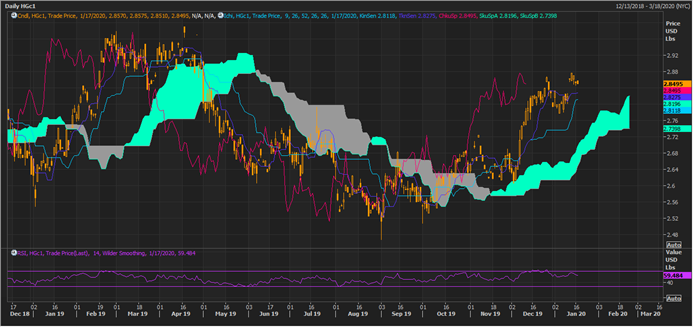
On the daily chart, copper is currently trading above the mean of the conversion line and base line, which is known as Span A (USD 2.8196) in Ichimoku Clouding Technique. The spread of Span A with Span B (which is mean of 52-period high and low) is increasing, which further suggests that uptrend is gaining further momentum.
The 14-day Relative Strength Index is further complementing the trend with a value of 59.48 (above mean 50.0), which further suggests, that the uptrend is yet to reach the overbought territory. The prices are also supported with a positive crossover between the conversion line (purple) and the base line (sky blue) above Span A.
If copper prices correct, the sky blue cloud would be the primary support for the prices, and investors should now dig into more fundamentals to reckon the strength of the present uptrend.
Key Takeaways
- Copper prices are holding near eight-month highs thanks to supply shortage and other supportive factors such as of high demand in China, slight recovery in global economic figures, and tighter import policy adopted by China over copper scrap to counter environmental issues.
- The year-to-date fixed asset investment in China surged to stand at 5.4 per cent for December 2019, as compared to the previous month YTD change and market expectations of 5.2 per cent.
- The industrial production witnessed an increase of 6.9 per cent (y-o-y) in December 2019 as compared to the market expectations of 5.9 per cent.
- China’s regulatory authorities released new standards over the copper scrap import on Sunday to counter the environmental issue and keep the carbon footprints under check, in line with Accord de Paris.
- The new standard kept the minimum copper content range within 99.9 per cent 94 per cent depending upon the type of scarp, which is now expected by industry experts to increase the demand for copper concentrate amid surmounting smelting capacity in China.
