
 AUS
AUS
 NZ
NZ
 UK
UK
 CA
CA
 USA
USA
 IND
IND








COVID-19 pandemic has emerged as the biggest threat to the global economy, as social distancing and worldwide lockdown cause supply chain disruptions, equity markets experience greater volatility than ever, and increasing restrictions on people’s movement hit hard businesses across varied industries like aviation and leisure.
No wonder, the pandemic has also wreaked havoc on the Australian economy, which seems heading towards a recession, a first in almost three decades. And, as the Federal Government is charting out a path out of the coronavirus crisis, lately on 16 April 2020, Prime Minister Scott Morrison highlighted that Aussies will have to live with the restrictions including self-isolation and social distancing for at least 4 more weeks.
Do Read: COVID-19 Pandemic: An Economic Emergency to be Dealt With
Given the current scenario, governments across the globe are introducing stimulus packages to contain the virus spread, ensure minimal damage to their respective economy, and help businesses and individuals impacted the most. Amidst the worsening spread of COVID-19, businesses are also implementing appropriate measures aimed towards balancing the health and wellbeing of their people while supporting business continuity and managing liquidity and cashflow keeping in mind a long-term view.
In light of this discussion, let us gauge through how the following ASX-listed companies from varied industries are performing and dealing with this market turbulence to maintain cashflow and business buoyancy.
Brambles Limited (ASX: BXB)
Industrials sector player, Brambles Limited, founded in 1875, operates through the CHEP brand as a supply chain logistics company, boasting operations in ~60 countries backed by approximately 11,000 employees. The Company primarily caters to the beverage, fresh produce, fast-moving consumer goods (grocery, dry food, and health & personal care), general manufacturing and retail industries.
Amid the COVID-19 outbreak, the last one-month return of the stock was noted at 17.44 percent, while on a YTD basis, the stock has delivered a negative return of around 0.52 percent, as on 17 April 2020. At the end of the day’s trading, BXB advanced further by 1.668 percent to settle at $11.580.
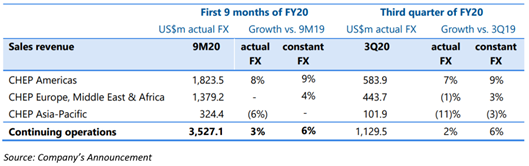
Revenue Growth for BXB Despite COVID-19 Uncertainty: On 17 April 2020, the Company released trading update for 3Q FY2020 for the period ended 28 March 2020.
- In 3Q and first nine months of FY2020, sales revenue grew by 6 percent, signifying the resilient and defensive nature of the business.
- Despite the prevailing conditions due to COVID-19 outbreak, BXB’s major markets registered solid growth in volume.
Revised FY2020 Guidance: BXB updated its previous guidance for FY20, as the Company anticipates COVID-19 impacts on the fourth quarter trading performance.
- A material reduction is expected in earnings and revenue contributions from automotive and Kegstar businesses in 4Q FY2020.
- With changes in network dynamics, BXB expects a higher short-term expenditure.
- The Company also mentioned potential risks associated with delays in the collection of receivables and receipt of compensation income.
Consequently, the Company expects sales revenue growth of 5-7 percent at constant FX rates and including the impact of AASB16, underlying profit growth of 3-5 percent at constant FX rates for FY20.
Business amidst COVID-19: While playing a vital role in keeping local, regional and international supply chains moving, Brambles is also taking measures towards the coronavirus impact, which is driving material changes in operating conditions.
- During the difficult time brought by COVID-19, BXB business is supporting the movement of grocery products to fulfil an increase in consumer demand;
- Shutdowns and lockdowns in key regions are likely to have a material impact on the Company’s automotive and Kegstar segments, accounting for nearly five percent of Group annual revenues;
- CHEP, drawing nearly 80 percent of revenues from consumer staples customers, witnessed record levels of demand for pallets during March 2020.
Scentre Group (ASX: SCG)
Real estate company, Scentre, founded on 30 June 2014, operates and owns living centres across Australia and New Zealand, with interest in 42 Westfield Living Centres, covering over 12k outlets. And, as at 31 December 2019, total assets under management stood at $56 billion.
On 17 April 2020, the stock inched upward by 4.369% to close the day’s trade at $2.150.
Reduction of 20% in remuneration: Amidst the COVID-19 outbreak, the Company released a Board and executive remuneration update, highlighting
- Board decided a reduction of 20 percent in base fees of the Board
- A reduction of 20 percent in the fixed remuneration agreed by the Company’s senior leadership team comprising of Chief Executive Officer, Peter Allen and Scentre’s Chief Financial Officer, Elliott Rusanow.
- Arrangements are also being applied in a similar way throughout the broader executive team of the Company.
- The remuneration cut will be effective from 1 May 2020 and the Board would relook at these arrangements in August 2020.
Liquidity update:
- On 1 April 2020, SCG notified the market to have attained additional unsecured bank facilities of a two-year duration, consequently, the liquidity position of Scentre increased to $3.1 billion, as at 1 April 2020;
- Also, SCG mentioned to have $2.5 billion of bank facilities and bonds, which are maturing through to 31 December 2021.
On 8 April 2020, Scentre addressed its security holders at the annual general meeting, highlighting-
- Guidance suspension: Though the Company’s performance during the early part of 2020 remained in line with its expectations, considering the market volatility due to coronavirus pandemic, SCG has suspended its previously announced outlook for 2020.
- Across the Company’s portfolio, around 39 percent of stores in Australia remain operational with selected essential retailers working in New Zealand.
- Further, SCG mentioned that all its 42 Westfield centres are operating within the guidelines issued by the Government in Australia and New Zealand.
- SCG has introduced Westfield Direct, which is a new drive-through Click and Collect service. This service has been rolled out across all Australian Westfield centres, enabling retail partners to connect with customers.
