
 AUS
AUS
 NZ
NZ
 UK
UK
 CA
CA
 USA
USA
 IND
IND





Summary
- Envirostream begins evaluating use of zinc and manganese derived from spent alkaline batteries as a source of micronutrients in blended fertilisers. Fertiliser/wheat-seeding trial being conducted near Kojonup, ~260 km southeast of Perth, WA’s capital city.
- Harvesting at the trial site scheduled for December 2020, with results expected by first quarter of 2021.
- Use of spent batteries in improving fertilisers to largely benefit crop growers, lower carbon footprint and landfill contamination.
Perth-based Lithium Australia NL (ASX: LIT) is committed to establishing a circular battery economy, taking in account its environmental, social and governance responsibilities. On 10 June 2020, the Company announced that its recycling division, Envirostream Australia Pty Ltd (90%-owned subsidiary) has commenced assessment of application of zinc and manganese obtained from recycled alkaline batteries as a source of micronutrients in blended fertilisers.
The initial pot trials undertaken in controlled greenhouse conditions had indicated that the Envirostream product does have the potential to be used as micronutrients in fertilisers which would in turn lower the carbon footprint of the battery industry as a whole, while also reduce landfill contamination, thereby improving global food production.
In the northern hemisphere, fertilisers manufactured using rapid-release micronutrients derived from spent alkaline batteries are currently commercially available.
However, the production of micronutrients being considered by Envirostream Australia are slow-release variants tailored specifically for broad-acre farming undertaken across Western Australia. The use of such nutrients in slow-release form, believed to be a first for the Antipodes, in the sandy soils, which is low in zinc and manganese, that characterise Western Australia’s wheatbelt region will provide growers with large benefits.
Micronutrient/Fertiliser Agglomeration
The zinc and manganese micronutrients used in the blended fertilisers have been recovered by Envirostream from single-use, disposable alkaline batteries (the type commonly found in torches, toys and remote-control units) in the form of mixed metal dust (MMD) at its recycling facility in Victoria, Australia. Subsequently, the MMD has been agglomerated with mono-ammonium phosphate (MAP) fertiliser for the trails.
Field Seeding Trails
Environstream’s fertiliser/wheat-seeding trial is being held near Kojonup, which is around 260 km southeast of Western Australian capital city of Perth. There were around five types of furrow treatment in the controlled Kojonup seeding on 5 June as:
- No fertiliser in seed furrows;
- Application of MAP only to furrows;
- Addition of commercial fertiliser with added zinc and manganese to furrows, and
- Use of MAP agglomerated with two different dosages of Envirostream’s MMD.
Given below are the snapshots of the packaged fertiliser variants, plus the specialised equipment used and seeding in progress:
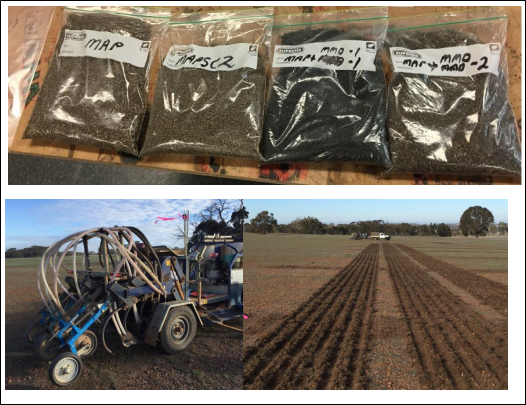
Source: Company’s announcement dated 10 June 2020
Envirostream Australia has planned harvesting at the trial site for December 2020, with results to follow in the first quarter of calendar year 2021.
Development of Blended Fertiliser
While Envirostream continues to conduct micronutrient field trials, the Company is also considering the use of its alkaline MMD as a source of micronutrients with a number of fertiliser manufacturers. The discussions ongoing in this regard have been positive to date and the Company has indicated to provide further updates as matters progress.
Management Commentary
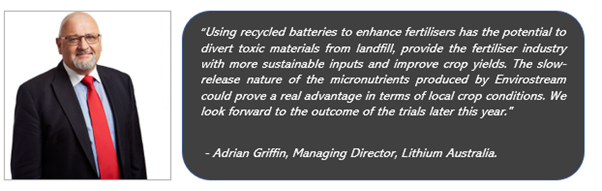
Lithium Australia has built a rational portfolio of lithium projects/alliances and has developed two disruptive proprietary extraction technologies (SiLeach® and LieNA®) for conversion of lithium silicates and unused fines from spodumene processing, to lithium chemicals. The Company’s goal is to ensure an ethical and sustainable supply of energy metals to the battery industry globally, to which recycling of old lithium-ion batteries (LIBs) is a crucial component.
Thereafter, the Company plans to utilise the chemicals to deliver advanced components to global battery industry, and for stationary energy storage systems within Australia.
Stock Performance: The LIT stock settled the day’s trade on 10 June 2020 at AUD 0.053, up 3.922% by AUD 0.002, with a market capitalisation of AUD 30.54 million. LIT has generated positive returns of 34.21% in the last six months and 18.60% in the last three months.
