
 AUS
AUS
 NZ
NZ
 UK
UK
 CA
CA
 USA
USA
 IND
IND







Palladium prices are skyrocketing to trade at a record high over the supply concerns and tighter emission standards across the globe.
Palladium futures on NYMEX soared to reach a record high of USD 2,298.35 per ounce (intraday high on 17 January 2020), and the prices are currently holding near the record high to trade at USD 2,255.75 (as on 22 January 2020 4:47 PM AEDT).
Also Read: Is the Time Right To Look At Platinum And Palladium Stocks On ASX?
Palladium is largely produced in Russia and South Africa as a by-product of nickel and platinum production and witnesses a high demand from the internal combustion engine to control the harmful emissions.
International dignitaries who assembled to ink the Paris Accord or Accord de Paris are now taking stringent actions to reach the carbon neutrality or net-zero emissions. The action embraced by these dignitaries also includes the adoption of EV vehicle, which is gaining momentum in the market and supporting the demand of other base metals such as copper, nickel, and cobalt.
Also Read: Tesla and Others are Back for Cobalt; Australian Mines’ Sconi Project To Lead the Australian Front?
While the electrification is surging, the internal combustion engine (or ICE) is yet playing a major part in aviation transportation and maritime transportation; thus, the demand for palladium and platinum- which are used as an auto catalyst to convert harmful emission into more environmentally friendly components.
Also Read: Australia Aviation Industry to Attain Carbon Neutrality by 2020? Qantas Improves Fuel Efficiency
In achieving the carbon neutrality, the hybrid engines and ICE are playing an important role, which is fuelling the demand for palladium, and palladium is soaring across the global front.
However, the investment case in palladium is taking another turn, with many ICE makers shifting towards platinum, which is a close substitute to palladium, amid the higher cost of palladium, which in turn, is further reflecting palladium as a bubble- a case similar to cobalt, where soaring prices and supply concerns led the auto carmakers to shift towards closer battery-metals alternative such as copper and nickel.
Currently, the palladium-to-gold ratio is trading around 1.6, which suggests that palladium is almost double the market price of gold- a metal with high regards throughout the investing community.
Suggested Read: Get Ready to Pay ~2.8k for 24k Gold; Gold Bulls Break the Gated Cage
Is Palladium A Bubble?
A drastic fall in nickel prices during the third quarter of the year 2019 from peak price of USD 18,842.50 (high in September 2019) to USD 12,897.50 (low in December 2019), which underpinned a price depreciation of ~31.55 per cent, led many nickel mining companies to halt the expansion and exploration over the unsupportive prices.
As a result of slow investment in nickel projects across the globe, and falling nickel prices, palladium witnessed a supply shortage, which coupled with high demand from China and Japan in the wake of the development in hybrid fuel cell technology, supported palladium prices.
- Nickel projects are now back in action
Post Indonesia implied export bans on nickel concentrate; there has been a boom in nickel prices with a recovery of ~ 11.90 per cent from September 2019 low, which in turn, is now prompting the nickel mining companies to reconsider the feasibility of new nickel projects and expansion of existing nickel projects amid industry anticipation of high demand for nickel ahead.
To Know More, Do Read: Indonesia Export Ban to Create a Nickel Boom while Mincor and Independence Develop Assets?
The surge in nickel exploration activities are now anticipated by industry experts to fill for the palladium supply as well, which coupled with a shift in palladium to platinum, is expected by the market to exert pressure on palladium ahead.
- Downward sloping futures curve
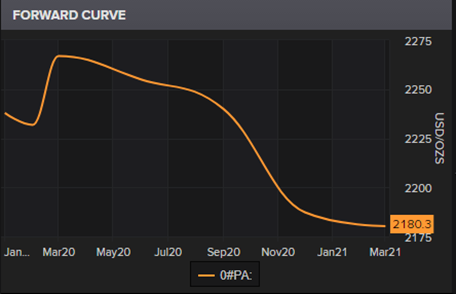
Palladium Futures Curve (Source: Thomson Reuters)
The futures curve for palladium is downward sloping post-March 2020, which further suggests that the market anticipates weaker demand and higher supply ahead. In technical terms, it also suggests that the convenience yield is currently higher than the storage cost of palladium, which is further expected by the market to reverse ahead.
To know more about these technical terms, and how they indicate a trend, Do Read: An Investor’s Guide for Commodity Valuation and Mining Stocks
- Backwardation in futures with low OI
The far-dated futures are showing lower prices and lower open interest, which further suggests that buyers are getting less interested in securing the physical supply ahead, which could be largely due to the shift by carmakers from palladium to platinum.
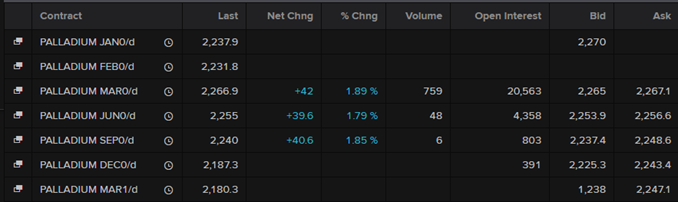
Palladium Futures LTPs (Source: Thomson Reuters)
In a nutshell, the market is not favouring palladium over the long-run as per current indications. Further, it would be worth noticing if the current supply concerns and spiked R&D in hybrid cell technology could push the palladium to shatter its own records ahead.
However, the current rally in palladium prices concern investors over a possible bubble amid above-mentioned reasons and market indications.
Key Takeaways
- Palladium prices are skyrocketing to trade at a record high over the supply concerns and tighter emission standards across the globe.
- Palladium is largely produced in Russia and South Africa as a by-product of nickel and platinum production and witnesses a high demand from the internal combustion engine to control the harmful emissions.
- While the electrification is surging, the internal combustion engine (or ICE) is yet playing a major part in aviation transportation and maritime transportation.
- In achieving the carbon neutrality, the hybrid engines and ICE are playing an important role, which is fuelling the demand for palladium, and palladium is soaring across the global front.
- A drastic fall in nickel prices during the third quarter of the year 2019 significantly lowered the palladium production amid halted nickel exploration activities on the global front.
- There are plenty of indication, which is suggesting that palladium could act as a bubble ahead-
- Nickel projects are now back in action.
- Downward sloping palladium futures curve.
- Backwardation in palladium futures with low OI
