
 AUS
AUS
 NZ
NZ
 UK
UK
 CA
CA
 USA
USA
 IND
IND








Technology disruptions have been the biggest talk of the decade since their innovations have displaced existing technologies and have nurtured new industries to grow and thrive at an unbelievable pace. These technologies are shaping the global economy since the dependence on technology is only increasing day by day.
According to Austrade, the share contributed by digital technologies towards the economy of Australia is anticipated to increase by 75% to $139 billion between 2014-2020.
Here, we shall discuss one of the technologies with great potential for Australia’s economy to become a world leader -.

Classical versus Quantum Computing
Under Classical computing, logical operations are carried out by computers using the definite position of a physical state, usually binary, meaning its operations are based on one of two positions (such as on or off, up or down, 1 or 0 called as a bit).
On the other hand, operations in quantum computing generate ‘qubit’ by using an object’s quantum state, which are undefined features of an object prior to their detection.

The development and implementation of Quantum computing is not only expected to change how we use, process and understand information but shall also allow us to create faster, more efficient computers that would quickly become the world’s most powerful artificial intelligence machines.
Disruptive technologies shaping the economies worldwide as well as daily human life
In September 2016, Australia as a world leader in advanced computing was boosted by an agreement between the Turnbull Government (2015 to 2018), the research community and business worth $70 million. The Government was expected to contribute $25 million over a period of five years via the National Innovation and Science Agenda to a consortium developing a prototype silicon quantum integrated circuit.
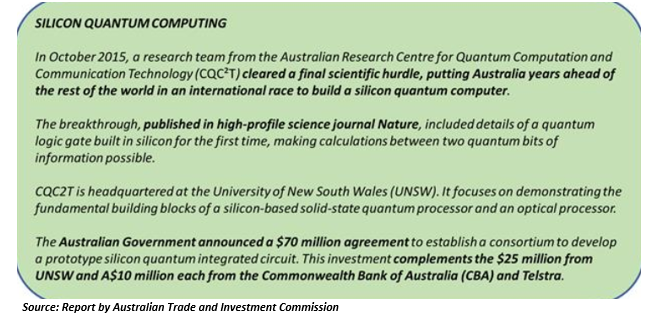
CQC²T, funded by the Australian Government through the Australian Research Council Centres of Excellence funding scheme, is formed as a result of a global cooperation between seven universities of Australia and over 25 partners to develop one of the largest joint efforts in quantum computation and communication research worldwide.
The revolutionary technology of quantum computing, that infuses an approach to cracking problems that involve large numbers of variables or different possible solutions, is anticipated to transform the use of information technology and data, as quantum computers can solve problems in minutes or hours that would take conventional computers, even supercomputers, centuries to do the same.
Quantum computing has prospective utility in a wide range of sectors like healthcare, defence, financial services, telecommunications, logistics and weather forecasting by allowing researchers to develop innovative catalysts and materials, improve medicines, push developments in AI, and provide solutions to the fundamental queries about the origin of the universe.

Let us now enrich this discussion with some facts from Google’s Quantum Supremacy Experiment.
Google, in its latest experiment - quantum supremacy experiment, found various pathways for its team to beat various technical challenges intrinsic to quantum systems engineering in order to create a programmable and powerful computer.
In order to perform the benchmark testing, Google developed a new 54-qubit processor, named ‘Sycamore’, containing fast, high-fidelity quantum logic gates. The results showed that the machine performed the target computation in an unbelievable time of 200 seconds; however, the world’s fastest supercomputer would take around 10,000 years to produce a similar output (determined from measurements in Google’s experiment).
Google’s fully programmable Sycamore quantum computer has the ability to run general-purpose quantum algorithms.
Researchers are of the view that quantum computing is already gaining shape of technology from a simple research topic and is prospective of exposing new computational capabilities. The concluding remark of the experiment reads that only one more creative algorithm can unlock the valuable near-term applications of quantum computing.
Bottomline
Australian government’s efforts in recognising the transformational potential of the digital economy can be validated from the government’s idea of making digital technologies an essential part of its National Innovation and Science Agenda.
Moreover, the Australian government has introduced a range of initiatives, including the Prime Minister’s Industry 4.0 Taskforce to drive innovation, investment and adoption of disruptive technologies across the economy.
Disclaimer
This website is a service of Kalkine Media Pty. Ltd. A.C.N. 629 651 672. The website has been prepared for informational purposes only and is not intended to be used as a complete source of information on any particular company. Kalkine Media does not in any way endorse or recommend individuals, products or services that may be discussed on this site. Our publications are NOT a solicitation or recommendation to buy, sell or hold. We are neither licensed nor qualified to provide investment advice.
