
 AUS
AUS
 NZ
NZ
 UK
UK
 CA
CA
 USA
USA
 IND
IND








Summary
- The shares of IAG and EasyJet once again took a hit in the wake of the recent rise in Covid-19 infections.
- On 20 October, the first UK testing for Covid-19 cases, Lamp Test, started at the Heathrow Airport.
- Recently, IAG said that the whole of its £2.5 billion rights issue shares were taken up.
- At EasyJet, the volume of passengers for the full year decreased by 50 per cent to reach 48 million.
In the past few days, the shares of International Consolidated Airlines Group SA or IAG (LON: IAG) and EasyJet Plc (LON: EZJ) have seen a downward trend. Amid the recent spike in Covid-19 infections across the world, the airline stocks have once again started falling. In order to check the spread of the infection, once again stricter restrictions have been imposed across Europe. On 20 October, the shares of IAG and EasyJet recorded negative year-to-date returns of minus 84.28 and minus 65.50, respectively.
From a value of GBX 107.50 on 8 October 2020, the IAG share prices dropped to a new low of GBX 95.76 on 15 October 2020, raising concern among investors. In a similar fashion the EZJ stock also dropped during the past few days from GBX 541.40 on 6 October 2020 to GBX 470.70 on 16 October 2020.
Covid-19 tests at the Heathrow Airport
In a latest measure to increase the confidence of the travelers and check the spread, the first UK testing for Covid-19 began at the Heathrow Airport on 20 October. As most countries have categorised Britain as being ‘at risk’, this test is aimed at assisting people who are visiting countries which demand a proof of negative infection on arrival.
The test that could provide results within 20 minutes would cost £80. At present, the test available at Heathrow Terminals 2 and 5 is a rapid saliva swab test and is called a Loop-mediated Isothermal Amplification (Lamp) test. Considered to be quicker than the PCR test, a Lamp test is widely used in the National Health Service (NHS), as the sample is not required to be sent to a laboratory.
The company running the testing project at Heathrow is Collinson and it has said that though this test is somewhat less sensitive than the PCR test, the results are much better than the antigen test. The passengers would be required to arrive at the airport an hour earlier in order to take the test. Collinson officials said that the testing would provide people confidence to travel by making the flights Covid secure.
The Lamp test would not be applicable to people travelling to Greece, Cyprus, the Bahamas, and Bermuda as they ask for proof of a negative PCR test. Sources said that it is expected that more countries would modify their rules and accept other types of tests that can be taken on the spot with less hassles.
It is to be recalled that during the summer of 2020, Collinson had set up a testing facility at the arrival terminal of Heathrow. As the government has not backed testing of people on arrival, this facility was not widely used by the travelers. In the meantime, some ministers have said that in November they would approve the proposal where people are willing to pay for a test after staying in quarantine for a week after their arrival. This would help the travelers to avoid the 14-day quarantine norm.
On 19 October, Transport Secretary Grant Shapps said that the government was in discussion with the US Department of Homeland Security about a multiple test system - one test two to three days prior to arriving in the UK, followed by another test upon arrival. This would possibly make the travelers avoid the 14-day quarantine rule altogether. Shapps, however, stressed that such a system would require international co-operation for implementation.
Also read: Easyjet Requests Government for Urgent Help, Annual Loss Could Mount Over £800 Million
Also read: easyJet, Ryanair flights fight coronavirus: What’s in store for airline operators
IATA downgrades forecasts for 2020
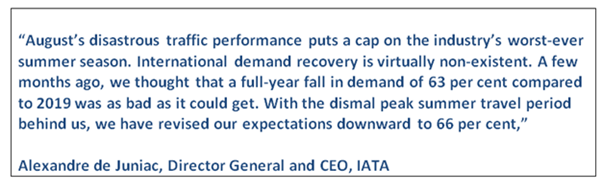
After describing it as a dull end to the worst-ever travel season, the International Air Transport Association (IATA) has cut its traffic forecasts for this year. The forecast released at the end of September reflected a weaker-than-expected recovery. The full-year traffic, according to IATA, is expected to fall 66 per cent as compared to 2019. IATA previously estimated an overall decline of 63 per cent.
In the northern hemisphere, the cash generated in the peak summer season generally provides a cushion to the airlines during the lean autumn and winter seasons. IATA noted that in 2020, the airlines lack all such protection.
IAG’s Rights issue
At the start of October, IAG, which owns the British Airways, informed its investors that as demand surpassed supply, all the shares in its £2.5 billion rights issue were taken up. During the pre-emptive subscription period that ended in September, shareholders of the company took up 92.75 per cent of new shares. Rest of the shares were allocated on a pro-rata basis as investors asked for more than double the number of new shares that remained.
IAG suffers losses
Aviation has been one of the hardest hit industries by the outbreak of the coronavirus pandemic. The recent increase in Covid-19 across Europe has necessitated tighter travel restrictions, besides the likelihood of another lockdown. Such a situation is expected to harm the entire industry. The aviation industry could not recover even after travel restrictions were eased after lifting the lockdown imposed in March. The fear of catching the infection, quarantine rules, and other health advisories discouraged people from making their travel plans.
For the first six months ending 30 June, IAG’s revenues dropped in excess of 50 per cent. The company reported €5326 billion, a fall of 55.7 per cent from €12,026 billion posted during the same period in 2019. This led the company to register a loss (excluding exceptional items) of €1,900 as compared to €1095 profit generated during the same period in 2019. The airline expected that passenger demand would recover to 2019 levels by 2023.
Trading update by EasyJet
In October, EasyJet released its trading update for the year ending 30 September, in which the company stated that in Q4, it carried more than nine million customers. The airline said it has implemented enhanced bio-security measures for best results. Besides a disciplined flying programme over the summer, the low-budget carrier has launched a restructuring programme.
In the winter season, the company would focus on cash generative flying for reducing losses and cash burn during the first half of financial year 2021. Since the beginning of the pandemic, EasyJet has risen over £2.4 billion in cash and is strongly positioned to face the ongoing challenging scenario. EasyJet posted total group revenue of £620 million for the quarter ending 30 September. Passenger numbers at the airline for the full year reduced by 50 per cent to 48 million.
Stock performance of IAG
Headquartered in London and registered as a Spanish organization, IAG is a global airline holding company. The shares of the airline are traded both on the Spanish Stock Exchange and the London Stock Exchange. On 20 October at 11.45 AM, the company’s stock (LON: IAG) was trading at £105.80 up 5.80 per cent from its previous day’s close of £100.00. The 52 week low high range was recorded as 91.00 and 671.00. With a market capitalisation of £4,965.74 million, the stock provided a negative return on price, which was minus 84.28 per cent on a year-to-date basis. The total volume of shares traded at the time of reporting was recorded at 25,804,108.
Stock performance of EasyJet Plc
EasyJet Plc is a low-cost European point-to-point airline. On 20 October 2020, at 11.49 AM, the company’s stock (LON: EZJ) was trading at £510.00 up 3.36 per cent from its previous day’s close of £493.40. The 52-week low high range was recorded as 470.70 and 1,552.00. With a market capitalisation of £2,253.60 million, the stock provided a negative return on price, which was minus 65.50 per cent on a year-to-date basis. The total volume of shares traded at the time of reporting was recorded at 1,988,944.
