
 AUS
AUS
 NZ
NZ
 UK
UK
 CA
CA
 USA
USA
 IND
IND




Summary
- J Sainsbury Plc’s sales contracted by 1.8% during H1 FY21.
- The Company has planned to close 420 standalone Argos stores by March 2024.
- Digital sales have increased by 117% year-on-year during H1 FY21.
- Special dividend of 7.30 pence was announced and will be paid on 18 December 2020.
J Sainsbury Plc (LON:SBRY) is the LSE listed consumer staples stock. Shares of SBRY were up by close to 1.11% from the last closing price (as on 9 November 2020, before the market close at 08:00 AM GMT).
J Sainsbury Plc: Sustainable business model and restructuring initiatives in process
J Sainsbury Plc is the FTSE 100 listed Company, which is operating in three business segments: Retail – Food, Retail – Clothing & General Merchandise and Financial Services. The leading brands of the Company are shown below –
(Source: Company website)
Operational updates for the 28 weeks ended on 19 September 2020 as of 05 November 2020.
Closing of 420 Argos stores: On 05 November 2020, the Company has updated that they will shut down around 420 Argos standalone stores by March 2024 because of reduced consumer demand for its products. It will cut down UK Argos standalone store estate to around 100.
583 Argos stores were closed on 24 March 2020 after the emergence of Covid-19 pandemic and restrictions due to nation-wide lockdown. The reopening of these stores happened in a phased manner and, 148 stores, that did not reopen since 24 March 2020 are now permanently closed. Although the Company has also mentioned that they would consider opening further 150 Argos outlets in its supermarkets by 2024, there is also planning to open other 150-200 collection points. Every supermarket will have either an Argos store or a collection point. The Company would reduce the operating costs by £105 million by March 2024 due to shifting 150 Argos standalone stores into Sainsbury's supermarket and bringing down the number of Argos standalone stores to 100 by March 2024.
Cutting down of 3,500 jobs: The Company has announced that they would cut down 3,500 roles because of restructuring activity. However, the Company is also expecting to add up 6,000 new jobs by the end of the financial year.
Shutting down of meat, fish, and delicatessen counters: The Company has closed its meat, fish and delicatessen counters in March 2020 on account of weak consumer demand for these products and reduction of food waste. The closure of the meat, fish and delicatessen counters will result in contraction of around £60 million in its operating costs.
Special dividend of 7.3 pence: The Company did not pay any dividend for the financial year 2019-20 and decided to defer dividend payments due to uncertainty revolving around the potential impact of Covid-19 Pandemic. However, the Company has agreed to pay the special dividend of 7.3 pence in place of a final dividend for the FY20 in addition to an interim dividend of 3.2 pence for the current year due to strong balance sheet and trading performance. The dividend will be paid on 18 December 2020.
H1 FY21 results (28 weeks ended on 19 September 2020) as reported on 05 November 2020
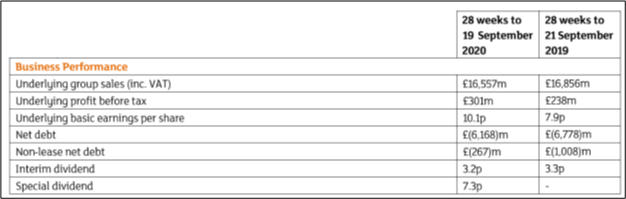
(Source: Company result)
Sales during the first half have been strong and remained on the same lines as it was during the prior year. The sales for H1 FY21 dropped by just 1.8% and stood at £16.56 billion in comparison to £16.86 billion in the first half of the prior year. However, Adjusted PBT (Profit before tax) was surged by 26.47% year-on-year from £0.238 billion in H1 FY20 to £0.301 billion in H1 FY21 indicating, strong trading performance.
The Company has strengthened its balance sheet during the period by reducing the net debt from £6.77 billion in H1 FY20 to £6.16 billion in H1 FY21. Free cash flow has surged by 35% from £0.698 billion in H1 FY20 to £0.943 billion in H1 FY21. Hence the Company has planned to pay the special dividend of 7.3 pence along with the interim dividend of 3.2 pence.
Segmental Performance
(Source: Company presentation)
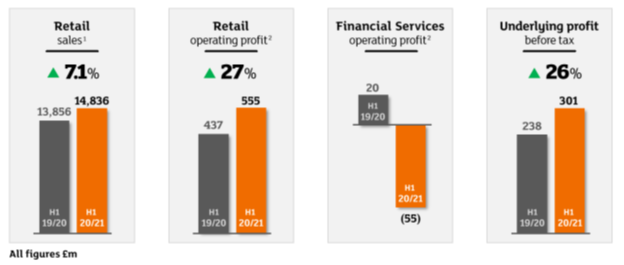
Retail sales have increased by 7.1 % year-on-year during H1 FY21, while Grocery sales and General Merchandise sales have grown by 8.2 % and 7.4 % year-on-year during the same period, respectively. The operating loss for the Financial Services business segment stood at £55 million during H1 FY21.
(Source: Company presentation)
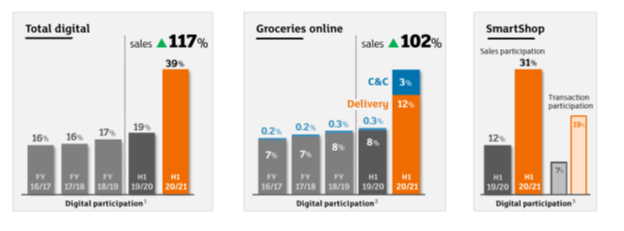
Digital sales have increased 117% year-on-year and stood at £5.80 billion during H1 FY21 reflecting, the shift in consumer preferences. Grocery online sales have also increased by 102% year-on-year during H1 FY21.
Share Price Performance Analysis of J Sainsbury Plc
(Source: EODHD/Others, chart created by Kalkine group)
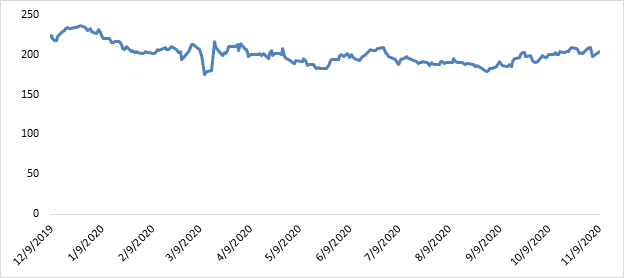
Shares of J Sainsbury Plc were trading at GBX 203.13 and were up by close to 1.11% against the previous closing price (as on 9 November 2020, before the market close at 08:00 AM GMT). SBRY's 52-week High and Low were GBX 236.70 and GBX 171.19, respectively. J Sainsbury Plc had a market capitalization of around £4.62 billion.
Business Outlook
Trading performance of the Company during the first half of the financial year remained strong driven by strong sales shown by Argos, despite unprecedented challenges. Retail costs of around £290 million incurred for the safety of employees were offset by £230 million of business rates relief. The Financial Services segment has underperformed during H1 FY21; however, it is expected to generate profit during the second half of the year. Grocery sales and general merchandise sales have performed very well so far in the second half of the year. The Company is expecting its profit for FY22 to remain higher than the reported profit for FY20.
The Company remained cautious regarding the outlook for the second half of the year considering another nation-wide lockdown. Still, the Company has estimated profit growth of at least 5% year-on-year for FY21. Capital Expenditure is going to increase for the next three years on account of funding high-quality logistics and restructuring of Argos. The Company will continue to generate strong cash flow with an average retail free cash flow of £500 million per annum for the next three years.
