
 AUS
AUS
 NZ
NZ
 UK
UK
 CA
CA
 USA
USA
 IND
IND


.jpg)





HIGHLIGHTS
- UK shares have managed a moderate gain in the present calendar year
- LSE’s FTSE 100 lags behind many European and three Wall Street averages
- The third-large share has outperformed the headline index FTSE 100
UK shares have managed a moderate gain in the present calendar year as compared to the regional European peers, as well as the American indices. The domestic benchmark index FTSE 100 has appreciated a little more than 10% in 2021 so far, while a bunch of underlying blue-chip components have outnumbered the benchmark gains with some shares vastly outperforming the index.
According to the historical data available with the London Stock Exchange, the FTSE 100 has advanced approximately 11% in the current year, absorbing a number of unforeseen market events as the Covid-19 pandemic continues to handhold the equities and other critical business functions.
A gain of nearly 11% in the year, which was touted as the stretch of recovery certainly disappoints a large section of investors as comparable peers including the DAX of Germany’s Frankfurt Stock Exchange, CAC 40 of France’s Euronext Paris, FTSE MIB of Italy’s Borsa Italiana and Swiss Market Index of Switzerland’s SIX Swiss Exchange have surged 14-26% with CAC 40 emerging as the biggest gainer among the pack.
Meanwhile, the three major American averages including the Dow Jones Industrial Average, the wider share barometer S&P 500 and the technology-laden Nasdaq Composite have amassed a gain between 18% and 27% with S&P 500 emerging as the clear winner among all the aforementioned indices.
As far as the top 20 components of FTSE 100 by market capitalisation are concerned, many shares have considerably outperformed the headline index. Here we take a look at the third-biggest stock included in the prestigious index that has soared more than 30%, effectively supporting the market index.
Top FTSE Stocks with over 30%
Shares of Diageo (LON:DGE), the London-headquartered alcoholic beverage maker, have rallied a little over 34%, staging a stronger run in the 11-month period so far. The stock has climbed as much as 34.5% to GBX 3,976.50 from a share price level of 2,956.50 apiece.
Diageo shares (YTD performance)
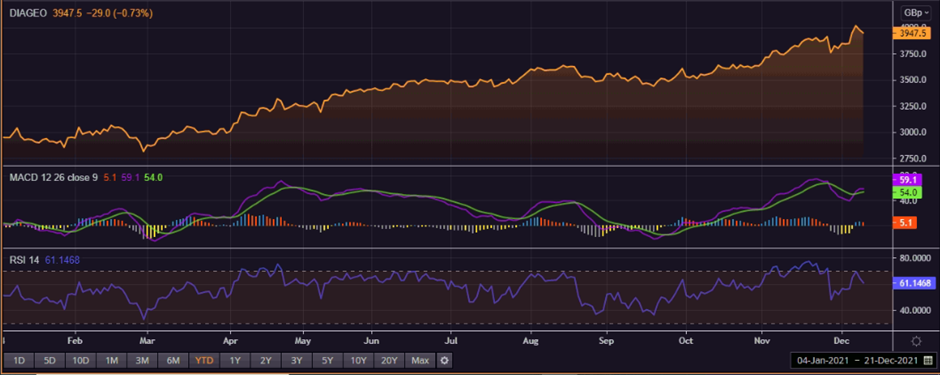
Source: EODHD/Others
Not only this, the stock of Diageo has been the best performer among the top five components of index according to the stock market value, effectively beating the likes of AstraZeneca (LON:AZN), Unilever (LON:ULVR), HSBC Holdings (LON:HSBA) and GlaxoSmithKline (LON:GSK). Of these four shares, the stock of Unilever stands with a loss of 11%, while the other three have gained 9-16%.
While announcing the financial results for the year ended 30 June, Diageo provided a cautious outlook as Covid-led uncertainty has severely disrupted the trade, travel and leisure holidays.

As a result of this, the sales growth in FY21 stands flat as compared to the sales in the year ended 30 June 2019.

However, the company has managed to report a growth of 10% in the net sales to GBP 12,733 million in FY21, with the operating profit and the profit attributable to shareholders rising 75% and 89%, respectively, as compared to a similar 12-month period of FY20.
The stock of the leading spirits manufacturer has managed an upswing of more than 60% in nearly 21 months from the multi-month lows recognised during the Covid-steered collapse.
Earlier in November 2021, the corporation announced to begin the next tranche of return of capital (ROC) programme, announced previously. Under the upcoming tranche, Diageo is planning to distribute up to £4.5 billion to all the eligible shareholders by the end of financial year 2024.

The Johnnie Walker maker had repurchased shares up to a value of £1.25 billion under the first phase of ROC programme, completed on 31 January 2020, just months before the markets experienced unforeseen adversities of the coronavirus pandemic. The second phase of ROC programme launched on 12 May 2021 of up to £1 billion, is set to be completed by the end of FY22.
Diageo, much like many other corporations, grappled with the operative challenges including the malfunctioned supply chains, higher input prices with the UK rate of inflation hovering near a decade high. The company expects its operating margin to benefit from a considerable recovery in the sales volume and premiumisation trends. The enterprise continues to manage the supply side troubles and higher inflationary pressures.
