
 AUS
AUS
 NZ
NZ
 UK
UK
 CA
CA
 USA
USA
 IND
IND








Summary
- The British government has allocated £32 million in funding for six high-tech healthcare projects.
- The amount would be divided between the projects undertaken by various UK universities.
- These projects shall focus on using innovative technologies like AI, infrared lasers, non-invasive scanning, robotics, remote health monitoring, hearing aids, optical fibres, and lasers.
- The UK government has also promised to provide £300 million of funding to upgrade research centres and labs throughout the UK.
The UK government has allotted £32 million for six high-tech healthcare projects on 7 September 2020. Over the years there have been significant developments on usage of modern technologies like artificial intelligence (AI), laser, sensor, and quantum computing for effective diagnosis and treatment. However, any related research requires substantial monetary investments and testing for meaningful outcomes. In this article we present the details of the funding and discuss some of the companies, including EMIS, KNOX, and Craneware that work on health-related technologies.
Government to fund six high-tech healthcare projects
Amanda Solloway, the minister for science, research, and innovation announced funding of £32 million for six high-tech healthcare projects at the launch of the London Tech Week on 7 September 2020. The amount would be divided between the projects undertaken by various UK universities. These projects have focused on usage of AI and infrared lasers to expedite early diagnosis, innovative non-invasive scanning, robotics, remote health monitoring, hearing aids that adapt to the environment, besides studies on microsurgery through optical fibres and lasers that could eradicate individual cells. In addition, the government has promised to provide £300 million of funding to upgrade research centres and labs throughout the UK.
It is known that the coronavirus-led crisis that disrupted the supply chain systems has also impacted the research related activities. Besides slowing the developments, it has reduced the government’s attention on research and development work in the healthcare segment. It is to be noted that the infrastructure required for some of these technologies like sensor and the internet of things (IoT) rely on various metals, including gallium, germanium, indium, tellurium, and cadmium, among others. The government’s renewed focus and funding on high-tech, healthcare projects is an indication of long-term and sustained demand for these specialist metals. In addition to transportation and manufacturing, healthcare is considered to be a leading growth driver for the semiconductor technology.
Also read: New Rules To Protect Critical Public Health Firms From Foreign Takeovers
Also read: 5 Vaccine Stocks Doing Well in the UK
Coronavirus pandemic brings increased focus on health tech companies
During the coronavirus pandemic, the role of companies in the health tech sector has taken a centre stage as they have been quite instrumental in the response to the unprecedented health crisis. The government has launched a support and investment package for innovative tech businesses that have suffered due to the crisis.
The speed at which the health tech companies have enabled the digital transformation in response to the pandemic has strengthened the focus on the activities, innovation, and research and development (R&D) being carried out by the sector. There have been instances of tech-enabled activities and ways to stay safe as well as delivery of routine services.
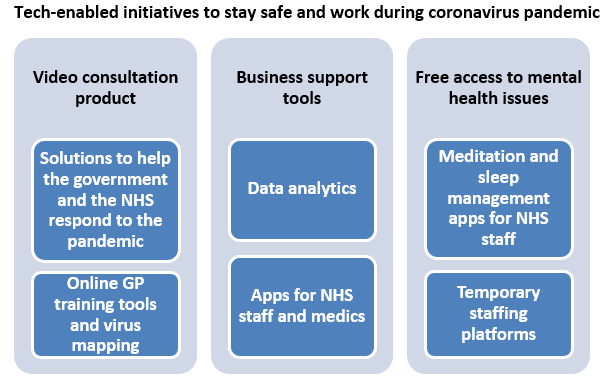
Some of these included development of a video consultation product, practical solutions to help the government and the NHS respond to the pandemic, online GP training tools and virus mapping, business support tools, data analytics, apps for NHS staff and medics, free access to mental health issues, meditation and sleep management apps for NHS staff, and temporary staffing platforms, etc.
Market experts believe that in addition to helping in these crisis times, such innovations would define the future of country’s healthcare and the world at large. It is to be recalled that the chancellor, Rishi Sunak had announced £1.25 billion government support package for innovative tech firms that are not eligible for the coronavirus rescue schemes. This amount included an investment fund of £500 million for high-growth companies. In order to access the fund, a company was required to have already raised at least £250,000 in private equity (PE) funding over the last five years.
As per the estimation from Tech Nation’s Data Commons, in the last five years, global venture capital (VC) investors had put around $7.7 billion, making it the second biggest tech sector investment after fintech.
Stock performance of three healthcare technology companies - EMIS, KNOS, and Craneware
EMIS Group plc (LON:EMIS) is a leading UK company that provides healthcare software, information technology, and other related services. On 8 September 2020, at 9.18 AM, the company’s stock was trading at £1,056.00 up 1.15 per cent from its previous day’s close of £1,044.00. The 52-week low high range was recorded as 813.00 and 1,226.00. With a market capitalisation (Mcap) of £660.97 million, the stock provided a negative return on price, which was minus 6.79 per cent on a year to date (YTD) basis. The total volume of shares traded at the time of reporting was recorded at 2,104.
Kainos Group plc (LON:KNOS) is into digital transformation across the commercial, public, and healthcare sectors. On 8 September 2020, at 9.27 AM, the company’s stock was trading at £991.00 down 1.69 per cent from its previous day’s close of £1,008.00. The 52-week low high range was recorded as 430.00 and 1,166.00. With a market capitalisation (Mcap) of £1233.10 million, the stock provided a negative return on price, which was plus 28.28 per cent on a year to date (YTD) basis. The total volume of shares traded at the time of reporting was recorded at 7,167.
Craneware plc (LON:CRW) provides automated value cycle solutions to boost financial performance of organisations in healthcare. On 8 September 2020, at 9.49 AM, the company’s stock was trading at £1,755.00 remaining unchanged from its previous day’s close. The 52-week low high range was recorded as 1330.00 and 2,650.00. With a market capitalisation (Mcap) of £470.81 million, the stock provided a negative return on price, which was minus 26.72 per cent on a year to date (YTD) basis. The total volume of shares traded at the time of reporting was recorded at 1,709.
Also read: The UK Healthcare Sector and Some Companies with Sound Performance
Also read: Two AIM Listed Healthcare Stocks Trending on LSE: Genedrive PLC & Midatech Pharma PLC
Conclusion
Many industry experts believe that the UK health tech sector has attracted increased importance in recent times and the pandemic has accelerated the interest significantly from various corners, including the government. The companies in the sector need to come forward and show creativity to face the challenges of the healthcare sector during the pandemic as well as the future. This is an opportune time to increase the emphasis on digital transformation, data, AI, IoT, and other related technologies to support the healthcare industry by developing easy to use and affordable tools. These require continued research by the sector and government’s funding for the high-tech healthcare projects is a step in the right direction.
