
 AUS
AUS
 NZ
NZ
 UK
UK
 CA
CA
 USA
USA
 IND
IND








Highlights
- Automaker Volvo Car AB’s IPO will be launched on the Nasdaq Stockholm Exchange today, a day later than its initial plan.
- The company now has a valuation of about US$ 18 billion, compared to its earlier US$ 23 billion valuation.
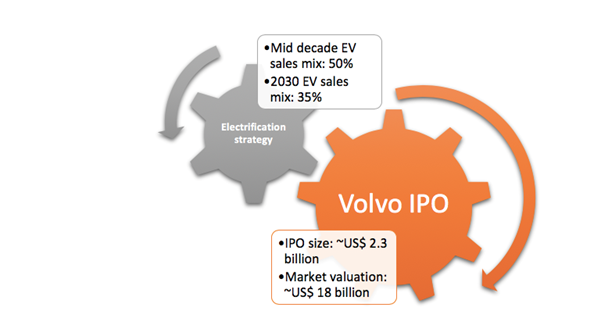
- The proceeds from the IPO are now expected to be around US$ 2.3 billion
Swedish automaker Volvo Car AB’s shares are set to begin trading on the Nasdaq Stockholm Exchange from 29 October, a day later than its initial plan.
The delay occurred as the group had to cut its valuation target and set its issue price at the bottom of its IPO price range earlier this week after it faced difficulty in attracting investor interest.
Despite its reduced price, Volvo is expected to be one of the biggest IPOs in Europe so far in 2021.
Volvo IPO
The group, which is owned by Chinese carmaker Zhejiang Geely, slashed its target market valuation from about US$ 23 billion to about US$ 18 billion ahead of its trading debut.
Volvo set its IPO issue price at SEK 53 per share, at the bottom of its previously announced IPO price range of SEK 53 to SEK 63. Thus, its IPO size is now expected to be around US$ 2.3 billion.
Geely, which plans to continue holding the majority shares of Volvo, also said it plans to convert its super-voting shares to normal ones.
On Monday, the group had said it’s free float would be between 16 per cent to 17.9 per cent on the listing. This would depend on whether the over-allotment option would be exercised ahead of its IPO.
The company said in a statement that the IPO is expected to have over 200,000 new shareholders. It added that the IPO was substantially oversubscribed due to strong interest from institutional investors in Sweden and abroad. The group has also attracted interest from retail investors in the Nordic region as well.
© 2021 Kalkine Media
UK retail investors would be able to buy Volvo’s shares for the first time starting today.
The amended pricing and listing details would now value Volvo lesser than EV group Polestar, which is expected to have a valuation of about US$ 20 billion. Polestar intends to list by merging with a special purpose acquisition company (SPAC) in 2022.
Volvo’s electrification plans
The company plans to use the proceeds from its IPO to help with its ambitious long-term electrification strategy, which is the most advanced amongst legacy auto manufacturing companies.
The group aims to have EVs account for 35 per cent of its total car sales by 2030. The move also coincides with the UK’s sales ban of new petrol and diesel vehicles by 2030.
Volvo also plans to up its EV sales to 50 per cent of its car sales mix by mid-decade. The company also increased its EV production to over 171,000 units in FY 2021, from less than 40,000 units a couple of years before.
Bottom Line
There has been strong momentum in the EV space; recently EV major Tesla crossed the US$ 1 trillion market cap to become one of the few US-based tech companies to have a valuation of over US$ 1 trillion.
However, concerns over Geely’s holding majority shareholding post listing, trade tensions between China and EU and global supply chain challenges can weigh on the company in the short term.
Volvo earlier had to scrap its IPO plans in 2018 due to trade tensions with China and due to the auto sector facing a downturn.
