
 AUS
AUS
 NZ
NZ
 UK
UK
 CA
CA
 USA
USA
 IND
IND







As Reckitt Benckiser Group Plc (LON: RB.) announced its full-year results, it highlighted that in this trying times, the demand for companyâs products such as Dettol and Lysol, as well as other hygiene products has steeply risen, as people want to move towards anti-septic and anti-infective due to a higher hygiene consciousness, especially in China.
Demand for Companyâs products increases due to coronavirus
In a twisted turn of events, the global epidemic Coronoavirus (Covid-19), which has caused a huge financial and operational hindrance to businesses all across the world, along with tragic loss of thousands of lives, it has also boosted the demand for Reckitt Benckiserâs products, especially in China. After the announcement of its results on 27th February 2020, the company reported that there was a massive surge in demand for the cleaning products such as Dettol and Lysol, which are an anti-septic and anti-infective product used for cleaning, primarily due to an increased awareness in terms of hygiene within customers. Such hygiene measures across the world has also led to a surge in the online orders for all its hygiene, health and nutritional goods.
The swiftly increasing presence of the company in the Chinese market, despite some resilience amidst the pandemic, will be a major boost for the company, as the company is looking to improve its competitiveness, through growth led initiatives. For this purpose, the company had also announced a £2 billion investment in the next three years period. The companyâs major focus is to improve its e-commerce business capabilities in China, a space that has seen a significant boost in consumer demand, especially since the coronavirus outbreak.
Reckitt Benckiser Group Plc
Reckitt Benckiser Group is a UK based company that manufacture and sell products that cater to the peopleâs needs for hygiene, nutrition, wellness as well as digital health. The companyâs primary objective is to cater to public systems as well as to the underlying demand for self-care, STI prevention and good hygiene practices amongst individuals all across the globe.
The company has categorised its products under three product segments, which are - Hygiene, Health and nutrition. In the Hygiene segment, the companyâs product portfolio is for the purpose of eliminating dirt, germs, pests and bad odours. The Health segment caters to self-care, health hygiene, sexual wellbeing as well as general wellness of individuals. In the Nutrition segment, the company has a portfolio of product, which are high quality in nature and fulfil the nutrition needs of families all across the globe.
Some of the companyâs most famous brands that are used globally, include the likes of Dettol, Lysol, Harpic, Air Wick, Mortein, Strepsils, Veet, Vanish, Durex and Nurofen.
- Financial Highlights
On 27th February 2020, Reckitt Benckiser Group Plc declared its fourth quarter as well as full-year results for the period that ended on 31st December 2019.  In terms of the results from the continuing operations, the net revenue for the year was reported to be at £12.846 billion, an actual increase of 2.0 per cent year on year, and a like for like net revenue growth of 0.8 per cent. The like for like net revenue growth for the fourth quarter declined by 0.5 per cent year on year, and the net revenue for the fourth quarter of 2019 was reported to be at £3.321 billion. On a reported basis, the operating loss for the period was reported to be at £1.954 billion, a decline of 163.9 per cent year on year, while the adjusted operating profit for the period declined by 0.1 per cent and was reported at £3.367 billion for FY 2019. On the reported basis, the net loss for the period had declined by 228.7 per cent year on year and was reported to be at £2.785 billion. The company declared a net income for the period on an adjusted basis, which was reported at £2.473 billion, an increase of 2.7 per cent year on year. The company declared a diluted loss per share of GBX 393.00 per share on a reported basis, which was a decline of 228.80 per cent year on year, while the diluted earnings per share for the period, on an adjusted basis stood at £349.00 million, which was an increase of 2.8 per cent.
For total operations, including the discontinued operations, the reported net loss declined by 270.60 per cent year on year and was reported to be at £3.683 billion, while the net profit on the adjusted basis increased by 2.7 per cent year on year and was reported to be at £2.473 billion.
It was also reported that the full-year dividend stood at GBX 174.6 per share, as opposed to the full- year dividend in 2018 at GBX 170.7 per share. This was a reflection of the boardâs proposal of a final dividend of GBX 101.60 per share, as compared to the final dividend in 2018 which stood at GBX 100.2 per share.
| Results at a glance | Q4 (£m) | % change actual | % change constant | FY (£m) | % change actual | % change constant |
| Continuing operations | Â | Â | ||||
| Net Revenue | 3,321 | -0.50 % | 0.40 % | 12,846 | 2.00 % | 0.80 % |
| - Like-for-like growth | Â | Â | 0.30 % | Â | Â | 0.80 % |
| Operating loss - reported | Â | -1,954 | -163.90 % | -166.00 % | ||
| Operating profit - adjusted | Â | 3,367 | -0.10 % | -1.90 % | ||
| Net loss - reported |  | -2,785 | -228.70 % | -231.00 % | ||
| Net income - adjusted |  | 2,473 | 2.70 % | 0.70 % | ||
| Loss per share (diluted) - reported | -393 | -228.80 % | ||||
| Earnings per share (diluted) - adjusted | 349 | 2.80 % | ||||
| Total operations (including discontinued operations) | Â | Â | Â | Â | Â | Â |
| Net loss - reported |  | -3,683 | -270.60 % | -272.90 % | ||
| Net income - adjusted |  | 2,473 | 2.70 % | 0.70 % | ||
| Loss per share (diluted) - reported | -519.7 | -270.70 % | ||||
| Earnings per share (diluted) - adjusted | 349 | 2.80% |
Source: Company Website
Stock Price Performance
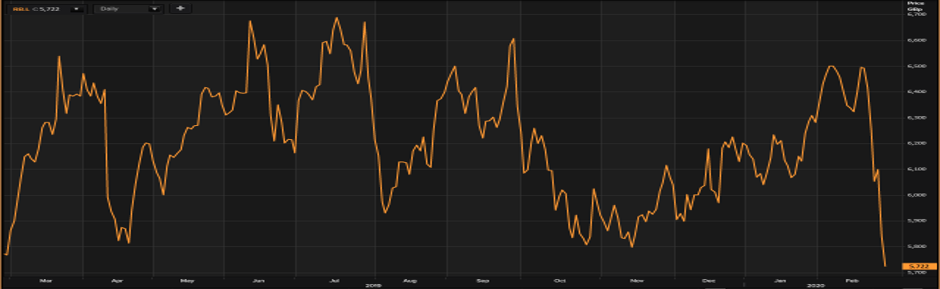
(Source: Thomson Reuters) Daily Chart as on 28-February-20, before the closing of the LSE Market
As on 28th February 2020, at 08:30 A.M (Greenwich Mean Time), by the time of writing this report, the Reckitt Benckiser Group Plc stock was trading at a price of GBX 5722.00 per stock on the London Stock Exchange market, a decline in the value of 2.04 per cent or GBX 119.00 per stock, as opposed to the price of the stock on the previous trading day, which had been reported to be at GBX 5841.00 per stock. As of the time of writing, the stock of Reckitt Benckiser Group Plc was reported to have been trading 3.85 per cent above the 52-week low stock price, that was GBX 5510.00 per stock, and the company set this price on October 22, 2019. At this time, the stock price was reported to have been trading 15.15 per cent lower than the 52-week high price of GBX 6744.00, that the company achieved as on September 27, 2019. At the time of writing this report, the market capitalisation of Reckitt Benckiser Group Plc has been reported to be at a value of GBP 43.287 billion, with respect to the current trading price of the companyâs stock.
It has been reported that the Reckitt Benckiser Group Plc stock had lost around 0.78 per cent in value, in the last twelve months, since February 28, 2019, when the stock was trading at a price of GBX 5767.00 per stock at the time of the close of the market. It has also been reported that the companyâs stock has lost approximately 10.10 per cent, in the last six months, in comparison with the stock price of GBX 6365.00 at the time of the close of the market as on August 28, 2019. Reckitt Benckiser Group Plcâs stock has been reported to have lost 8.29 per cent, in the previous thirty daysâ time from the stock price of GBX 6239.00 per stock that the stock set as on January 28, 2020.
The beta of the stock of the company was reported at a value of 0.83 at the time of writing. This indicates that the movement in the price of the stock, is less volatile, as opposed to the movement in the value of the comparative benchmark index.
