
 AUS
AUS
 NZ
NZ
 UK
UK
 CA
CA
 USA
USA
 IND
IND







Summary
- The European Union has witnessed a record plunge in car sales for the year ended December 2020 because of COVID-19 led shutdowns.
- There were significant double-digit declines for car sales across several countries of the European Union.
- The latest numbers reflect varied performance between markets with 9.9% growth in Germany’s car registrations during December 2020.
- COVID-19 has presented tough times for the automotive industry, but several new trends are emerging in the new year.
Despite moving into the new year, the pandemic-related challenges continue to affect the world economy with no quick-fix in sight at the moment.
2020 was a defining year in many ways due to the significant challenges faced by societies and businesses. Several industries suffered due to the pandemic as continuing business activities during the lockdown phase was complicated. The automotive industry is no different and had to face the music.
The impact on business continuity was evident across all the sectors with varying intensity. The official numbers coming from industry associations reflect the pandemic’s effects and are raising alarms within the global business community.

©Kalkine Group 2021
Let us assess the impact of the pandemic on the European auto industry.
European Car Sales Experience Sharpest Decline
The 2020 numbers released by the ACEA (European Automobile Manufacturers Association) indicate that car sales across Europe contracted by as much as 25% during November 2020. According to the industry association, the demand for new passenger cars declined further by 3.3% in December 2020. The EU passenger car market shrank by 23.7% to 9.9 million units during the year. The decline came as a direct effect of the COVID-19 pandemic which triggered full-scale lockdowns and various restrictions across the year.
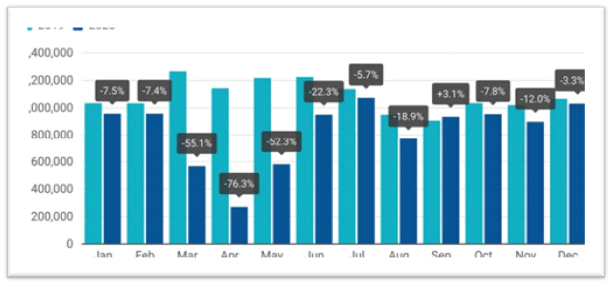
Passenger car registrations: (Source: ACEA)
ACEA also declared that this is the biggest year-on-year plunge in car demand ever to hit the capital-intensive industry since record-keeping began. Notably, double-digit declines were recorded throughout 2020 across all 27 markets of the EU. Spain reported the sharpest drop of 32.3%, followed by 27.9% in Italy and 25.5% across France.
For December, the numbers presented a mixed picture. While Italy and France recorded 14.9% and 11.8% fall respectively in car registrations, Germany posted a substantial gain of 9.9%, and Spain had steady numbers, comparable to December 2019 figures. Moreover, full-year declines for Germany (regarding new-car registrations) were comparatively lower at 19.1%.
Past Projections Hold True
In June 2020, the ACEA had provided a revised estimate for EU passenger car registrations with the industry body anticipating a ~25% decline. The revised forecast was based on the substantial economic crisis stemming from the COVID-19 scenario and its bearing on the global auto industry. The final figures released on Tuesday corroborated the June estimates.
The ACEA had remained hopeful about mitigating this dramatic situation by instilling quick and robust procedures directed by the EU and local governments. Moreover, there were concerns raised over the urgent need for purchase incentives and scrappage arrangements. These were anticipated to provide the much-required boost to the demand for new cars and limit the damage on production as well as employment fronts in coming times.
The 2020 performance was in stark contrast to the previous year’s performance with the EU passenger car fleet growing 1.8% (~242.7 million cars on the road).
Europe’s automotive industry is a crucial component of the region’s prosperity and is among the biggest motor vehicles manufacturers across the globe. The sector represents the biggest private investor in R&D, for which the European Commission provides financial aid.
The automotive industry is of great importance for the EU economy as it creates a multiplier effect, vital for both upstream industries (textiles steel and chemicals) and downstream industries (repair, ICT, and mobility services).
Challenging Environment created by the Pandemic
COVID-19 has imposed challenging times for businesses worldwide, and companies are struggling to get back to pre-COVID-19 levels. This seems touch at the moment as the situation is still not calm regarding the spread of COVID-19 infections. A new strain of COVID-19 was detected in the UK, which is 70% more contagious than the original COVID-19 virus.
The disease’s speedy spread led to nationwide lockdowns across almost all the economies and businesses were forced to shut down, resulting in no production during these months’ extended shutdowns.
However, the Governments have remained at the forefront in formulating policies and incentive schemes that could limit the industries’ damage in terms of unemployment and production. Emphasis is being placed on electrification of transportation, but a lot still depends on how soon the situation can cool down.
Although 2020 was a year to forget for the business community, several developments around innovation and resilience surfacing across the industry offer hope for the coming period.
DO WATCH: Can a tiny chip scarcity halt the Automobile industry operations?
