
 AUS
AUS
 NZ
NZ
 UK
UK
 CA
CA
 USA
USA
 IND
IND







Summary
- Chinese UC Davis researcher was arrested on visa fraud in the US.
- The US also plans on banning one of the popular video-sharing social networking platform TikTok.
- ByteDance claims that the TikTok does not store data in China, but the Company's privacy policy has the rights to share any information with the Chinese authorities.
Last week, the US Justice Department accused two Chinese hackers with cyber theft campaign, including stealing COVID-19 research.
After the incident, The US President Donald Trump said that the US-China trade pack mean less to him now. Amid the uncertainties, one thing is evident, US-China diplomatic relations are worsening day by day.
On Friday, a Chinese UC Davis researcher was arrested and booked at the Sacramento County Jail on visa fraud. Tang Juan was caught hiding in Chinese consulate in San Francisco. Tang is currently facing charges in federal court in California for lying about her military background.
Tang Juan had lied about her military affiliation in a visa application last October. She lied to work at University of California, Davis and again during an FBI investigation interview last month. Tang had been a visiting researcher at UC Davis.
FBI found Tang’s photographs wearing the uniform of People's Liberation Army civilian cadre. They also reviewed articles from China which identified her military affiliation.
When agents interviewed her last month, she denied having any past or current association with the military. She claimed not knowing the significance of the insignia on the uniform she was photographed wearing. The agents found more evidence at her house after the search.
In a statement issued by UC Davis, Tang left the university at the end of June. Her work was in the research laboratory, in the Department of Radiation Oncology. Her work was funded by an exchange program affiliated with China's Ministry of Education and Xijing Hospital in Xi'an, China.
The strained relations between the US and China is deteriorating as the US ordered the closure of the Chinese consulate in Houston. The latter retaliated by shutting down the US consulate in Chengdu, Sichuan.
The US mulls banning TikTok
Apart from the arrest of a researcher and indictment of Chinese hackers, the US also plan on banning one of the popular video-sharing social networking platforms, TikTok. The US Secretary of State Mike Pompeo claimed that the user data is being sent to China. As of now, China is denying all the allegation coming from the White House.
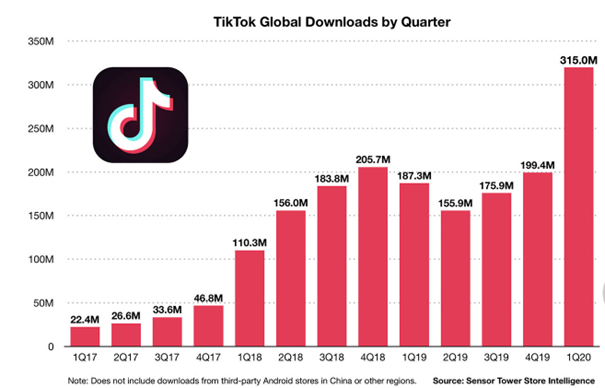
A video-sharing service, China’s TikTok is owned by Beijing-based ByteDance. The video-sharing app was launched in 2017 on iOS and Android platforms outside China, but it came available worldwide after merging with Musicaly.Iy. After that, it became the most downloaded app in the US in 2018.
ALSO READ: TikTok is popular no doubt, but it is not ticking the right box in the US
Source: SensorTower
TikTok in Controversy Over Security:
In January 2019, an independent investigation was conducted by an American think tank Peterson Institute for International Economics. It described TikTok was “Huawei-sized problem” which posed a national security threat to the countries. The danger included to armed forces personals who are using this app, alleged apps ability to capture location, image, and biometric data to its Chinese parent company. ByteDance is legally unable to refuse to share data with the Chinese government under the China Internet Security Law. The observers also accuse ByteDance's founder and CEO Zhang Yiming of issuing a letter to the ruling Chinese Communist Party to promote its policies.
However, ByteDance claims that the app does not store data in China, but the Company's privacy policy has the rights to share any information with the Chinese authorities.
In December 2019, the United States Navy, as well as the US Army, banned the usage of the platform. Following the prohibition in the US, the Australian Defense Force also banned TikTok on its devices. The legislation was also passed in the US Senate to prohibit the use of the platform for all federal employees. After India-China border tensions in the Ladakh region, TikTok became unavailable from Apple’s App Store and Google Play Store in India. India banned other China-based platforms as well. With this ban, TikTok lost about 200m users in India.
People want to stay entertained during coronavirus pandemic. According to Sensor Tower Store Intelligence estimates, the app downloaded more than 2bn times globally on the App Store and Google Play. This report was from April 2020, before India banned the app.
A white paper published by Penetrum Security, a Swiss-based company, states that 37.70% of the known IP addresses linked to TikTok are Chinese. On TikTok’s ISP's privacy policy, they declare that they harvest and share your data with third-party vendors and business partners.
As the security concerns rise after Researchers arrest, TikTok remains caught in security controversy and Sino-American politics.
