
 AUS
AUS
 NZ
NZ
 UK
UK
 CA
CA
 USA
USA
 IND
IND







Summary
- The 6-month annualised growth rate in the Westpac-Melbourne Institute Leading Index rose from –4.42% in July to –2.56% in August, with bulk of the improvement observed in consumer sentiment, unemployment expectations and dwelling approvals.
- Westpac expects that growth in Q3 will be a robust 1.8% even after an anticipated 4% reduction in Victoria.
- Leading Index growth rate has continued to improve after bottoming out in April but remains below the pace, prior to Australia's nationwide lockdown.
- Westpac is expecting an expansionary budget from authorities on 6 October, the same day when Reserve Bank of Australia is also due to meet for the next monetary policy.
The Australian economy has started to pick up momentum gradually after it suffered a massive jolt from the coronavirus outbreak.
The 6-month annualised growth rate in the Westpac-MI Leading Index that shows the anticipated pace of economic activity comparative to 3-9 months into the future has shown a rise from -4.42% in July to -2.56% in August.
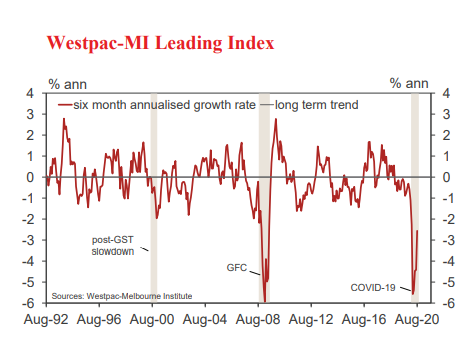
Source: Westpac-MI Leading Index, dated: 16 September 2020
The Westpac-Melbourne Institute Leading Index gauges a range of macroeconomic indicators, from drivers of economic growth to the sentiments bolstering the economic stance of the country.
Bill Evans, Chief Economist of Westpac, stated that the majority of the improvement in August was witnessed in consumer sentiment, unemployment expectations and dwelling approvals.
These indicators have been largely in line with Westpac's projection that the growth rate will be at robust 1.8% for the September quarter amid an estimated 4% reduction in Victoria, which represents about 25% of the national economic activity.
ALSO READ: GDP Plunged 7% in the June quarter | ASX Market Update
The upgraded growth for Q3 (September 2020) now implies a moderated rate for the following Q4 (December 2020), i.e. a reduction from 2.8% to 2.2%, as the anticipated recovery rate in Victoria has been lowered from 6% to 4%.
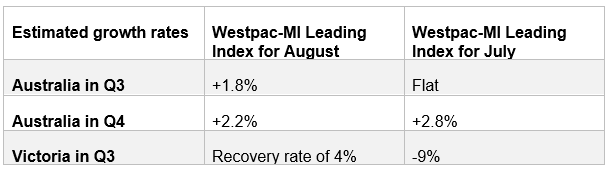
Mr Evans had earlier expected, as mentioned in the Westpac-MI Index for July, that strict lockdown measures due to resurgence of the virus in Victoria could lead to a 9% shrinkage in the economy of Victoria during the September quarter.
DID YOU KNOW? Victoria’s second wave of COVID-19 is pulling down jobs and consumer spending
The July index also showed projections that the growth rate for Australia would be flat in the September quarter before rising by 2.8% in December quarter assuming that Victoria shifts from Stage 4 to Stage 2, while there is no outbreaks in the other states.
However, Westpac forecasts have been more positive than RBA. Last month, RBA had projected the growth rate of Australia for 2H20 at 1.3% compared to Westpac's forecast of 4%. The central bank has also forecasted a much higher unemployment rate of 10% for the end of 2020 compared to Westpac's projection of 7.7%.
DID YOU MISS READING? Second Page of the COVID-19 Diary: Business Insolvencies, Unemployment, Underemployment
The Index growth rate is improving
Mr Evans stated that while the index's growth rate had been progressing from a severe low of -5.61% in April, it was still moving at a pace slower than that witnessed immediately prior to Australia's countrywide lockdown.
In August index, US industrial production, monthly hours worked, and commodity prices were the major components that had been acting as an added drag on the index, down by 0.76 ppts, 0.82 ppts and 0.35 ppts, respectively.
However, they have been counterbalanced by more positive contributions from other components, which includes the S&P/ASX 200 Index, the Westpac-MI Unemployment Expectations Index, the Westpac-MI Consumer Expectations Index and the yield spread, up by 0.66 ppts, 0.54 ppts, 0.39 ppts and 0.22 ppts, respectively.
Mr Evans stated that coronavirus induced adverse jolt experienced by Australia in March-April would eventually begin to cycle out of the 6-month growth rate calculation in the months ahead.
The growth rate is expected to shift into positive territory from September onwards as the severe weakness witnessed during March-April steps into the base of the calculation.
Consumer sentiment rises for September
According to Westpac’s bulletin dated 9 September, given the new COVID-19 cases in Victoria had slowed down remarkably, and there were no pieces of evidence of a second wave in either NSW or Queensland, consumer sentiment has risen for September by 18%.
DID YOU READ? 5 Steps Australia should take as the business re-opens across Victoria
The Westpac-MI index for consumer sentiment increased from 79.5 in August to 93.8 in September. The 18% increase in the sentiment arrived at the time when official statistics confirmed the news of Australia slipping into its first recession since 1992.
ALSO READ: Westpac-MI consumer sentiment index rebounds 18% in September
However, the September survey was concluded prior to the declaration of Victorian State Premier Andrews, on 6 September on the reopening to take more time than expected earlier.
The declaration could have resulted in decreased 14.9% rise in confidence in Victoria, but the dissatisfaction that came from expanding the lockdown measures would have been still more than compensated by the state's progress in suppressing the virus.
Outlook ahead
As per the RBA minutes for the September meeting, there has been some market speculation about a cut in the cash rate from the present 0.25% to 0.1%. Westpac stated that the alternative would stay under consideration, but the economy has no need to exercise the option at present.
ALSO READ: How increased spending support and cash rate at 0.25% would help the Australian economy
The policy measures adopted by the RBA Board persisted in bolstering accommodative financial conditions. The Board noted that the cash rate had been very low at 13 basis points and investors anticipated it to stay at that level for some time, reflecting a large amount of liquidity in the system.
DO READ: Policy rates remain unchanged, RBA expects 6% fall in GDP
The Reserve Bank of Australia is expected to be concentrating on helping government bond markets, including state and territorial borrowings, as it seeks to foster fiscal stimulus strategies to improve the growth rate of Australia.
GOOD READ: RBA's Projection: What if the Cash Rate stays at 0.25 per cent for 3 years?
The RBA Board is due to meet next on 6 October on the same day when the federal budget will also be announced. Westpac expects an expansionary budget from the Federal authorities on the budget day.
