
 AUS
AUS
 NZ
NZ
 UK
UK
 CA
CA
 USA
USA
 IND
IND


_06_12_2026_04_16_23_972185.jpg)




Summary
- Australian Energy Market Operator highlights the major decline in the wholesale electricity and gas market across Australia
- Major electricity generation uptake experienced in solar and wind power, whereas demand declined due to pandemic restrictions
- Government remains committed to passing on the benefits of low prices to consumers
The Australian Energy Market Operator (AEMO) released the Quarterly Energy Dynamics (QED) report for Q3 ending on 30 September 2020, outlining the electricity demand variations, price variations in the wholesale electricity and gas market. AEMO also highlighted the impact of pandemic restrictions on energy demand.
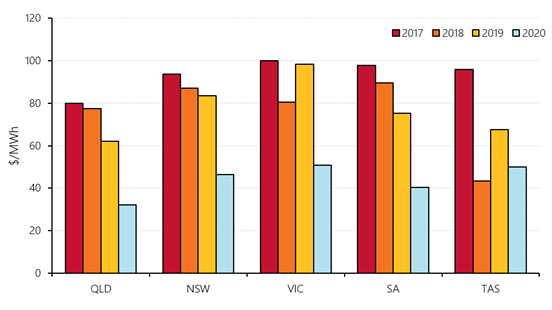
Q3 NEM prices Source: Australian Energy Market Operator (AEMO) Quarterly Energy Dynamics (QED) Report 2020
Must Read: Western Australia Gas Demand to Surpass Existing Production Capacity- Says AEMO Report
The prices in the National Electricity Market (NEM) dropped to the lowest levels since 2014, recording a decline of up to 48% against the corresponding period last year.
- South Australia - The quarterly electricity prices declined to the lowest Q3 levels since 2011 of $40 per MWh. The prices in September stood at the record monthly lows of $15/MWh
- Queensland – The quarterly average price stood at lowest Q3 levels since 2014 at $32/MWh
- New South Wales – The quarterly average price stood at lowest Q3 levels since 2014 at $46/MWh
Read Here: Renewable Energy Integration into The National Grid- Challenges and Opportunities
The report highlighted that the NEM‑average operational demand during the September 2020 quarter slumped by almost 313 megawatts (MW), registering a 1.4% decline against the previous year.
The major factors impacting the prices are-
- Enhanced output from coal generators
- Increased Solar and Wind electricity generation
Also Read: The Future of Energy Generation in Australia; Solar to Increase Three-Fold By 2024
Grid-scale wind and solar power together contributed to almost 14% of the energy mix, gaining 2% in the energy mix against Q3,2019. Additionally, wind and solar power generation surged to a record level of 35% of the total generation on 27 September 2020.
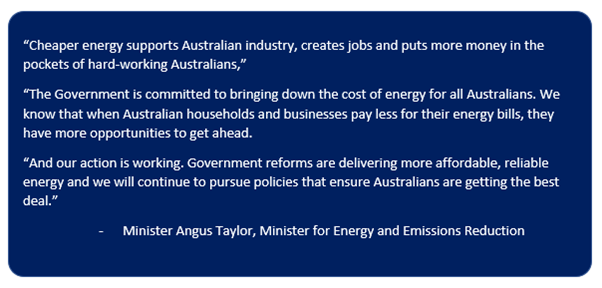
The Australian government remains committed to ensuring that the benefit of the declining energy cost is passed on to the end-users. The much-discussed Big Stick Legislation will ensure that the objective is met.
Suggested Reading: NEM Prices Average At Multi-year Low As Demand Dazes And Gas Price Declines in Q12020
AEMO also highlighted that the energy demand was adversely impacted due to the COVID-19 restrictions, especially in Victoria. Furthermore, the report confirmed the findings by the Clean Energy Regulator of observing a record increase in the domestic solar power during the pandemic.
