
 AUS
AUS
 NZ
NZ
 UK
UK
 CA
CA
 USA
USA
 IND
IND


.jpg)





Highlights
- A group of 24 countries and leading car manufacturers have committed to phase out fossil-fuel vehicles by 2040 in a bid to cut carbon emissions.
- The three leading car manufacturer, Volkswagen AG, BMW and Toyota Motors Corp and major car markets Germany, China, and the US, did not sign up due to challenges faced by the electric car industry.
- The UK government has already announced to end the sale of new petrol and diesel vehicles by 2030.
A group of 24 countries and leading car manufacturers have committed to phase out fossil-fuel vehicles by 2040 as part of efforts set at COP26 in a bid to cut carbon emissions. However, three leading car manufacturer, Volkswagen AG, BMW and Toyota Motors Corp and major car markets Germany, China, and the US, did not sign up due to challenges faced by the electric car industry.
Canada, the Netherlands, UK, New Zealand, and Ireland have already agreed to cut the production of new petrol and diesel car sales by 2030 and major car manufacturer such as Volvo, Ford, Mercedes, and Mercedes-Benz pledged to reach the goal by 2035.
Some countries including Kenya and India have agreed to seriously work towards accelerated proliferation of zero-emissions vehicles, and the group of fleet owners and financiers agreed to phase out fossil-powered cards.
Some car manufacturers are cautious of the high cost in shifting technology and lack of commitments from governments to ensure that the required charging and grid infrastructure would be build. The European Commission also announced an effective ban on fossil fuel vehicles by 2035 with commitment to build necessary infrastructure.
In 2020, around 175,000 electric vehicles were registered in the UK, up by 66% as compared to 2019 and there are more than 600,000 plug-in vehicles on the UK road. The UK government has already announced to end the sale of new petrol and diesel vehicles by 2030.
Also read: Fuel crisis: Good times ahead for electric vehicles?
Although, electric vehicles are becoming an attractive option to overcome the global issue of climate change, but there are a bagful of challenges that need to be addressed before the mass adoption and acceptance of electronic vehicles at a mass scale.
- Growing Infrastructure
The major challenge to shift towards electric vehicle is a limited charging infrastructure. Currently, the UK has over 22,000 connectors in around 12,000 locations, which means if you run out of charge it might not be easy to reach charging stations. So, it is still a long way to go, however some of the UK has well charging infrastructure.
Charging electric vehicles are far more time consuming than petrol and diesel vehicles. Factors such as how long it takes is down to the make and model of electric vehicles, the charging network its connected to and the type of charger it uses make a huge difference.
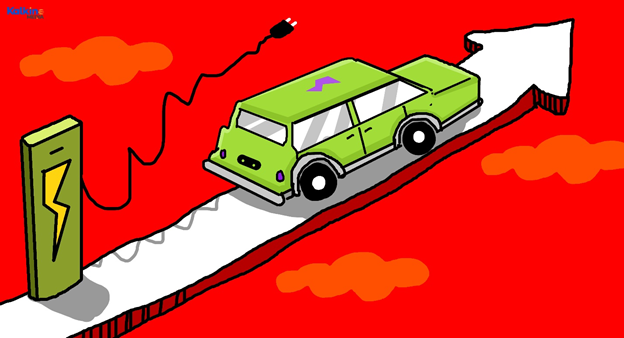
Source: Copyright © 2021 Kalkine Media
For example, it may take half an hour to charge 80% electric vehicle battery of the modern model connected to the fastest chargers, while for more basic models on slower connections it may take up to eight hours.
- A Lifestyle Choice
While an electric vehicle takes a lot of time to charge, but many EV owners don’t see this as a problem as of now. In fact, many EV owners are now installing EV chargers at homes and workplaces that means you can charge your car while you are working.
Longer trips may take some planning, you may charge EVs for free at many shopping centers and hotels but have to pay charges elsewhere. Websites and apps like Zap-Maps are making it easy to spot charging points.
Also read: Bold climate goals in COP26: Unwavering move or political greenwashing?
- Expensive to buy and maintain
Electric vehicles are still quite expensive to buy as compared to internal combustion engine vehicles. Many governments across Asia, Europe and North America have introduced financial incentives and discounts, which may reduce initial vehicle costs. But as compared to petrol and diesel vehicles, operational costs such as electricity for battery electric vehicles and plug-in hybrids is much lower. If the EV owner can charge their vehicle at home or work, they can run their car for a fraction of the cost of a petrol or diesel alternative.
However, if you use the public charging network regularly, you may struggle to find a free spot.
You may also save vehicle tax on pure electric battery vehicles, while the tax on hybrid vehicles is lower than petrol or diesel cars. The cheapest electric cars tend to cost between £20,000 and £30,000 and maintenance is often reliant on main dealer.
- Range Anxiety
The major concern of EV owners and companies is the distance electric vehicles can travel without a charge. With more acceptance, innovation and increasing options in electric vehicles, the range anxiety usually goes down. According to a 2020 AAA survey, 77% of EV owners in the US reported no anxiety post purchase.
- Insuring Electric Vehicles
The EV owner may save on their insurance. The factors that determine insurance premium include where your car is parked overnight, driving experience and the miles you cover in a year. The other factor is the insurance group your car is part of. As electric vehicle needs specialist parts and services, this factor increases the premium amount.
Also read: 2 EV focused stocks to buy as global automakers step up electric plans
Bottom Line
Electric vehicles are gaining popularity and getting support from various countries due to its ability to cut carbon emissions. Electric vehicles are smooth and easy to drive and cost effective to run. Although, electric vehicle industry is currently facing infrastructural challenges but are gradually becoming an attractive option for cost-conscious motorists.
