
 AUS
AUS
 NZ
NZ
 UK
UK
 CA
CA
 USA
USA
 IND
IND








Summary
- Utility stocks are a great addition to the portfolio during recessionary climates, such as the ongoing pandemic.
- The Canadian utilities sector is vast with most organization operating in energy, renewables, electricity, gas and water supply.
- In Canada’s pandemic-induced economic downturn, utility stocks have been trading above average because of higher dividend yields.
Utilities are as essential as staple goods and health care for consumers today. Unlike typical market movers, this sector yields slow but stable returns to investors and is an excellent portfolio choice during times of distress such as the ongoing COVID-19 pandemic. Utility equities are a decade-long gameplay. They are an investment haven during a recessionary climate but give lower yields during economic booms.
Canada’s Utility Sector: An Outlook
The utilities sector is vast. As of 2019, there were 4,941 utilities related establishments in Canada. Most of these organizations operate in energy, renewables, electricity, gas and water supply. Canada’s electricity industry alone contributes over C$ 34 billion to the gross domestic product (GDP) and employed 89,000 people as of mid-2020.
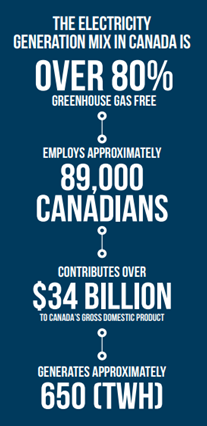
In the last couple of years, efforts to contain global warming has had an impact on the operational side of utilities, especially in energy, gas, and power subsectors. The ongoing pandemic has now acted as a catalyst for economy-wide clean energy transition, making 2020 a transformative year for the industry.
A decade ago, consumers had a “one-way relationship” with utilities, says Canadian Electricity Association (CEA) in its midyear 2020 power and utilities industry outlook.
But in the smart and digitally integrated home ecosystem of the future, customers will be active participants and seek lower carbon footprint.
By 2040, the global interconnected electricity systems will reach over one billion households and energize over 11 billion smart appliances, says International Energy Agency.
With this backdrop, the Justin Trudeau-led federal government has chalked out “ambitious policy goals” to reach climate goals and meet customer and competitive demands, says CEA.
This includes achieving zero emissions by 2050, reducing carbon by 2030 and “electrification of the economy”. At present, federal government has allocated more than C$ 180 billion to support low-carbon and green economy with a long-term growth path via its ‘Investing in Canada Plan’.
As the economy reopens and recovers from the COVID-19 crisis, Canada is diverting funds toward clean energy. The federal government recently announced a C$ 5.1-million investment in London Hydro project to develop smart microgrid in Ontario.
Coming to natural gas, another crucial segment among utilities, Canada is world’s fourth-largest producer and sixth-largest exporter of natural gas, as per Natural Resources Canada. This sector is primarily made of three industries:
- Upstream gas industry, which consists of exploration, drilling, and raw natural gas-producing companies
- Midstream natural gas industry that operates processing plants, storage facilities, gathering pipelines and natural gas liquification facilities
- Downstream natural gas industry, which consists of long-haul transmission pipelines and distribution companies
Canada Energy Regulator projects that the overall natural gas production will increase by 32 percent from 2018 to 2040.
Canada’s Marketable Natural Gas Production Projection
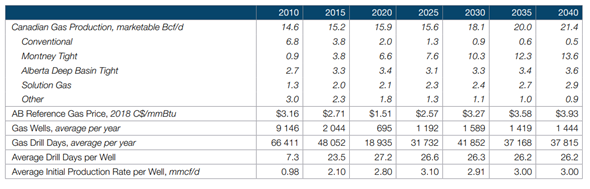
(Source: Canada Energy Regulator)
Canadian water supply and irrigation systems is a US$ 7-billion industry and its revenue is expected to grow at an annualized rate of 0.9 percent to US$ 6.8 billion over the next five years, says an IBIS world report.
The utility industry also includes solar, wind, hydroelectric, coal, nuclear, geothermal, tidal and other sub-sectors.
Utility Sector & Market
Utility stocks are immune to market volatilities and offer stable and consistent dividends. Such equities tend to perform well during economic downturns, like the current pandemic, when central banks slash borrowing rates.
However, when the economy improves and interest rates rise, utility stocks yield lower dividends and investors move on to better-performing stocks.
In Canada’s pandemic-induced economic downturn, utilities have been trading above average because of higher dividend yields. The industry currently constitutes for 5.14 percent of the key Toronto Stock Exchange (TSX) index but just 0.26 percent on TSX Venture index.
TSX’s capped utilities index has performed remarkably well during the pandemic, advancing over 43 percent after bottoming out on March 24. Overall, the index has traded flat this year, indicating the sector’s stability during macroeconomic downturn.
Here are two performing utility stocks:
Fortis Inc. (TSX:FTS)
Fortis is a utility transmission and distribution firm with 10 operational units across Canada and the United States. The company’s currently market valuation is C4 24 billion and reported earnings of C$ 0.67 per common share in the first quarter of 2020. It has a current dividend yield of 3.6 percent.
Average annual shareholder return
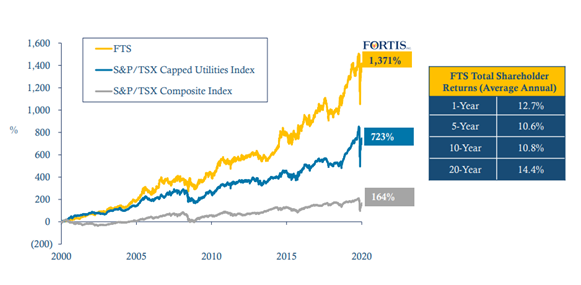
(Source: Fortis Inc)
Brookfield Renewable Partners LP (TSX: BEP.UN)
Shares of Brookfield Renewable Partners have gained over 24 percent this year. In the last three months, its scrips advance by 10 percent. It has a current market capitalization of C$ 12.7. The company announced a quarterly dividend of C$ 0.5425 and its current dividend yield is 4.15 percent.
The renewable energy firm has wind, solar, hydroelectric, and storage facilities across in Asia, South America, Europe and North America.
The utilities sector is undergoing radical transformation with the onslaught of coronavirus and the need for digitalization, increased consumer consciousness and sustainable and clean energy requirements. The next five years will see market players adapting to survive through new business models and agile mindset.
