
 AUS
AUS
 NZ
NZ
 UK
UK
 CA
CA
 USA
USA
 IND
IND






Air Canada (TSX:AC) stocks opened in the green on Monday, January 18, after raising approximately C$912 million gross proceeds from over-allotment option. In an official statement, the national air carrier announced that it has concluded its additional over-allotment option of 2.587 million shares at C$24.00 per share.
Stocks of the national airline has a total of 332,171,985 listed shares outstanding on the Toronto Stock Exchange (TSX).
Previously, the company announced streamlining of operations in the Atlantic region, which will lead to a job cut of nearly 1,700 employees. Air Canada is set to operate with 20 per cent of its services in the first quarter of 2021 as against Q1 2019, with the latest operation curtailment.
Let us take a glance at the airline’s market fundamental and its financial health:
Air Canada (TSX:AC)
AC stocks were trading at C$ 23.07 a pop, up one per cent at the time of writing this (11:07 AM ET).
Stocks of the Canadian carrier have recovered over 46 per cent in the last three months. However, its scrips declined by 54.50 per cent in the last one year due to the pandemic blows. Air Canada’s current market cap is around C$ 7.663 billion, as per the TMX portal data.
AC stock is among the most active stocks on the TSX. Its 10-day stock trading volume stands at 4.44 million. Its 30-day average volume has touched 6 million.
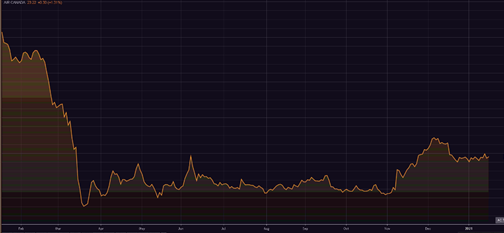
Air Canada Stock’s One-Year Price Chart / Image Source: EODHD/Others, Thomson Reuters
The aviation stock has a price-to-book of 3.984, a present price-to- cashflow of 22.80, and a current debt-to-equity (D/E) ratio of 7.67.
The mid-cap airline company reported negative EBITDA of C$ 554 million in the third quarter results of 2020, down from C$ 1.472 billion in the third quarter of 2019. Air Canada posted unrestricted liquidity of C$ 8.189 billion at the end of Q3 2020.
Currently, the company has been exploring more options to acquire the tour company, Transat AT (TSX:TRZ).
