
 AUS
AUS
 NZ
NZ
 UK
UK
 CA
CA
 USA
USA
 IND
IND



_06_15_2026_08_31_29_563066.jpg)

Highlights
- Dundas informed today (26 September) that massive sulphides and ultramafic rocks were found in two holes.
- The holes were drilled to a depth of 37 meters.
- Shares of Dundas were trading 69.04% higher at AU$0.36 apiece on ASX today at 2.19 PM AEST.
Dundas Minerals Limited (ASX:DUN), Australia's battery-minerals and gold focussed exploration company, informed today (26 September) that massive sulphides and ultramafic rocks were found in two holes that were drilled to a maximum depth of 37 meters.
According to a filing with the ASX, the company has been actively looking for nickel, copper, cobalt, and gold in Western Australia's potential Albany-Fraser Orogen.
Dundas’ shares were trading 69.04% higher at AU$0.36 apiece on ASX today at 2.19 PM AEST.
Anomalous pXRF Geochemistry – Central Target
It is now complete to move a diamond drill rig, drilling support equipment, and a camp to the company's Central exploration area. The drill rig has already finished three shallow holes for drilling water. According to Dundas’ filing, large sulphides were found in hole 22CEWB003 (from 17m), while altered stockwork veins rich in pyrite were found in hole 22CEWB001 (also from 17m).
Notably, each hole's drilling waste (chips) was collected and examined with a portable handheld XRF gun. Numerous samples of cobalt (Co), nickel (Ni), copper (Cu), and silver (Ag) returned large sulphide anomalies. Due to the RAB drilling technique, samples were vulnerable to formational contamination and downhole smearing. The wet water table also hampered sample recovery.
According to Dundas, in hole 22CEWB003, it was not possible to determine the exact depth of the sample.
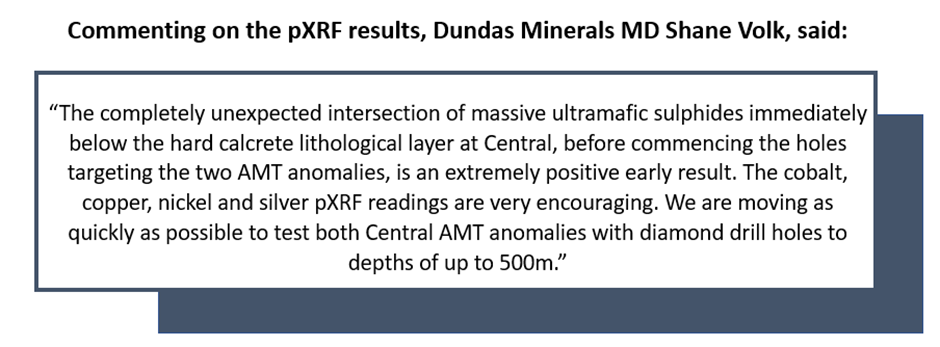
Image Source: © 2022 Kalkine Media ®
Data Source- Company announcement dated 26 September 2022
Anomaly line 12250, which is where Hole 22CEWB003 is situated, is one of two audio magnetotellurics (AMT) anomalies. Notably, huge sulfur deposits found starting at 17 meters are linked to ultramafic rock.
Composite samples collected from both holes have been sent for analysis; a 4-week turnaround is expected. Dundas said that visible pyrite was recovered from each hole, but findings for this element won't be accessible until the return of laboratory assays because the pXRF does not analyse for gold.
Dundas Minerals first discovered the Central target in late 2021 using data from an aerial electromagnetic (EM) survey.
