
 AUS
AUS
 NZ
NZ
 UK
UK
 CA
CA
 USA
USA
 IND
IND







Highlights
- Desert Metals’ shares were trading nearly 34% higher today.
- The company's shares outperformed ASX 200 Materials index, which was 1.66% down at 15,611.20 points at 12.14 PM AEST.
- Desert Metals shared preliminary results from the most recent drilling program at the Innouendy project in WA.
Shares of Desert Metals Limited (ASX:DM1) were zooming nearly 34% higher today (16 September) after the company announced the preliminary results from its most recent drilling program. The shares of mining explorer were trading at AU$0.56 each, up 33.73% on ASX today at 12.09 PM AEST. The company's shares outperformed ASX 200 Materials index, which was 1.66% down at 15,611.20 points at 12.14 PM AEST.
Desert Metals is a multi-commodity exploration company that primarily explores copper, gold, lead, nickel, zinc, and platinum group elements deposits.
Meanwhile, the overall ASX market was trading in the red. ASX 200 index was trading at 6,759.90 points, 1.21% lower today at 12.15 PM AEST.
Why are Desert Metals’ shares trading higher today?
Despite today's general decline in the ASX market and materials index, shares of Desert Metals were trading at all-time highs. This is mostly due to the company's today's announcement that preliminary results from the most recent drilling program at the Innouendy project in Washington State have confirmed a large clay-hosted rare earth deposit.
Last month (on 30 August), Desert Metals informed that drilling at Innouendy Project had been completed.
Image Source: © Fireflyphoto | Megapixl.com
Following new exceptional Total Rare Earth Oxide (TREO) intersections are among the assays from the first 1,128 meters of the current 12,745 meters drilling operation:
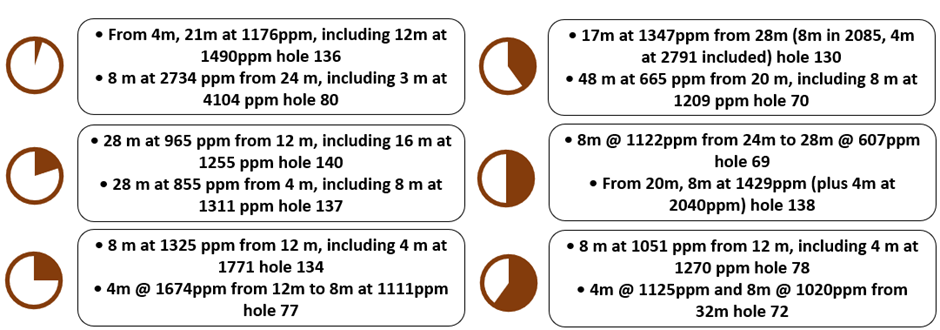
Image Source: © 2022 Kalkine Media ®
Data Source- Company announcement dated 16 September 2022
According to the preliminary results, TREO intersections within the clay are thick and generally continuous. Desert Metals informed that lab analysis would be used to assess whether these units are home to significant mineralisation. Step-out drilling traverses spanning a 20 km strike length have struck thick clays and significant amounts of mafic and ultramafic rock. However, assays for a further 11,617m are still pending.
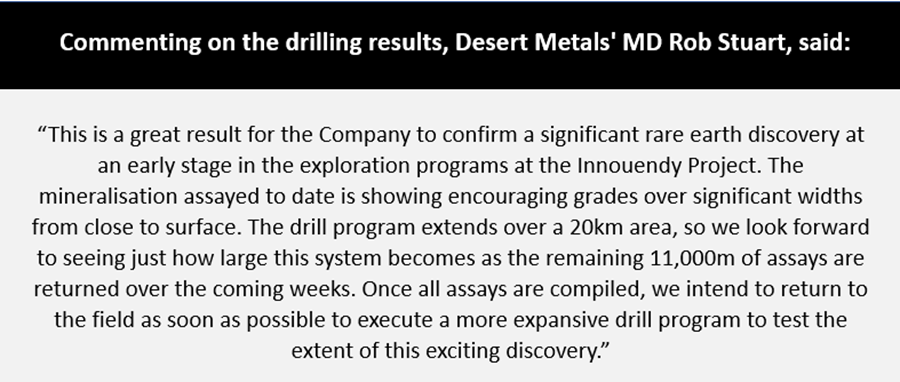
Image Source: © 2022 Kalkine Media ®
Data Source- Company announcement dated 16 September 2022
